
Description
PrymaLab · Research use only
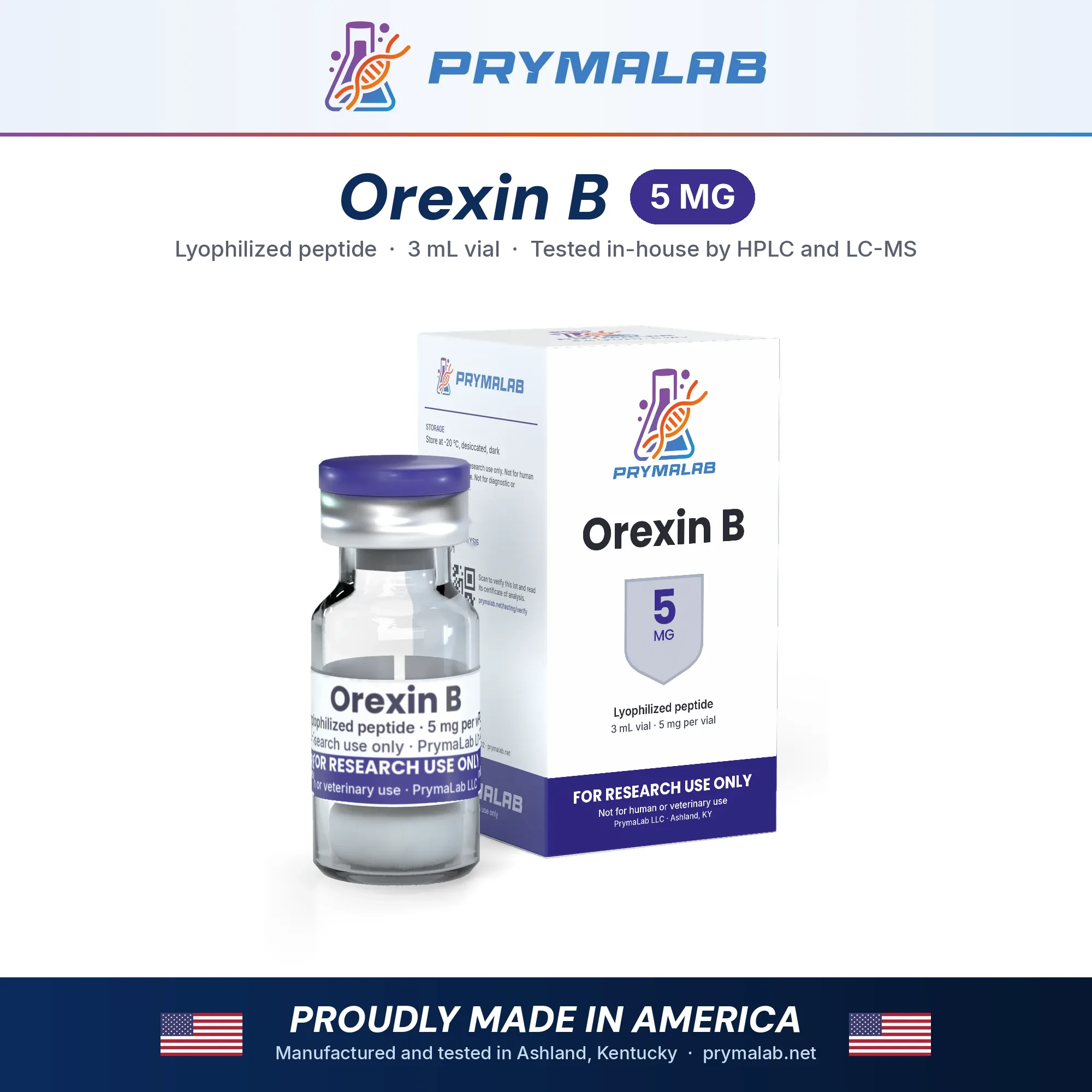
Orexin B (Hypocretin-2) 5mg
Orexin-B (hypocretin-2), the 28-residue OX2-preferring neuropeptide, human sequence, 5 mg freeze-dried
Orexin B, or hypocretin-2, is the second peptide cut from the prepro-orexin precursor, 28 residues long with a C-terminal methionine amide and no cysteines. At the OX2 receptor it is about as potent as orexin A; at OX1 it is 10 to 100 times weaker. This listing is the 5 mg vial of freeze-dried powder, the main fill; a 1 mg vial is also sold. Unlike orexin A, human and rodent orexin B differ at two positions, so the sequence on the certificate matters; this listing is the human sequence.
Specifications
| Property | Value |
|---|---|
| Compound | Orexin-B (hypocretin-2, Hcrt-2), human prepro-orexin 70-97, C-terminal amide; OX2-preferring endogenous agonist |
| CAS number | 205599-76-4 (human orexin B) |
| Molecular formula | C123H212N44O35S |
| Theoretical mass | 2899.3 Da (human sequence) |
| Sequence / structure | H-RSGPPGLQGRLQRLLQASGNHAAGILTM-NH2; 28 residues, human sequence, C-terminal Met amide, no cysteines. |
| Label claim | 5 mg per vial |
| Form | Lyophilized (freeze-dried) powder or cake in a sealed glass vial with a rubber stopper and aluminium crimp cap |
| Storage, sealed | −20 °C, desiccated, dark |
| Purity specification | 99.0% or higher by RP-HPLC |
| Lot certificate | Certificate for the first lot: in preparation. Published certificates appear on the results page and can be checked on the verify page. |
Fills in this range
Orexin B is sold in 2 fills. The compound and the testing are the same in every fill; only the amount in the vial changes.
| Fill | Listing |
|---|---|
| 1 mg | Orexin B (Hypocretin-2) 1mg |
| 5 mg | Orexin B (Hypocretin-2) 5mg (this page) |
What the structure is
Human: Arg-Ser-Gly-Pro-Pro-Gly-Leu-Gln-Gly-Arg-Leu-Gln-Arg-Leu-Leu-Gln-Ala-Ser-Gly-Asn-His-Ala-Ala-Gly-Ile-Leu-Thr-Met-NH2 (RSGPPGLQGRLQRLLQASGNHAAGILTM-NH2), linear, free N-terminus, no disulfides. Formula C123H212N44O35S, theoretical mass 2899.3 Da (PubChem CID 44404987, CAS 205599-76-4). NMR shows two alpha-helices joined by a short linker. The rat and mouse peptide has Pro2 and Asn18 instead of Ser2 and Ser18 (C126H215N45O34S, about 2936 Da), so the observed mass tells the two apart.
The C-terminal methionine oxidises to the sulfoxide (+16 Da on LC-MS), which is the main handling concern. Orexin B is degraded within minutes in blood and did not reach mouse brain intact after peripheral injection, which is why in vivo work uses central routes or stabilised analogues.
What the research covers
Discovery and relation to orexin A
Orexin-A and orexin-B were identified in 1998 as two peptides processed from one hypothalamic precursor that bind and activate two closely related G protein-coupled receptors (OX1 and OX2); prepro-orexin mRNA and orexin immunoreactivity were localised to neurons in and around the lateral and posterior hypothalamus of the adult rat, and central administration of either peptide stimulated food intake1. The same peptides were reported independently as the hypocretins, hypothalamus-specific products whose precursor shares limited similarity with secretin2. Orexin-B carries no cysteines and no N-terminal pyroglutamate, so it lacks the disulfide-stabilised structure of orexin-A1.
Receptor selectivity
In CHO cells expressing the human receptors, orexin-B has affinity and potency comparable to orexin-A at the OX2 receptor but 10- to 100-fold lower affinity and potency at OX1; alanine-replacement work indicated the OX2 receptor requires fewer sequence determinants for activation, which the authors proposed as an explanation for that asymmetry4. A structure-activity study at the human receptors found orexin B(6-28) to be the shortest highly active orexin-B analogue and generated OX2-selective ligands (orexin B(10-28), [A27]orexin B(6-28), [P11]orexin B(6-28)) with more than 1000-fold selectivity, as well as the OX1-preferring orexin A(2-33)5.
Structure
Two-dimensional NMR of human hypocretin-2/orexin-B in water and in 30% trifluoroethanol showed two alpha-helices joined by a short linker, with the helical axes oriented about 60-80 degrees to each other, a secondary-structure motif the authors noted resembles human neuropeptide Y3. Orexin-B has no cysteines, so it lacks the disulfide-stabilised turn that distinguishes orexin-A.
Feeding and in vivo behaviour
In rats, intracerebroventricular orexin-B stimulated food intake on some but not all occasions and significantly less than neuropeptide Y, with an effect size similar to melanin-concentrating hormone or galanin6. In a microinjection study, orexin-B increased feeding only after injection into the lateral cerebral ventricle, not when placed in the perifornical hypothalamus, lateral hypothalamus, paraventricular nucleus or ventral tegmental area, whereas orexin-A was active in the perifornical and lateral hypothalamus7.
Stability after peripheral administration
In mice, radiolabelled orexin-B was rapidly degraded in blood, and no intact orexin-B could be detected in brain after peripheral injection; its octanol/buffer partition coefficient was 0.030 versus 0.232 for orexin-A, which entered brain by simple diffusion8. This is the main practical difference between the two peptides for in vivo work by a peripheral route.
What is not established
Most orexin-system findings in sleep and arousal come from orexin-A, from genetic loss of the whole prepro-orexin precursor (which removes both peptides), or from receptor-level work, and relatively little in vivo pharmacology is specific to orexin-B. Its feeding effect in rats is inconsistent and site-restricted6,7, and the peptide is degraded in blood with no detectable brain entry after peripheral administration in mice8, so peripheral studies are hard to interpret. There are no human studies of exogenous orexin-B; the small human pilot work in narcolepsy used orexin-A/hypocretin-1. Species ambiguity in commercial material (human versus rodent sequence) is an additional source of between-study variability. None of the cited work used this supplier’s material.
Clinical and regulatory status
No clinical development of orexin-B as a drug was found; it has no approval in any jurisdiction and is used as a research peptide. The receptor it prefers is nonetheless a validated target: the US FDA approved oveporexton (Orzeyful, Takeda), an oral small-molecule OX2 receptor agonist, for narcolepsy type 1 on 5 August 2026, and dual orexin receptor antagonists are approved for insomnia. This listing is a research-grade lyophilized peptide.
Related listings: Orexin A (Hypocretin-1) 5mg, DSIP 10MG, Selank 11mg, Semax 11mg, Pinealon 10mg. The cognitive, sleep and mood peptides category lists the rest of the range.
How each lot is tested
Every lot is tested in PrymaLab’s own laboratory in Ashland, Kentucky before release: RP-HPLC for purity, LC-MS for identity, Karl Fischer titration for water, LAL for endotoxin and USP <71> for sterility. Published certificates are listed on the results page and can be checked by number and key on the verify page. These are in-house results from PrymaLab Analytical, not an independent test, and the lab is not accredited to ISO 17025. The third-party testing guarantee on this page still applies: if any independent laboratory finds the wrong compound, or less than the stated purity or amount, the order is refunded and the cost of the test is reimbursed.
Frequently asked questions
Is orexin B the same as hypocretin-2?
Yes. Sakurai et al. named it orexin-B and de Lecea et al. named it hypocretin-2 in 1998; both refer to the 28-residue amidated peptide from residues 70-97 of prepro-orexin.
How does orexin B differ from orexin A?
Orexin B is shorter (28 versus 33 residues), linear, has a free N-terminus and no cysteines or disulfide bonds, and is C-terminally amidated on methionine. Functionally it is roughly equipotent with orexin A at OX2 but 10- to 100-fold weaker at OX1, and it is far less lipophilic and rapidly degraded in blood, whereas orexin A crosses the mouse blood-brain barrier by diffusion.
Is this the human or the rodent sequence?
Human and rodent orexin B differ at two positions: human RSGPPGLQGRLQRLLQASGNHAAGILTM-NH2 versus rat/mouse RPGPPGLQGRLQRLLQANGNHAAGILTM-NH2 (Ser2-to-Pro, Ser18-to-Asn). The PubChem entry under CAS 205599-76-4 is the human sequence (C123H212N44O35S, 2899.3 Da); the rodent peptide has a different composition and mass. Check the sequence and observed mass on the certificate of analysis for the specific lot.
What does the literature actually show for orexin B?
Solid receptor-level data: OX2 preference and the sequence determinants behind it, and a two-helix NMR solution structure. In vivo, central orexin B stimulates feeding in rats inconsistently and only from the ventricle in one microinjection study. Sleep-wake conclusions about the orexin system rest mainly on orexin A and on genetic deletion of the whole precursor, which removes both peptides, so little of that evidence is specific to orexin B.
Why is orexin B a poor choice for peripheral dosing studies?
Because it is rapidly broken down in blood and has low lipophilicity: in mice no intact peptide reached brain after intravenous injection, in contrast to orexin A. Studies therefore use central routes, in vitro receptor systems, or stabilised analogues.
How should the lyophilized peptide be stored?
Sealed at -20 °C with desiccant and protected from light, equilibrated to room temperature before opening. It dissolves in water or aqueous buffer. The C-terminal methionine is oxidation-prone, so avoid oxidising conditions, prolonged exposure to air in solution and repeated freeze-thaw; aliquot reconstituted material and keep it at 2-8 °C only for short periods.
References
- Sakurai T, Amemiya A, Ishii M, et al. Orexins and orexin receptors: a family of hypothalamic neuropeptides and G protein-coupled receptors that regulate feeding behavior. Cell. 1998;92(4):573-85. DOI · PubMed
- de Lecea L, Kilduff TS, Peyron C, et al. The hypocretins: hypothalamus-specific peptides with neuroexcitatory activity. Proc Natl Acad Sci U S A. 1998;95(1):322-7. DOI · PubMed
- Lee JH, Bang E, Chae KJ, Kim JY, Lee DW, Lee W. Solution structure of a new hypothalamic neuropeptide, human hypocretin-2/orexin-B. Eur J Biochem. 1999;266(3):831-9. DOI · PubMed
- Ammoun S, Holmqvist T, Shariatmadari R, et al. Distinct recognition of OX1 and OX2 receptors by orexin peptides. J Pharmacol Exp Ther. 2003;305(2):507-14. DOI · PubMed
- Lang M, Söll RM, Dürrenberger F, Dautzenberg FM, Beck-Sickinger AG. Structure-activity studies of orexin A and orexin B at the human orexin 1 and orexin 2 receptors led to orexin 2 receptor selective and orexin 1 receptor preferring ligands. J Med Chem. 2004;47(5):1153-60. DOI · PubMed
- Edwards CM, Abusnana S, Sunter D, Murphy KG, Ghatei MA, Bloom SR. The effect of the orexins on food intake: comparison with neuropeptide Y, melanin-concentrating hormone and galanin. J Endocrinol. 1999;160(3):R7-12. DOI · PubMed
- Sweet DC, Levine AS, Billington CJ, Kotz CM. Feeding response to central orexins. Brain Res. 1999;821(2):535-8. DOI · PubMed
- Kastin AJ, Akerstrom V. Orexin A but not orexin B rapidly enters brain from blood by simple diffusion. J Pharmacol Exp Ther. 1999;289(1):219-23. DOI · PubMed
Research use only
For laboratory research use only. Orexin B (Hypocretin-2) 5mg is not a drug, food, cosmetic or dietary supplement, is not approved by the FDA or any comparable authority for human or veterinary use, and must not be given to people or animals. It is sold to qualified researchers and institutions, and the buyer is responsible for lawful handling and disposal.







Reviews
There are no reviews yet.