
Description
PrymaLab · Research use only
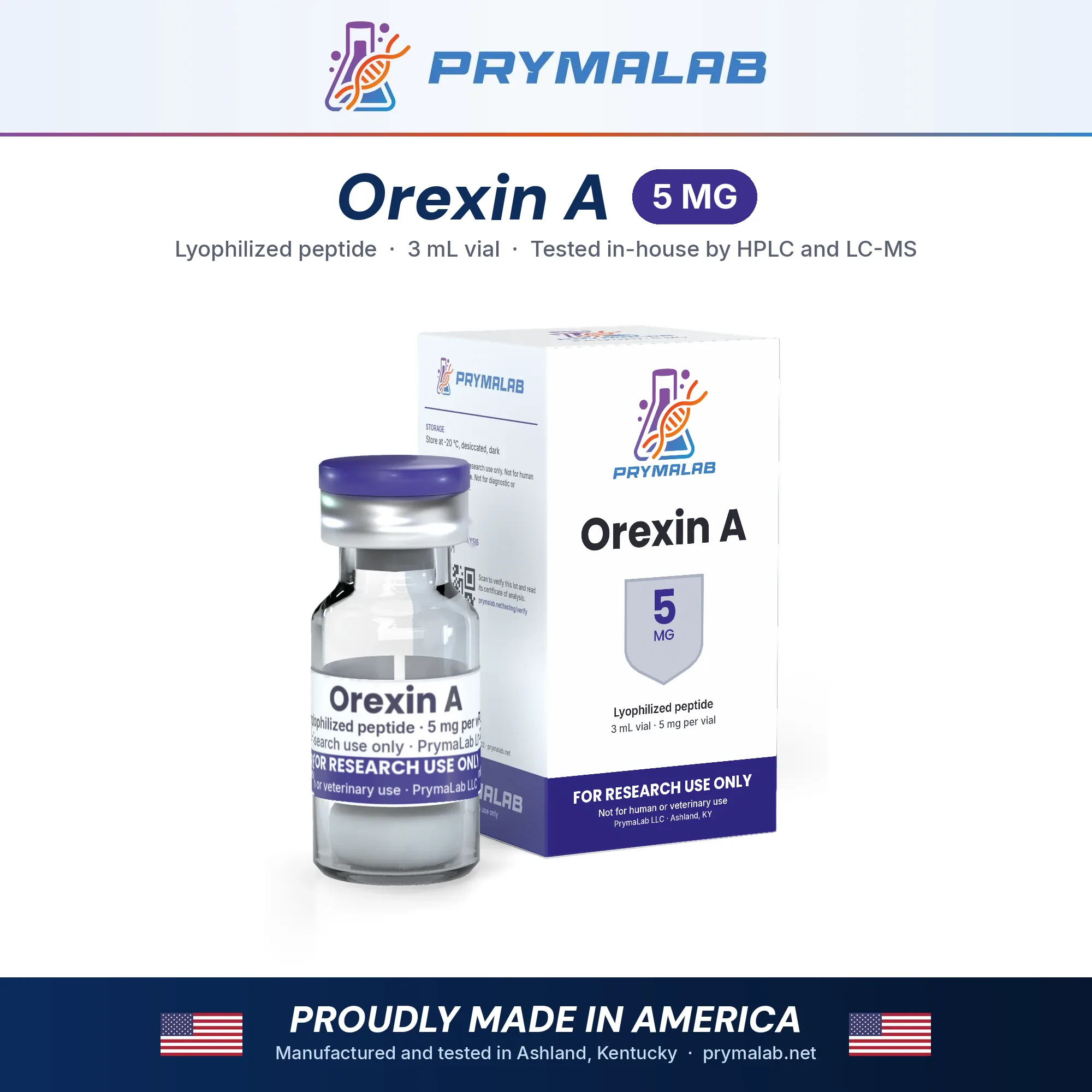
Orexin A (Hypocretin-1) 5mg
Orexin-A (hypocretin-1), the 33-residue hypothalamic wake-promoting neuropeptide, 5 mg freeze-dried
Orexin A, also called hypocretin-1, is a 33-residue neuropeptide made by a few thousand neurons in the lateral hypothalamus. Two groups described it independently in 1998; within two years its absence had been identified as the lesion behind human narcolepsy type 1. It carries an N-terminal pyroglutamate, a C-terminal amide and two intrachain disulfide bonds. This listing is the 5 mg vial of freeze-dried powder, the only fill. The mature sequence is identical in humans, rats, mice, dogs, pigs and cattle, so there is no species version to choose.
Specifications
| Property | Value |
|---|---|
| Compound | Orexin-A (hypocretin-1, Hcrt-1), prepro-orexin 34-66; endogenous OX1/OX2 receptor agonist |
| CAS number | 205599-75-3 |
| Molecular formula | C152H243N47O44S4 |
| Theoretical mass | 3561.1 Da |
| Sequence / structure | pGlu-PLPDCCRQKTCSCRLYELLHGAGNHAAGILTL-NH2; 33 residues, disulfides Cys6-Cys12 and Cys7-Cys14. |
| Label claim | 5 mg per vial |
| Form | Lyophilized (freeze-dried) powder or cake in a sealed glass vial with a rubber stopper and aluminium crimp cap |
| Storage, sealed | −20 °C, desiccated, dark |
| Purity specification | 99.0% or higher by RP-HPLC |
| Lot certificate | Certificate for the first lot: in preparation. Published certificates appear on the results page and can be checked on the verify page. |
What the structure is
pGlu-Pro-Leu-Pro-Asp-Cys-Cys-Arg-Gln-Lys-Thr-Cys-Ser-Cys-Arg-Leu-Tyr-Glu-Leu-Leu-His-Gly-Ala-Gly-Asn-His-Ala-Ala-Gly-Ile-Leu-Thr-Leu-NH2, with disulfides Cys6-Cys12 and Cys7-Cys14. Formula C152H243N47O44S4, theoretical mass 3561.1 Da (PubChem CID 56842143, CAS 205599-75-3, UniProt O43612 residues 34-66). No methionine or tryptophan; the single tyrosine allows quantification at 280 nm. Its octanol/buffer partition coefficient of 0.23 is high for a peptide and is the reason it crosses the mouse blood-brain barrier by diffusion when orexin B does not.
A reduced, mis-paired, free-acid or non-pyroglutamyl preparation is a different analytical entity sold under the same name, so the certificate’s mass and the absence of free thiols are what confirm the native form. Reducing agents such as DTT or TCEP open the disulfides.
What the research covers
Discovery and receptor pharmacology
Orexin-A and orexin-B were identified in 1998 as two peptides processed from one hypothalamic precursor that bind and activate two closely related G protein-coupled receptors, now OX1 and OX21. The same peptides were reported independently as the hypocretins, confined to neurons of the dorsal and lateral hypothalamus with projections to brainstem and thalamus, one of which excited cultured hypothalamic but not hippocampal neurons2. In CHO cells expressing the human receptors, orexin-A activates OX1 and OX2 with comparable affinity and potency while orexin-B is 10- to 100-fold weaker at OX1; stepwise truncation reduced activity at both subtypes, and alanine replacement identified Leu20, Asp25 and His26 as particularly important residues6.
Arousal and sleep-wake regulation
In rats, the brain region most densely innervated by orexin fibres is the locus coeruleus; local application of orexin A increased firing of its noradrenergic neurones, and central orexin A increased arousal and locomotor activity3. Mice lacking the prepro-orexin gene show a phenotype strikingly similar to human narcolepsy by behavioural and EEG criteria4. In humans, cerebrospinal fluid hypocretin-1 was undetectable in seven of nine patients with narcolepsy, which established orexin-A deficiency as the lesion in narcolepsy type 15. These findings are what make orexin-A a wake-promoting peptide of interest rather than only a feeding peptide.
Feeding
The peptide was named for its orexigenic action: centrally administered orexin-A increased food consumption in rats, and prepro-orexin mRNA was up-regulated by fasting, which the original authors read as a role in central feedback control of feeding1. This effect has been characterised almost entirely by central (intracerebroventricular or intrahypothalamic) administration in rodents; it is one of several orexigenic signals rather than a dominant one.
Blood-brain barrier behaviour and intranasal administration
In mice, an intravenous bolus of radiolabelled orexin A entered the brain rapidly by a non-saturable route consistent with simple diffusion, reached brain parenchyma largely as intact peptide, and had an octanol/buffer partition coefficient of 0.232; orexin B, by contrast, was degraded in blood and could not be detected intact in brain7. In a placebo-controlled crossover study in 14 patients with narcolepsy with cataplexy, intranasal orexin-A (435 nmol, given in the morning) reduced wake-to-REM transitions and REM sleep duration and produced fewer false reactions on a divided-attention test8; this is the only controlled human administration study of the peptide located.
What is not established
The arousal and narcolepsy findings are replicated across species and laboratories, but evidence for exogenous orexin-A as an intervention is thin: the human work is confined to small pilot crossover studies in narcolepsy using intranasal peptide, with surrogate endpoints (REM-sleep measures, attention tasks) and no large or long-term trial8; clinical development for narcolepsy has instead moved to small-molecule OX2 receptor agonists. The feeding effect is documented by central administration in rodents1, and its relevance after any peripheral route is unclear. Blood-brain barrier entry by diffusion has been shown in mice7; it has not been characterised comparably in other species, and the pharmacokinetics of intranasal delivery in humans are not well defined. None of the cited work used this supplier’s material.
Clinical and regulatory status
Orexin-A is not an approved drug anywhere and has been used only as an investigational peptide in a small academic crossover study8. The pathway it acts on is nonetheless a validated drug target: dual orexin receptor antagonists are approved insomnia drugs, and on 5 August 2026 the US FDA approved oveporexton (Orzeyful, Takeda), an oral small-molecule OX2 receptor agonist, for narcolepsy type 1 in adults on the basis of the phase 3 FirstLight and RadiantLight trials. The lyophilized peptide listed here is a research-grade material, not a pharmaceutical product.
Related listings: Orexin B (Hypocretin-2) 5mg, DSIP 10MG, Selank 11mg, Semax 11mg, Pinealon 10mg. The cognitive, sleep and mood peptides category lists the rest of the range.
How each lot is tested
Every lot is tested in PrymaLab’s own laboratory in Ashland, Kentucky before release: RP-HPLC for purity, LC-MS for identity, Karl Fischer titration for water, LAL for endotoxin and USP <71> for sterility. Published certificates are listed on the results page and can be checked by number and key on the verify page. These are in-house results from PrymaLab Analytical, not an independent test, and the lab is not accredited to ISO 17025. The third-party testing guarantee on this page still applies: if any independent laboratory finds the wrong compound, or less than the stated purity or amount, the order is refunded and the cost of the test is reimbursed.
Frequently asked questions
Is orexin A the same thing as hypocretin-1?
Yes. Two groups described it in 1998: Sakurai et al. named it orexin-A and de Lecea et al. named it hypocretin-1. Both refer to the 33-residue peptide from residues 34-66 of prepro-orexin.
How does orexin A differ from orexin B?
Orexin A is 33 residues with an N-terminal pyroglutamate, a C-terminal leucine amide and two intrachain disulfide bonds; orexin B is 28 residues, linear, with no cysteines. Orexin A activates OX1 and OX2 with similar potency whereas orexin B is 10- to 100-fold weaker at OX1. Orexin A is also far more lipophilic and, unlike orexin B, survives in blood and enters mouse brain by diffusion.
Is there a separate human and rodent orexin A?
No. The mature orexin-A sequence is identical in the reviewed human, rat, mouse, dog, pig and bovine prepro-orexin entries in UniProt, which is why PubChem titles the record ‘Orexin A (human, rat, mouse)’. Orexin B does differ between human and rodent, so the distinction matters for that peptide but not this one.
What does the literature actually show for orexin A?
Strongest: wake promotion and the pathophysiology of narcolepsy – increased locus coeruleus firing and arousal in rats, a narcolepsy-like phenotype in prepro-orexin knockout mice, and undetectable CSF hypocretin-1 in most narcolepsy patients. Supporting: improved cognitive performance in sleep-deprived monkeys and effects on REM sleep and attention in a small human narcolepsy crossover study after intranasal delivery. Also a central orexigenic effect in rodents.
Why does the disulfide pattern matter for this peptide?
Native orexin A carries two specific pairings, Cys6-Cys12 and Cys7-Cys14 (UniProt O43612). A reduced or mis-paired preparation is chemically a different species, will differ in mass by about 4 Da in the fully reduced form and may behave differently in stability work, so lots should be checked for correct oxidation rather than assumed correct.
How should lyophilized orexin A be stored and reconstituted?
Keep the sealed vial at −20 °C or colder, desiccated and dark, and let it reach room temperature before opening. It dissolves in water or aqueous buffer. Avoid reducing agents such as DTT or TCEP, which would open the disulfides, and avoid repeated freeze-thaw; hold working solutions at 2 to 8 °C for short periods or aliquot and freeze.
References
- Sakurai T, Amemiya A, Ishii M, et al. Orexins and orexin receptors: a family of hypothalamic neuropeptides and G protein-coupled receptors that regulate feeding behavior. Cell. 1998;92(4):573-85. DOI · PubMed
- de Lecea L, Kilduff TS, Peyron C, et al. The hypocretins: hypothalamus-specific peptides with neuroexcitatory activity. Proc Natl Acad Sci U S A. 1998;95(1):322-7. DOI · PubMed
- Hagan JJ, Leslie RA, Patel S, et al. Orexin A activates locus coeruleus cell firing and increases arousal in the rat. Proc Natl Acad Sci U S A. 1999;96(19):10911-6. DOI · PubMed
- Chemelli RM, Willie JT, Sinton CM, et al. Narcolepsy in orexin knockout mice: molecular genetics of sleep regulation. Cell. 1999;98(4):437-51. DOI · PubMed
- Nishino S, Ripley B, Overeem S, Lammers GJ, Mignot E. Hypocretin (orexin) deficiency in human narcolepsy. Lancet. 2000;355(9197):39-40. DOI · PubMed
- Ammoun S, Holmqvist T, Shariatmadari R, et al. Distinct recognition of OX1 and OX2 receptors by orexin peptides. J Pharmacol Exp Ther. 2003;305(2):507-14. DOI · PubMed
- Kastin AJ, Akerstrom V. Orexin A but not orexin B rapidly enters brain from blood by simple diffusion. J Pharmacol Exp Ther. 1999;289(1):219-23. DOI · PubMed
- Weinhold SL, Seeck-Hirschner M, Nowak A, Hallschmid M, Göder R, Baier PC. The effect of intranasal orexin-A (hypocretin-1) on sleep, wakefulness and attention in narcolepsy with cataplexy. Behav Brain Res. 2014;262:8-13. DOI · PubMed
Research use only
For laboratory research use only. Orexin A (Hypocretin-1) 5mg is not a drug, food, cosmetic or dietary supplement, is not approved by the FDA or any comparable authority for human or veterinary use, and must not be given to people or animals. It is sold to qualified researchers and institutions, and the buyer is responsible for lawful handling and disposal.







Reviews
There are no reviews yet.