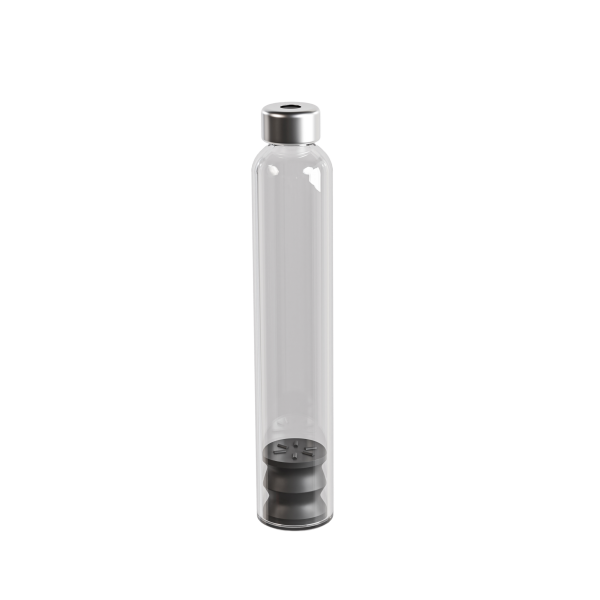
Description
PrymaLab · Research use only
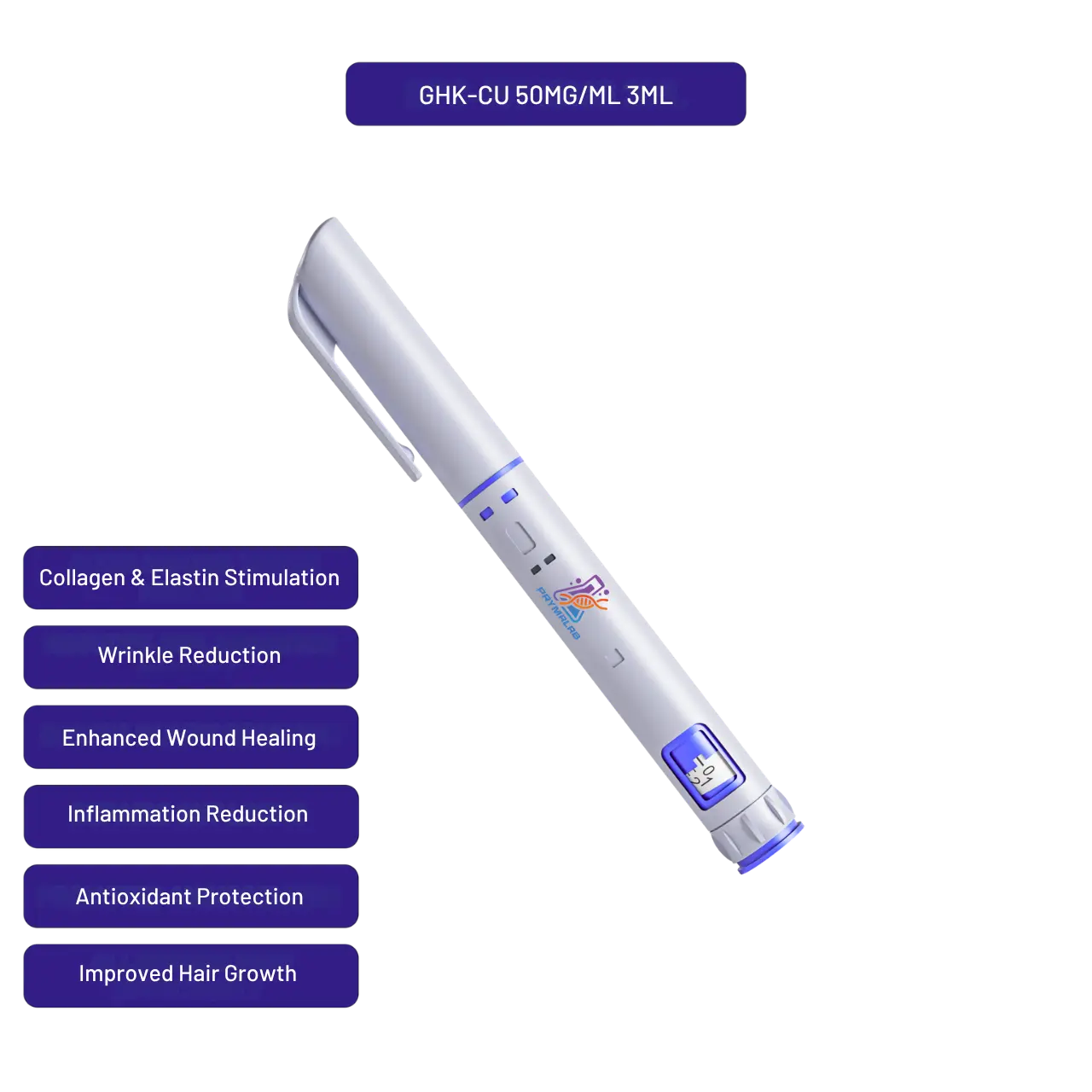
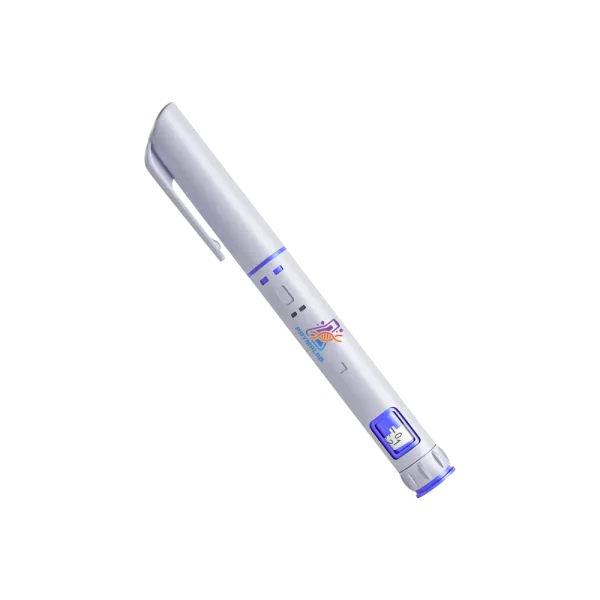
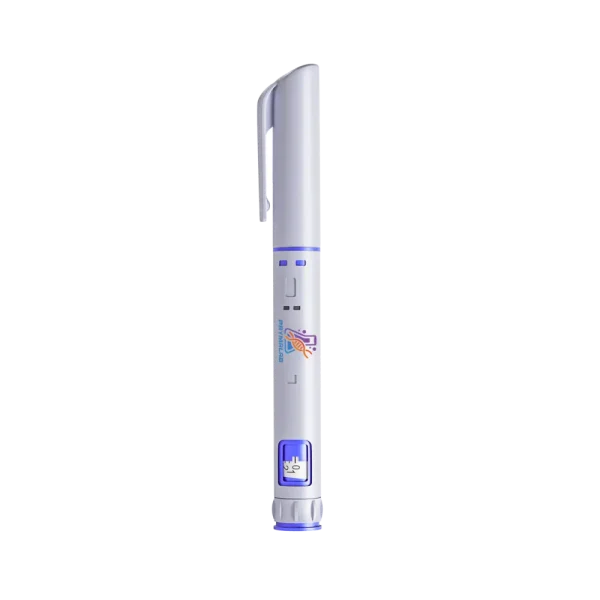
Preloaded Autoinjector | GHK-CU | 3ml Pen | 50mg/ml
GHK-Cu in solution at 50 mg/mL, 150 mg in a preloaded 3 mL pen
GHK-Cu is the copper(II) complex of the tripeptide Gly-His-Lys, a molecule first isolated from human plasma and studied mainly in fibroblast and wound models. This listing is a preloaded pen holding 3 mL of clear blue solution at 50 mg/mL, 150 mg of complex in all, so there is nothing to reconstitute. The research behind it concerns collagen, matrix remodelling and repair, almost all of it in cells and animals.
Specifications
| Property | Value |
|---|---|
| Compound | GHK-Cu Copper tripeptide-1; Gly-His-Lys · Cu(II) |
| CAS number | 89030-95-5 |
| Molecular formula | C14H22CuN6O4 |
| Theoretical mass | 401.9 Da |
| Sequence / structure | H-GHK-OH · Cu(II) (1:1 complex; copper bound by the Gly α-amine, the Gly–His amide nitrogen and the His imidazole) |
| Contents | GHK-Cu: 150 mg per 3 mL pen (5% w/v) |
| Form | Sterile aqueous solution in bacteriostatic water (0.9% benzyl alcohol), supplied in a 3 mL glass cartridge inside a preloaded autoinjector pen fitted with a needle |
| Storage, sealed | Store at 2–8 °C in the original carton, protected from light |
| Safety data sheet | PL-SDS-059 |
What is in the pen
According to the pen’s safety data sheet (PL-SDS-059), each pen holds a 3 mL glass cartridge of sterile aqueous solution with GHK-Cu at 5% w/v, which is 50 mg/mL and 150 mg per pen. The solvent is bacteriostatic water with 0.9% benzyl alcohol as preservative. The sheet lists benzyl alcohol as harmful if swallowed or inhaled, a serious eye irritant and a possible skin sensitiser; GHK-Cu itself is not classified. The solution is clear and blue to blue-violet because of the copper complex.
Store the pen at 2 to 8 °C in its carton, out of the light, and keep it capped once in use. Do not freeze it, and discard a pen whose solution has frozen, changed colour or gone cloudy. Copper ions are toxic to aquatic life, so the contents should not be emptied into a drain. The same complex comes freeze-dried in the GHK-Cu 100 mg vial, and peptide pen vs vial sets out what each format trades.
What the research covers
GHK is a three-residue peptide with a strong affinity for copper(II), found in human plasma1. Its best known cell result comes from fibroblast culture, where the copper complex raised collagen synthesis at picomolar to nanomolar concentrations without increasing cell numbers1. Work on the same cell type found that GHK-Cu also raised the matrix-degrading enzyme MMP-2 and its inhibitors TIMP-1 and TIMP-2, so it acted on breakdown as well as synthesis; copper ions on their own produced the MMP-2 rise and the bare tripeptide did not2.
GHK circulates in plasma and also occurs in saliva and urine, at levels that fall with age3. Review articles co-written by Pickart, who first described the peptide, extend the picture to wound repair in rats, mice, pigs and dogs, to cosmetic studies of skin firmness and fine lines, and to gene expression data covering thousands of human genes3. The reviews summarise those studies rather than report them, and the abstracts give no designs to judge them by.
Nothing cited here studied GHK-Cu kept as a ready-made solution or delivered from a pen, and the stability of the complex in bacteriostatic water over the life of a pen has not been published. The GHK-Cu peptide guide covers the full literature.
How each lot is tested
Every lot is tested in PrymaLab’s own laboratory in Ashland, Kentucky before release: RP-HPLC for purity, LC-MS for identity, Karl Fischer titration for water, LAL for endotoxin and USP <71> for sterility. Published certificates are listed on the results page and can be checked by number and key on the verify page. The certificate covers the peptide lot used to fill the pen, not the finished solution. These are in-house results from PrymaLab Analytical, not an independent test, and the lab is not accredited to ISO 17025. The third-party testing guarantee on this page still applies: if any independent laboratory finds the wrong compound, or less than the stated purity or amount, the order is refunded and the cost of the test is reimbursed.
Frequently asked questions
How does the pen differ from the GHK-Cu vials?
The vials hold freeze-dried complex kept at −20 °C and dissolved when needed. The pen holds the same complex already dissolved in bacteriostatic water at 50 mg/mL, 150 mg in all, and is kept at 2 to 8 °C. A vial lets you pick the concentration; the pen fixes it in advance.
What does the certificate cover for the pen?
It covers the lot of GHK-Cu used to fill the pen, tested in PrymaLab's own laboratory, not the finished solution in the cartridge. The testing section on this page explains what is measured and how to check a certificate by number and key.
Why is the solution blue, and what if it is not?
The colour comes from the copper(II) bound by the peptide, and the safety data sheet describes the solution as clear blue to blue-violet. A pen whose solution has changed colour, turned cloudy or been frozen should be discarded, as the sheet directs.
Is the pen for human use?
No. It is sold only for laboratory research, is not approved for human or veterinary use by the FDA or any other authority, and must not be used on or in people or animals.
References
- Maquart FX, Pickart L, Laurent M, et al. Stimulation of collagen synthesis in fibroblast cultures by the tripeptide-copper complex glycyl-L-histidyl-L-lysine-Cu2+. FEBS Lett. 1988;238(2):343-6. DOI · PubMed
- Siméon A, Emonard H, Hornebeck W, et al. The tripeptide-copper complex glycyl-L-histidyl-L-lysine-Cu2+ stimulates matrix metalloproteinase-2 expression by fibroblast cultures. Life Sci. 2000;67(18):2257-65. DOI · PubMed
- Pickart L, Vasquez-Soltero JM, Margolina A. GHK Peptide as a Natural Modulator of Multiple Cellular Pathways in Skin Regeneration. Biomed Res Int. 2015;2015:648108. DOI · PubMed
Research use only
For laboratory research use only. This product is not a drug, food, cosmetic or dietary supplement, is not approved by the FDA or any comparable authority for human or veterinary use, and must not be given to people or animals. It is sold to qualified researchers and institutions, and the buyer is responsible for lawful handling and disposal.
Other formats of GHK-CU
GHK-CU is also stocked as GHK-CU 50MG and GHK-Cu Nasal Spray. Each listing states its own quantity and concentration, and the pen and vial comparison explains what changes between formats.







10 reviews for Preloaded Autoinjector | GHK-CU | 3ml Pen | 50mg/ml