
Description
PrymaLab · Research use only
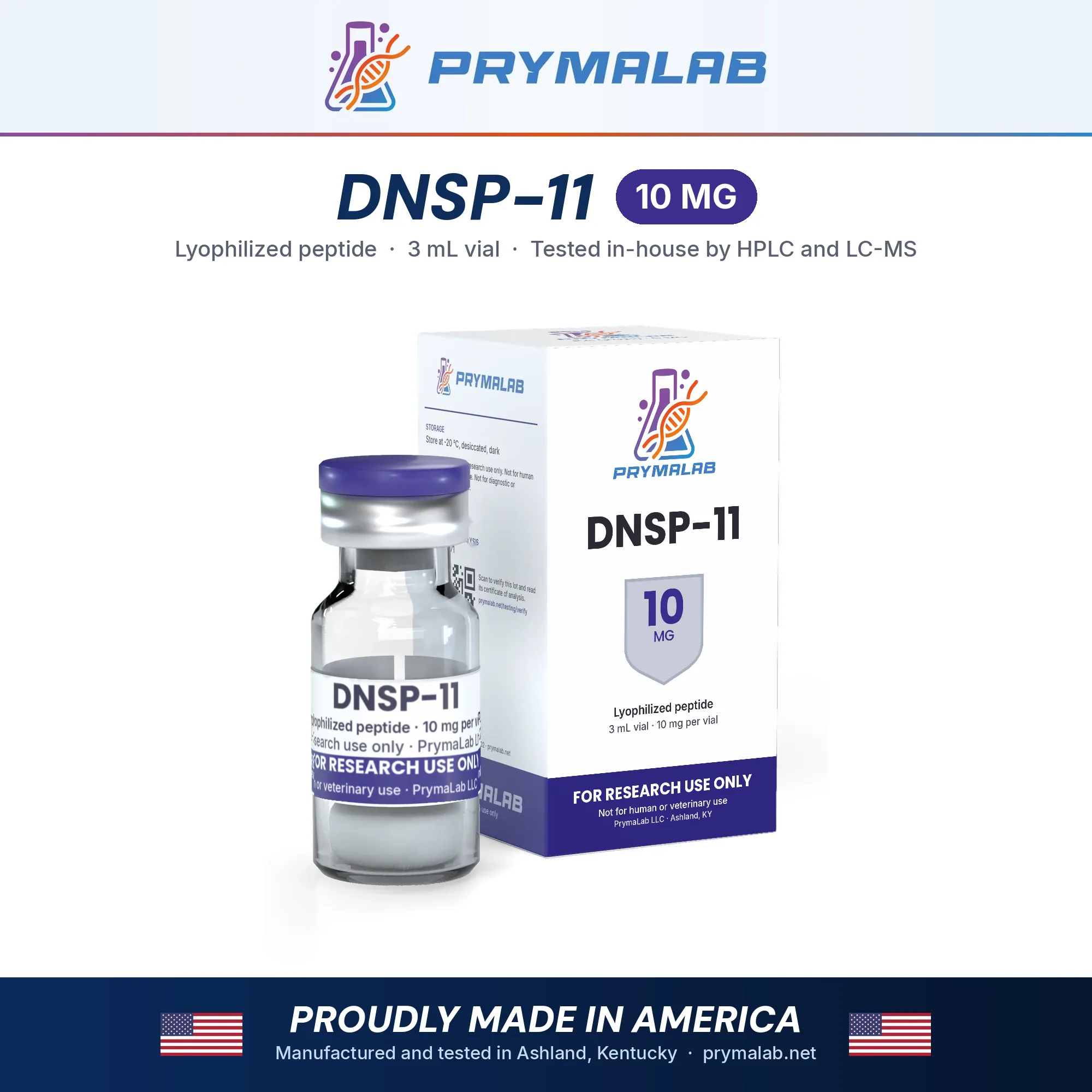
DNSP-11 10mg
Dopamine neuron stimulating peptide-11, the amidated GDNF pro-domain peptide PPEAPAEDRSL-NH2, 10 mg freeze-dried
DNSP-11 is an 11-residue, C-terminally amidated peptide whose sequence sits in the pro-region of human pre-proGDNF. It was named by Bradley, Gash and Gerhardt’s group at the University of Kentucky, who predicted its release from the GDNF precursor and tested it as a small alternative to the hard-to-deliver GDNF protein. This listing is the 10 mg vial of freeze-dried powder, the main fill; a 5 mg vial is also sold. Almost all of its literature comes from that one group.
Specifications
| Property | Value |
|---|---|
| Compound | DNSP-11 (dopamine neuron stimulating peptide-11), GDNF pro-domain peptide, C-terminal amide |
| CAS number | None assigned |
| Molecular formula | Not in a public registry |
| Theoretical mass | Not in a public registry; confirmed by LC-MS on the lot certificate |
| Sequence / structure | H-PPEAPAEDRSL-NH2; 11 residues, C-terminal amide, no disulfides. |
| Label claim | 10 mg per vial |
| Form | Lyophilized (freeze-dried) powder or cake in a sealed glass vial with a rubber stopper and aluminium crimp cap |
| Storage, sealed | −20 °C, desiccated, dark |
| Purity specification | 99.0% or higher by RP-HPLC |
| Lot certificate | Certificate for the first lot: in preparation. Published certificates appear on the results page and can be checked on the verify page. |
Fills in this range
DNSP-11 is sold in 2 fills. The compound and the testing are the same in every fill; only the amount in the vial changes.
| Fill | Listing |
|---|---|
| 5 mg | DNSP-11 5mg |
| 10 mg | DNSP-11 10mg (this page) |
What the structure is
H-Pro-Pro-Glu-Ala-Pro-Ala-Glu-Asp-Arg-Ser-Leu-NH2 (PPEAPAEDRSL-amide), linear, no disulfides, no D-amino acids, no N-terminal acyl group. The C-terminal amide is part of the defined compound: every published study used the amidated peptide, and a free-acid PPEAPAEDRSL is a different material with no pharmacology behind it. No PubChem record, CAS number or registry formula exists for DNSP-11, so identity rests on the sequence and the measured mass on the lot certificate.
DNSP-11 is not GDNF and is not a fragment of the mature, receptor-binding part of GDNF; the originating study found no binding to GFRα1. It is also distinct from the sibling peptides DNSP-5 and DNSP-17 proposed by the same group, and the rat orthologue appears in the literature under a different name, brain excitatory peptide (BEP).
What the research covers
Where it comes from and why it was made
GDNF is produced as a proprotein, and inspection of the human prosequence predicts dibasic endopeptidase cleavage sites that would liberate a C-terminally amidated 11-mer; that predicted peptide is DNSP-111. The stated rationale was that GDNF protein itself is hard to deliver to the brain because of its size and poor tissue distribution, so a small synthetic peptide from the pro-domain was investigated as a more tractable molecule1. Independently, the rat equivalent (BEP) was shown to increase synaptic excitability in rat hippocampal CA1 pyramidal neurons, an effect sensitive to N-ethylmaleimide, which the authors read as pointing to a G protein-coupled receptor2. The predicted proteolytic release has not been demonstrated experimentally, and the origin of the DNSP-11 immunoreactivity seen in nigral neurons is stated by the authors to be unknown1.
Cell-culture survival, morphology and anti-apoptotic readouts
In primary cultures from embryonic day 14 Sprague-Dawley rat ventral mesencephalon treated for 5 days over 0.03-10 ng/mL, DNSP-11 increased tyrosine hydroxylase-positive cell survival by about 75% relative to citrate-buffer control, with a response that was flat rather than graded across that concentration range; it increased neurite length and branch number but, unlike GDNF, did not increase soma size1. In MN9D dopaminergic cells challenged with 6-hydroxydopamine it reduced TUNEL-positive nuclei and caspase-3 activity, and in nutrient-deprived B65 cells it blocked staurosporine- and gramicidin-induced cytotoxicity and prevented cytochrome c release from mitochondria, in conditions where GDNF did not1. A separate report found concentration-dependent protection of HEK-293 cells against staurosporine and 3-nitropropionate3, and a later study showed that a single application to MN9D cells phosphorylates ERK1/24.
Single intranigral injection in rats
Fischer 344 rats given a single infusion of 30 ug into the substantia nigra took the peptide up into neurons within 30 minutes, with staining no longer detectable by 3 hours; 28 days later, striatal microdialysis showed higher basal extracellular dopamine in treated animals (45.8 +/- 7.7 nM versus 26.0 +/- 2.7 nM in vehicle), with DOPAC and HVA each roughly doubled1. In rats with a unilateral 6-hydroxydopamine medial forebrain bundle lesion severe enough to produce more than 300 apomorphine-induced rotations per 60 minutes, a single intranigral 100 ug dose produced an approximately 50% reduction in rotations that was significant at one week and maintained for four weeks, and at five weeks nigral tissue dopamine was 74% higher and DOPAC 132% higher than vehicle1.
What the follow-up study did and did not reproduce
A later study from the same group re-examined dopamine release after a single intranigral dose in rats and reported no significant change in potassium- or D-amphetamine-evoked striatal dopamine release by microdialysis at four weeks; high-speed chronoamperometry detected increased potassium-evoked release in specific striatal subregions at two weeks but not at one or four weeks, and spontaneous locomotor activity was unchanged4. This is an important qualification on the earlier basal-neurochemistry result: the measured effect depends on the technique, the striatal subregion and the time point.
Intranasal delivery in rats and macaques
In rats, three weeks of repeated intranasal dosing raised dopamine turnover in striatum and substantia nigra at the 300 ug level; in 6-hydroxydopamine-lesioned rats the same route reduced D-amphetamine-induced rotation at two weeks, lowered dopamine turnover in the lesioned striatum and increased sparing of tyrosine hydroxylase-positive neurons in one sub-region of the lesioned substantia nigra pars compacta, and radioiodinated peptide was distributed diffusely through the brain within 30 minutes of a single dose5. A proof-of-concept methods study in awake rhesus macaques, dose-escalated over 10 weeks, reported bilateral striatal changes in dopamine metabolites without observable adverse behavioural effects or weight loss, and diffuse rostral-to-caudal brain distribution of a radioiodinated dose6. Both papers are published as methodology studies, with small group sizes and no blinded efficacy endpoint.
Mechanism and target: still open
The originating study found no interaction between DNSP-11 and GFRa1 in pull-down and ELISA assays, and concluded that the peptide likely signals through pathways not directly involving GFRa11. A pull-down from normal rat substantia nigra homogenate identified 16 binding proteins, 11 of them with metabolic functions including GAPDH, and none belonging to the GDNF/GFRa1/RET pathway1. ERK1/2 phosphorylation has been shown in a dopaminergic cell line4, and the N-ethylmaleimide sensitivity of the rat homologue’s electrophysiological effect has been interpreted as GPCR involvement2, but no receptor has been identified. Immunohistochemistry with an affinity-purified antibody found DNSP-11 signal distributed differently from mature GDNF in rat brain – strongest in locus coeruleus, where GDNF is not expressed – with the authors themselves noting that sequence homologues exist and that antibody specificity is a caveat7.
What is not established
Almost the entire DNSP-11 literature comes from one laboratory group at the University of Kentucky1,3,4,5,6,7; the single clearly independent report concerns the rat homologue BEP in a hippocampal slice electrophysiology preparation, not DNSP-11 in a dopaminergic model2. No receptor or defined molecular target has been established, and the proposed endoproteolytic release of DNSP-11 from proGDNF is a prediction from sequence, not a demonstrated processing event; the source of the peptide detected in nigral tissue is explicitly stated to be unknown1. Key in vivo readouts are not uniformly reproducible: the follow-up study found no change in evoked striatal dopamine release and no change in spontaneous locomotor activity4. There is no human data of any kind and no registered clinical trial (a ClinicalTrials.gov query for “DNSP-11” on 4 Nov 2026 returned no studies). All published in vivo work used direct intranigral infusion or intranasal administration in anaesthetised or restrained animals, which says nothing about any other route. None of the cited work used material supplied by PrymaLab or any other commercial research-peptide vendor; the published peptide was custom-synthesised and HPLC-purified to >98% for each study1.
Clinical and regulatory status
No clinical development found. DNSP-11 is not an approved drug in any jurisdiction, and a ClinicalTrials.gov query for “DNSP-11” on 4 Nov 2026 returned no registered studies. The published record is entirely preclinical: rat primary culture and cell lines, rats, and a small proof-of-concept study in rhesus macaques1,3,4,5,6. For class context (not compound data): reviews of GDNF-family pharmacology note that despite encouraging preclinical results, clinical translation of GDNF-family ligands has not been achieved, which is part of the stated motivation for pursuing smaller molecules in this space8. This material is a research-grade peptide with no approved pharmaceutical form.
Related listings: Cerebrolysin 60mg, P21 (P021) 10mg, Semax 11mg, Selank 11mg. The cognitive, sleep and mood peptides category lists the rest of the range.
How each lot is tested
Every lot is tested in PrymaLab’s own laboratory in Ashland, Kentucky before release: RP-HPLC for purity, LC-MS for identity, Karl Fischer titration for water, LAL for endotoxin and USP <71> for sterility. Published certificates are listed on the results page and can be checked by number and key on the verify page. These are in-house results from PrymaLab Analytical, not an independent test, and the lab is not accredited to ISO 17025. The third-party testing guarantee on this page still applies: if any independent laboratory finds the wrong compound, or less than the stated purity or amount, the order is refunded and the cost of the test is reimbursed.
Frequently asked questions
What exactly is DNSP-11, and is it the same thing as GDNF?
No. DNSP-11 is a synthetic 11-residue, C-terminally amidated peptide, PPEAPAEDRSL-NH2, whose sequence sits in the pro-domain (proregion) of the human pre-proGDNF precursor. Mature GDNF is a much larger, disulfide-bonded, glycosylated homodimeric protein that signals through the GFRa1/RET receptor complex. DNSP-11 was not detected binding GFRa1 in the originating study, and the authors concluded it works through other pathways.
Why is the C-terminal amide part of the name, and does it matter?
The processing model that generated the peptide predicts an amidated product, and every published study used “PPEAPAEDRSL-amide”. A free-acid version of the same 11 residues is chemically a different compound with a different charge at the C-terminus, and no published pharmacology supports it. Any material intended to correspond to the literature compound should be specified as the C-terminal amide and ideally supported by a mass-spectrometry certificate.
How does DNSP-11 differ from DNSP-5 and DNSP-17?
They come from the same processing hypothesis but are different peptides: DNSP-5 is a 5-mer and DNSP-17 a 17-mer, proposed to be released from the pro- and mature GDNF sequences respectively. In that comparison DNSP-17 bound heparin about as tightly as GDNF, while DNSP-5 and DNSP-11 did not, which the authors took as relevant to how far each would distribute in brain tissue.
Does a receptor or binding partner for DNSP-11 exist in the literature?
No defined receptor has been reported. A pull-down from rat substantia nigra identified 16 binding proteins, 11 with metabolic functions including GAPDH, and none from the GDNF/GFRa1/RET pathway. ERK1/2 phosphorylation has been shown in MN9D cells, and the N-ethylmaleimide sensitivity of the rat homologue’s electrophysiological effect has been read as suggesting a G protein-coupled receptor, but that is an inference, not an identified target.
What is known about its stability in solution?
The originating paper reports the peptide to be stable in vitro at a range of experimentally relevant concentrations and temperatures, including 31 days at 37 °C in sterile pH 5 citrate buffer. A dedicated physicochemical study using reverse-phase HPLC and mass spectrometry found DNSP-11 stable for one month across a range of storage and experimental conditions, and circular dichroism indicated it is soluble and behaves independently in solution. Sequence-wise it has no cysteine, methionine or tryptophan, so it lacks the most oxidation-prone residues.
Has DNSP-11 been studied in humans?
No. There are no human studies in the peer-reviewed literature and no registered clinical trial (ClinicalTrials.gov query for “DNSP-11”, 4 Nov 2026, returned no studies). The published work is in rat primary cultures, immortalised cell lines, rats and a small non-human primate methods study.
References
- Bradley LH, Fuqua J, Richardson A, Turchan-Cholewo J, Ai Y, Kelps KA, Glass JD, He X, Zhang Z, Grondin R, Littrell OM, Huettl P, Pomerleau F, Gash DM, Gerhardt GA Dopamine neuron stimulating actions of a GDNF propeptide. PLoS One. 2010;5(3):e9752. DOI · PubMed
- Immonen T, Alakuijala A, Hytonen M, Sainio K, Poteryaev D, Saarma M, Pasternack M, Sariola H A proGDNF-related peptide BEP increases synaptic excitation in rat hippocampus. Experimental Neurology. 2008;210(2):793-796. DOI · PubMed
- Kelps KA, Turchan-Cholewo J, Hascup ER, Taylor TL, Gash DM, Gerhardt GA, Bradley LH Evaluation of the physical and in vitro protective activity of three synthetic peptides derived from the pro- and mature GDNF sequence. Neuropeptides. 2011;45(3):213-218. DOI · PubMed
- Fuqua JL, Littrell OM, Lundblad M, Turchan-Cholewo J, Abdelmoti LG, Galperin E, Bradley LH, Cass WA, Gash DM, Gerhardt GA Dynamic changes in dopamine neuron function after DNSP-11 treatment: effects in vivo and increased ERK 1/2 phosphorylation in vitro. Peptides. 2014;54:1-8. DOI · PubMed
- Stenslik MJ, Potts LF, Sonne JW, Cass WA, Turchan-Cholewo J, Pomerleau F, Huettl P, Ai Y, Gash DM, Gerhardt GA, Bradley LH Methodology and effects of repeated intranasal delivery of DNSP-11 in a rat model of Parkinson’s disease. Journal of Neuroscience Methods. 2015;251:120-129. DOI · PubMed
- Stenslik MJ, Evans A, Pomerleau F, Weeks R, Huettl P, Foreman E, Turchan-Cholewo J, Andersen A, Cass WA, Zhang Z, Grondin RC, Gash DM, Gerhardt GA, Bradley LH Methodology and effects of repeated intranasal delivery of DNSP-11 in awake Rhesus macaques. Journal of Neuroscience Methods. 2018;303:30-40. DOI · PubMed
- Sonne JWH, Groshong JS, Seavey C, Gash DM Spatial and temporal immunoreactivity in the rat brain using an affinity purified polyclonal antibody to DNSP-11. Journal of Chemical Neuroanatomy. 2019;100:101664. DOI · PubMed
- Sidorova YA, Saarma M Small molecules and peptides targeting glial cell line-derived neurotrophic factor receptors for the treatment of neurodegeneration. International Journal of Molecular Sciences. 2020;21(18):6575. DOI · PubMed
Research use only
For laboratory research use only. DNSP-11 10mg is not a drug, food, cosmetic or dietary supplement, is not approved by the FDA or any comparable authority for human or veterinary use, and must not be given to people or animals. It is sold to qualified researchers and institutions, and the buyer is responsible for lawful handling and disposal.







Reviews
There are no reviews yet.