


Description
PrymaLab · Research use only
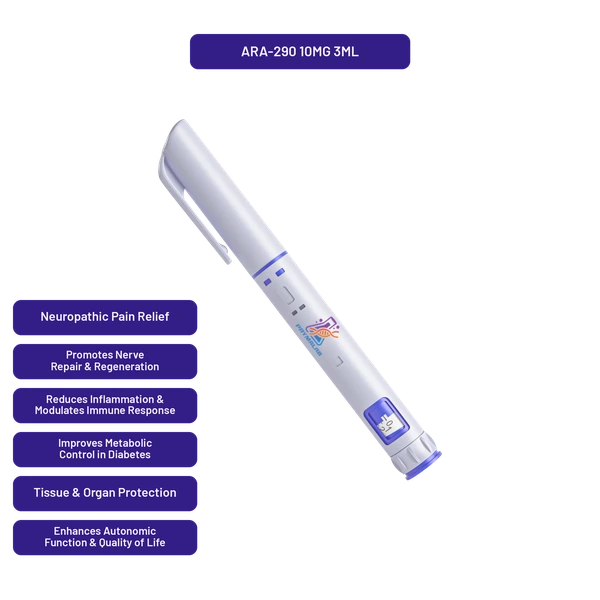
Preloaded Autoinjector | ARA-290 (Cibinetide) | 3ml Pen | 10mg
Cibinetide in solution: 10 mg in 3 mL of bacteriostatic water, in a preloaded pen
Cibinetide, sold as ARA-290, is an 11-residue peptide derived from the helix B surface of erythropoietin and designed to keep the hormone’s tissue-protective activity without its effect on red cells. This listing is a preloaded autoinjector pen with 10 mg of the peptide dissolved in 3 mL of bacteriostatic water. The research behind it runs from rodent injury models to small neuropathy trials.
Specifications
| Property | Value |
|---|---|
| Compound | ARA-290 Cibinetide; erythropoietin helix-B surface peptide |
| CAS number | 1208243-50-8 |
| Molecular formula | C51H84N16O21 |
| Theoretical mass | 1257.3 Da |
| Sequence / structure | pGlu-EQLERALNSS-OH (11 residues; N-terminal pyroglutamate; free C-terminus) |
| Contents | ARA-290: 10 mg per 3 mL pen (0.33% w/v) |
| Form | Sterile aqueous solution in bacteriostatic water (0.9% benzyl alcohol), supplied in a 3 mL glass cartridge inside a preloaded autoinjector pen fitted with a needle |
| Storage, sealed | Store at 2–8 °C in the original carton, protected from light |
| Safety data sheet | PL-SDS-016 |
What is in the pen
The safety data sheet describes a 3 mL glass cartridge of sterile aqueous solution inside a preloaded pen. It holds 10 mg of cibinetide at 0.33% w/v, about 3.3 mg/mL, in bacteriostatic water with 0.9% benzyl alcohol as a preservative. At the theoretical mass of 1257.3 Da that is roughly 8.0 µmol per pen and a solution of about 2.65 mM. The peptide is not classified as hazardous; benzyl alcohol is listed as harmful if swallowed or inhaled, a serious eye irritant and a possible skin sensitiser.
Store the pen at 2 to 8 °C in its original carton, out of the light, and never freeze it. Discard it if the solution has frozen, discoloured or turned cloudy, and keep it capped between uses. The general differences between the formats are covered in peptide pen vs vial.
Handling notes
A peptide in solution can change in ways the same peptide stored dry largely avoids, and the standard review of protein stability has separate sections on stabilisation in aqueous solution and in the dried state1. One of the best-studied changes in solution is deamidation of asparagine and glutamine. Robinson and Robinson measured deamidation rates for 306 asparaginyl sequences in model peptides at pH 7.4 and 37 °C and proposed that these residues work as molecular timers2. Cibinetide has one asparagine, at position 9 next to a serine, and one glutamine, at position 3. No paper cited here measured how fast cibinetide itself changes in solution, so the storage limits on the safety data sheet are the ones to follow.
What the research covers
Erythropoietin protects tissue through a receptor complex, the EPO receptor paired with CD131, that is separate from the receptor homodimer behind red-cell production3. Brines and colleagues found that a peptide copying the water-facing surface of EPO’s helix B kept the protective effect in rodent models of stroke and kidney ischaemia-reperfusion, sped wound healing, and produced no red cells in vitro or in vivo3. Developed as ARA 290, the peptide went into small human trials. In type 2 diabetes with painful neuropathy, a phase 2 study reported improved HbA1c, lipid profiles and PainDetect scores over 56 days4. In a 28-day phase 2b trial in 64 people with sarcoidosis-associated small nerve fibre loss, one of three cibinetide arms increased corneal nerve fibre area significantly compared with placebo, the primary endpoint, and pain improved in every group5.
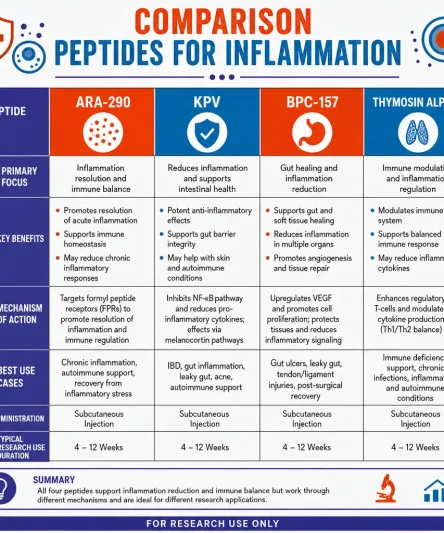
The trials were short and small, and their corneal outcomes are surrogate markers. No study cited here used a preloaded solution or reported how stable cibinetide is once dissolved. The fuller account, from the receptor work to each trial, is on the ARA-290 10 mg vial page. PrymaLab has no separate cibinetide guide, but the guide to peptides for inflammation research covers it alongside KPV and other compounds.
How each lot is tested
Every lot is tested in PrymaLab’s own laboratory in Ashland, Kentucky before release: RP-HPLC for purity, LC-MS for identity, Karl Fischer titration for water, LAL for endotoxin and USP <71> for sterility. Published certificates are listed on the results page and can be checked by number and key on the verify page. The certificate covers the peptide lot used to fill the pen, not the finished solution. These are in-house results from PrymaLab Analytical, not an independent test, and the lab is not accredited to ISO 17025. The third-party testing guarantee on this page still applies: if any independent laboratory finds the wrong compound, or less than the stated purity or amount, the order is refunded and the cost of the test is reimbursed.
Frequently asked questions
How does the pen compare with the ARA-290 vial?
The vial holds 10 mg of freeze-dried peptide kept at −20 °C and dissolved when needed. The pen holds the same 10 mg already dissolved in 3 mL of bacteriostatic water, about 3.3 mg/mL, and is kept at 2 to 8 °C and never frozen.
What does the certificate cover for the pen?
The lot of cibinetide used to fill the pen, not the finished solution in the cartridge. The testing section explains the methods, and certificates can be found on the results page and checked on the verify page.
Does the solution change over time?
Peptides in water can change in ways a dry powder avoids, and cibinetide carries an asparagine and a glutamine, two residues prone to deamidation. No cited study measured its stability in solution, so keep to the safety data sheet limits and discard a cloudy or discoloured pen.
Is the pen for human use?
No. It is supplied for laboratory research only, is not approved for human or veterinary use, and nothing on this page describes using it in people or animals.
References
- Manning MC, Chou DK, Murphy BM, et al. Stability of protein pharmaceuticals: an update. Pharm Res. 2010;27(4):544-75. DOI · PubMed
- Robinson NE, Robinson AB. Molecular clocks. Proc Natl Acad Sci U S A. 2001;98(3):944-9. DOI · PubMed
- Brines M, Patel NS, Villa P, et al. Nonerythropoietic, tissue-protective peptides derived from the tertiary structure of erythropoietin. Proc Natl Acad Sci U S A. 2008;105(31):10925-30. DOI · PubMed
- Brines M, Dunne AN, van Velzen M, et al. ARA 290, a nonerythropoietic peptide engineered from erythropoietin, improves metabolic control and neuropathic symptoms in patients with type 2 diabetes. Mol Med. 2015;20(1):658-66. DOI · PubMed
- Culver DA, Dahan A, Bajorunas D, et al. Cibinetide Improves Corneal Nerve Fiber Abundance in Patients With Sarcoidosis-Associated Small Nerve Fiber Loss and Neuropathic Pain. Invest Ophthalmol Vis Sci. 2017;58(6):BIO52-BIO60. DOI · PubMed
Research use only
For laboratory research use only. This product is not a drug, food, cosmetic or dietary supplement, is not approved by the FDA or any comparable authority for human or veterinary use, and must not be given to people or animals. It is sold to qualified researchers and institutions, and the buyer is responsible for lawful handling and disposal.
Other formats of ARA-290 (Cibinetide)
ARA-290 (Cibinetide) is also stocked as ARA-290 10mg Nasal Spray. Each listing states its own quantity and concentration, and the pen and vial comparison explains what changes between formats.








Reviews
There are no reviews yet.