


Description
PrymaLab · Research use only
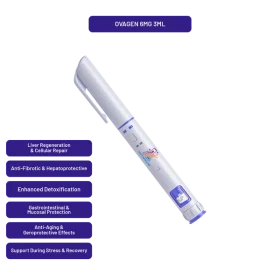
Preloaded Autoinjector | Vilon | 3ml Pen | 6mg
Vilon (Lys-Glu) dissolved at 0.2% w/v, 6 mg in a preloaded 3 mL pen
Vilon is the Lys-Glu dipeptide (KE) from the Khavinson bioregulator series, the smallest peptide in that series and the one its developers linked to the thymus. This listing is a preloaded pen: a 3 mL cartridge of Vilon already in solution, 6 mg in all, so there is no powder to weigh or dissolve. The Vilon literature is short and comes mostly from one St Petersburg group, with chromatin studies in human leukocytes and enzyme and tumour studies in rats.
Specifications
| Property | Value |
|---|---|
| Compound | Vilon Lys-Glu (KE); Khavinson thymic peptide bioregulator |
| CAS number | 45234-02-4 |
| Molecular formula | C11H21N3O5 |
| Theoretical mass | 275.3 Da |
| Sequence / structure | H-KE-OH (2 residues; free N- and C-termini) |
| Contents | Vilon: 6 mg per 3 mL pen (0.2% w/v) |
| Form | Sterile aqueous solution in bacteriostatic water (0.9% benzyl alcohol), supplied in a 3 mL glass cartridge inside a preloaded autoinjector pen fitted with a needle |
| Storage, sealed | Store at 2–8 °C in the original carton, protected from light |
| Safety data sheet | PL-SDS-182 |
What is in the pen
The glass cartridge holds 3 mL of sterile aqueous solution. Vilon makes up 0.2% w/v, which is 2 mg/mL and 6 mg per pen, or about 22 µmol at the certificate’s theoretical mass of 275.3 Da. The solvent is bacteriostatic water with 0.9% benzyl alcohol as an antimicrobial preservative. The safety data sheet gives the peptide no hazard classification; benzyl alcohol is listed as harmful if swallowed or inhaled, a serious eye irritant and a possible skin sensitiser.
Store the pen at 2 to 8 °C in its carton, out of the light, and keep it capped once in use. Do not freeze it, and discard a pen whose solution has frozen, discoloured or turned cloudy. For a larger amount kept dry, the Vilon 20 mg vial holds freeze-dried powder, and peptide pen vs vial sets out the general trade-offs between the formats.
What the research covers
Vilon is one of the synthetic short peptides from Vladimir Khavinson’s programme at the St Petersburg Institute of Bioregulation and Gerontology. The group’s working model, restated in a 2021 systematic review, is that peptides of two to seven residues reach the cell nucleus and act on gene expression through histones, DNA and DNA methylation1. That model is a hypothesis built mostly on the group’s own experiments.
The findings for Vilon itself are few. In leukocytes from people aged 75 to 88, Vilon and four other short peptides activated ribosomal genes and decondensed tightly packed chromatin, freeing genes that age-related condensation had silenced2. In rats exposed to a bladder carcinogen, tumours appeared in 56% of animals given Vilon against 75.5% of controls3. Both papers come from the same programme, both appeared in the Bulletin of Experimental Biology and Medicine, which carries Russian research in English, and neither abstract gives the number of subjects or animals.
No study has used Vilon in solution in a pen, and none reports how long the dipeptide stays intact in bacteriostatic water. The storage conditions for the pen therefore come from its safety data sheet, not from a published stability study. The complete set of studies, including the rat digestive enzyme work, is described in the Vilon guide.
How each lot is tested
Every lot is tested in PrymaLab’s own laboratory in Ashland, Kentucky before release: RP-HPLC for purity, LC-MS for identity, Karl Fischer titration for water, LAL for endotoxin and USP <71> for sterility. Published certificates are listed on the results page and can be checked by number and key on the verify page. The certificate covers the peptide lot used to fill the pen, not the finished solution. These are in-house results from PrymaLab Analytical, not an independent test, and the lab is not accredited to ISO 17025. The third-party testing guarantee on this page still applies: if any independent laboratory finds the wrong compound, or less than the stated purity or amount, the order is refunded and the cost of the test is reimbursed.
What the gene expression work on Vilon reported
Two experiments carry most of the mechanistic weight for the Vilon peptide, and both are worth reading at the level of what was counted. Neither measures the Vilon peptide in solution, and neither used a pen.
The first is a DNA-microarray study of mouse heart. Anisimov and colleagues measured 15,247 cDNA clones and found 300 of them, 1.94 per cent, changed more than twofold4. The Vilon peptide on its own accounted for 36 of those clones, Epithalon for 98, and the two given together for 1444. Read that as clones rather than unique genes, since a microarray of that era carried several clones per gene. Direction matters too: across the Vilon and combination arms 157 clones were activated, the largest change 6.13-fold, and 23 were inhibited4. It is a gene expression screen in one tissue after dosing, not a demonstration that the molecule reached a nucleus. A gene expression change counted this way says which clones moved, and nothing about why.
The second is the thymus culture work. Sevostianova and colleagues grew primary thymus cells from three-month-old Wistar rats and from human fetal thymus to passage three, adding peptide at 0.05 ng/mL at each passage, and measured CD4, CD5 and CD8 expression area by immunocytochemistry5. The Vilon peptide raised CD5 by 78 per cent in the rat cultures and 45 per cent in the human ones, raised CD4 by 31 per cent in the human cultures only, and left CD8 unchanged, which the authors read as pushing thymocytes toward the CD4 helper lineage5. One caveat belongs with it: the paper never writes out Lys-Glu, naming the compound by an internal code, so the identification rests on the title and on later reviews from the same group rather than on a stated sequence.
The chromatin result already cited above sits alongside those two. Decondensation of tightly packed chromatin structure is the proposed route by which gene expression resumes at silenced ribosomal genes, and decondensation of that kind was reported in leukocytes from donors aged 75 to 882. What no study has shown is the intact dipeptide crossing into a nucleus in a living animal. For a two-residue molecule the chromatin structure model is harder to sustain than for the longer sequences in this family, because two residues give very little surface with which to recognise anything specifically.
What the Vilon lifespan experiment actually found
The Vilon peptide lifespan study is cited more loosely than it reads. Khavinson and colleagues gave 120 six-month-old female CBA mice either 0.1 microgram of the Vilon peptide subcutaneously for five consecutive days each month or saline, and followed them to natural death6.
Mean lifespan did not differ: 685.0 plus or minus 9.2 days in controls against 694.0 plus or minus 12.5 days with peptide6. What moved was the tail. Lifespan of the oldest tenth rose from 737.0 plus or minus 1.1 to 761.0 plus or minus 7.7 days, which reached significance, and maximum lifespan went from 740 to 792 days6. Survival curves were identical out to 21 months and separated only after that. Spontaneous tumour incidence fell about 1.5-fold, with lung adenomas roughly halved6.
That paper’s own abstract says the peptide prolonged lifespan, and on its own numbers that overstates what was measured, because the mean was flat. A compound that lengthens the tail of a survival curve without moving the mean has changed what the longest-lived animals died of rather than slowed ageing across the cohort. Tissue repair and tissue regeneration are not endpoints anywhere in this record: no study of the Vilon peptide has measured wound closure, tendon or ligament healing, or any other tissue repair variable, and the tissue regeneration language attached to the compound comes from the family’s general framing rather than from a measurement.
Checking the identity of a Vilon peptide lot
The Vilon peptide is easy to pin down, and one figure circulating for it is wrong. Lys-Glu is C11H21N3O5, and lysine at 146.19 plus glutamic acid at 147.13 less one water gives 275.30 g/mol. PubChem records the same under CID 7010502, as lysylglutamic acid, with Vilon, L-Lys-L-Glu, KE dipeptide and the internal code AB-0 among its synonyms. A molecular weight of 246.3 appears on vendor pages and in some catalogues for this compound. It corresponds to no salt, anhydride or free-base form of the dipeptide, and a molarity calculated from it is about 12 per cent out.
What a useful COA shows follows from what the molecule lacks. There is no aromatic residue in Lys-Glu, so the peptide is effectively invisible at 280 nm and purity has to be read at 214 nm with the gradient stated. Ask for that, for an accurate mass against 275.30, for water content, and for the counterion with its percentage, which on the research market is usually acetate or trifluoroacetate and changes the mass per milligram substantially at this weight. A certificate of analysis whose identity section says 246.3 should be queried before the lot is used, because an error there casts doubt on the rest of the document. Each PrymaLab COA is published by number on the results page linked above.
Format decides the rest. A vial of lyophilized powder is weighed and dissolved in the laboratory, so the reconstitution volume sets the concentration and the researcher owns that arithmetic. Small dipeptides of this kind dissolve freely in water, and a reconstitution that resists or turns cloudy points at the salt form rather than at technique. Work drawn from a vial also needs syringes matched to the volume, and at the low-microlitre end syringes contribute error of their own. This pen removes the weighing and the reconstitution step and fixes the concentration at 2 mg/mL instead.
One note on search results, since the word pen belongs to two markets. This is a medical-format autoinjector holding peptide solution in a glass cartridge. It is not a ballpoint pen, it takes no ink refill, and a ballpoint pen listing appearing beside this product in a search result is a different category of object. The two share the noun and the barrel-and-cartridge arrangement, and a ballpoint pen has no needle, no graduation and nothing to refrigerate.
Frequently asked questions
How does the Vilon pen differ from the 20 mg vial?
The vial holds 20 mg of freeze-dried Vilon, stored at −20 °C and dissolved in the lab when needed. The pen holds 6 mg already dissolved in 3 mL of bacteriostatic water, kept at 2 to 8 °C and never frozen. The peptide is identical; the pen trades dry powder for a ready, fixed concentration.
What does the certificate cover for a pen?
It covers the Vilon peptide lot used to fill the pen, not the finished solution in the cartridge. The testing section on this page lists what each certificate reports and where a certificate can be checked by its number and key.
Has Vilon been studied in solution or in a pen?
Not in the papers cited here. They describe the peptide itself, in human cells and in rats, and none measures how stable Vilon is in bacteriostatic water. For the pen, the storage limits on the safety data sheet are the ones to follow.
Is the Vilon pen meant for human use?
No. Like every PrymaLab product it is sold only for laboratory research. It is not approved for human or veterinary use, and nothing on this page describes using it in people or animals.
How many genes did Vilon change in the microarray study?
What did the thymus culture study show?
In rat and human fetal thymus cultures at 0.05 ng/mL, the Vilon peptide raised CD5 expression area by 78 per cent in rat and 45 per cent in human cells, raised CD4 by 31 per cent in human cells only, and left CD8 unchanged5. The authors read that as a shift toward the CD4 helper lineage. The paper names the compound by internal code rather than by sequence.
Did Vilon extend lifespan in mice?
Not on the mean. In 120 female CBA mice, mean lifespan was 685.0 plus or minus 9.2 days in controls against 694.0 plus or minus 12.5 days with peptide, which is no difference6. The oldest tenth lived from 737.0 to 761.0 days, maximum lifespan rose from 740 to 792 days, and spontaneous tumour incidence fell about 1.5-fold6.
Is the molecular weight 275.30 or 246.3?
275.30. Lysine at 146.19 plus glutamic acid at 147.13 less one water gives 275.30 for C11H21N3O5, and PubChem CID 7010502 records the same. The 246.3 figure in circulation matches no form of this dipeptide, and a molarity calculated from it is about 12 per cent out.
What should a COA show for this compound?
Purity at 214 nm with the gradient stated, since Lys-Glu has no aromatic residue and 280 nm detection is nearly blind to it, plus an accurate mass against 275.30, water content, and the counterion with its percentage. Query any certificate of analysis whose identity section gives 246.3.
References
- Khavinson VK, Popovich IG, Linkova NS, et al. Peptide Regulation of Gene Expression: A Systematic Review. Molecules. 2021;26(22). DOI · PubMed
- Khavinson VKh, Lezhava TA, Malinin VV. Effects of short peptides on lymphocyte chromatin in senile subjects. Bull Exp Biol Med. 2004;137(1):78-81. DOI · PubMed
- Pliss GB, Mel'nikov AS, Malinin VV, et al. Inhibitory effect of peptide vilon on the development of induced rat urinary bladder tumors in rats. Bull Exp Biol Med. 2001;131(6):558-60. DOI · PubMed
- Anisimov SV, Boheler KR, Khavinson VKh, Anisimov VN. Studies of the effects of Vilon and Epithalon on gene expression in mouse heart using DNA-microarray technology. Bull Exp Biol Med. 2002;133(3):293-299. DOI · PubMed
- Sevostianova NN, Linkova NS, Polyakova VO, et al. Immunomodulating effects of Vilon and its analogue in the culture of human and animal thymus cells. Bull Exp Biol Med. 2013;154(4):562-565. DOI · PubMed
- Khavinson VK, Anisimov VN, Zavarzina NY, et al. Effect of vilon on biological age and lifespan in mice. Bull Exp Biol Med. 2000;130(7):687-690. DOI · PubMed
Research use only
For laboratory research use only. This product is not a drug, food, cosmetic or dietary supplement, is not approved by the FDA or any comparable authority for human or veterinary use, and must not be given to people or animals. It is sold to qualified researchers and institutions, and the buyer is responsible for lawful handling and disposal.
Other formats of Vilon
Vilon is also stocked as Vilon 10mg Nasal Spray. Each listing states its own quantity and concentration, and the pen and vial comparison explains what changes between formats.







Reviews
There are no reviews yet.