

Description
PrymaLab · Research use only
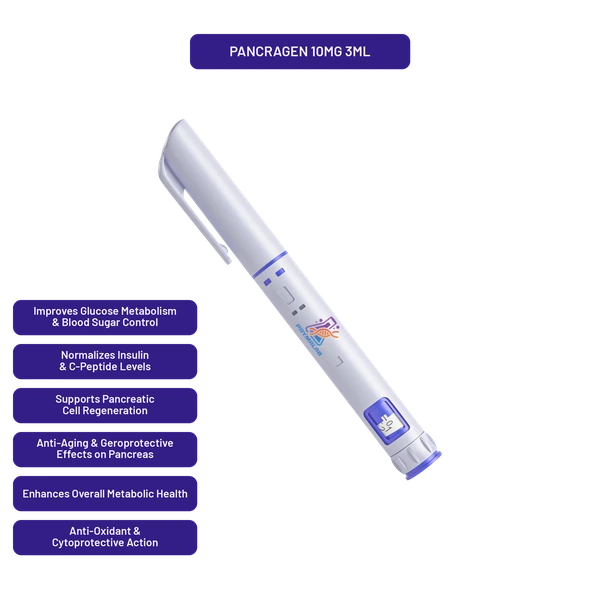
Preloaded Autoinjector | Pancragen | 3ml Pen | 20mg
Pancragen (Lys-Glu-Asp-Trp) free acid at 0.67% w/v, 20 mg in a 3 mL pen
Pancragen, the Khavinson tetrapeptide Lys-Glu-Asp-Trp (KEDW), is supplied in this listing as a preloaded pen: a 3 mL cartridge holding 20 mg of the free-acid form in solution. The published Pancragen studies, mostly from the developers’ St Petersburg group, used the C-terminal amide and looked at pancreatic cell differentiation in culture and at glucose-related measures in rats and older adults.
Specifications
| Property | Value |
|---|---|
| Compound | Pancragen Lys-Glu-Asp-Trp (KEDW); Khavinson pancreatic peptide bioregulator (free-acid form as supplied) |
| CAS number | Not assigned |
| Molecular formula | C26H36N6O9 |
| Theoretical mass | 576.6 Da |
| Sequence / structure | H-KEDW-OH (4 residues; free N- and C-termini) |
| Contents | Pancragen: 20 mg per 3 mL pen (0.67% w/v) |
| Form | Sterile aqueous solution in bacteriostatic water (0.9% benzyl alcohol), supplied in a 3 mL glass cartridge inside a preloaded autoinjector pen fitted with a needle |
| Storage, sealed | Store at 2–8 °C in the original carton, protected from light |
| Safety data sheet | PL-SDS-126 |
What is in the pen
The 3 mL glass cartridge holds a sterile aqueous solution of Pancragen at 0.67% w/v, 20 mg per pen, in the free-acid form named on the safety data sheet. That is about 35 µmol at the certificate’s theoretical mass of 576.6 Da. The solvent is bacteriostatic water with 0.9% benzyl alcohol as an antimicrobial preservative. The peptide has no hazard classification; benzyl alcohol is listed as harmful if swallowed or inhaled, a serious eye irritant and a possible skin sensitiser.
Keep the pen at 2 to 8 °C in its original carton and away from light, which matters more than usual because the peptide contains tryptophan. Cap it between uses, never freeze it, and discard it if the solution has frozen, discoloured or turned cloudy. The Pancragen 20 mg vial holds the same free acid dry, and peptide pen vs vial compares the formats.
What the research covers
Pancragen’s cell work comes from Khavinson’s group. In pancreatic cells ageing in culture, the peptide raised transcription factors that mark acinar and islet differentiation, among them Pdx1, Ptf1a, Pax6 and Nkx2.21. Those results are marker expression, not a measured change in how the cells worked. In rats with streptozotocin-induced diabetes, Pancragen lowered blood glucose during treatment when given by mouth, and by another route it normalised adhesion of the capillary endothelium in the mesentery2. That rat paper names the peptide as Lys-Glu-Asp-Trp-NH2, the amide, not the free acid in this pen2. Both studies appeared in the Bulletin of Experimental Biology and Medicine, a Russian journal published in English.
For a solution, the tryptophan residue is the main chemical concern. Light converts tryptophan in synthetic peptides into products such as hydroxytryptophan, N-formylkynurenine and kynurenine, which Grosvenor and colleagues profiled by tandem mass spectrometry3. No study has measured how Pancragen itself holds up in bacteriostatic water, so cold, dark storage as set out on the safety data sheet is the only control on record. The Pancragen guide covers the primate and human studies in detail, and the Pancragen 20 mg vial page has the full research summary.
How each lot is tested
Every lot is tested in PrymaLab’s own laboratory in Ashland, Kentucky before release: RP-HPLC for purity, LC-MS for identity, Karl Fischer titration for water, LAL for endotoxin and USP <71> for sterility. Published certificates are listed on the results page and can be checked by number and key on the verify page. The certificate covers the peptide lot used to fill the pen, not the finished solution. These are in-house results from PrymaLab Analytical, not an independent test, and the lab is not accredited to ISO 17025. The third-party testing guarantee on this page still applies: if any independent laboratory finds the wrong compound, or less than the stated purity or amount, the order is refunded and the cost of the test is reimbursed.
Frequently asked questions
How does the pen differ from the Pancragen vial?
Both hold 20 mg of the free-acid tetrapeptide. The vial keeps it as dry powder at −20 °C until it is dissolved in the lab; the pen holds it already dissolved in 3 mL of bacteriostatic water at 0.67% w/v, stored at 2 to 8 °C in the dark and never frozen.
Is the peptide in the pen the amide or the free acid?
The free acid, H-KEDW-OH, as the safety data sheet states. The published studies describe the amide, Lys-Glu-Asp-Trp-NH2. The LC-MS identity result on the certificate for the filling lot is the check that it is the free acid.
What does the certificate cover for a pen?
It covers the Pancragen peptide lot used to fill the pen, not the finished solution in the cartridge. The testing section on this page explains what certificates report and how to check one by its number and key.
Is the Pancragen pen meant for human use?
No. It is sold only for laboratory research, has no approval for human or veterinary use, and nothing on this page describes using it in people or animals.
References
- Khavinson VKh, Durnova AO, Polyakova VO, et al. Effects of pancragen on the differentiation of pancreatic cells during their ageing. Bull Exp Biol Med. 2013;154(4):501-4. DOI · PubMed
- Khavinson VKh, Gavrisheva NA, Malinin VV, et al. Effect of pancragen on blood glucose level, capillary permeability and adhesion in rats with experimental diabetes mellitus. Bull Exp Biol Med. 2007;144(4):559-62. DOI · PubMed
- Grosvenor AJ, Morton JD, Dyer JM. Profiling of residue-level photo-oxidative damage in peptides. Amino Acids. 2010;39(1):285-96. DOI · PubMed
Research use only
For laboratory research use only. This product is not a drug, food, cosmetic or dietary supplement, is not approved by the FDA or any comparable authority for human or veterinary use, and must not be given to people or animals. It is sold to qualified researchers and institutions, and the buyer is responsible for lawful handling and disposal.







Reviews
There are no reviews yet.