


Description
PrymaLab · Research use only
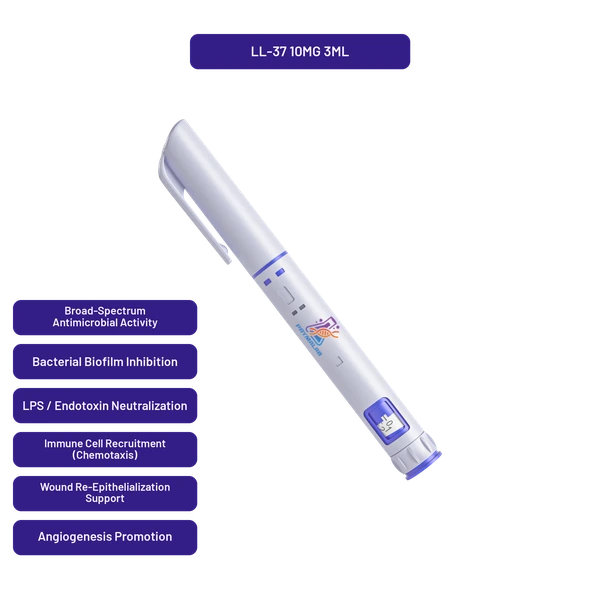
Preloaded Autoinjector | LL-37 | 3ml Pen | 10mg
LL-37, the human cathelicidin peptide, 10 mg in solution in a preloaded 3 mL pen
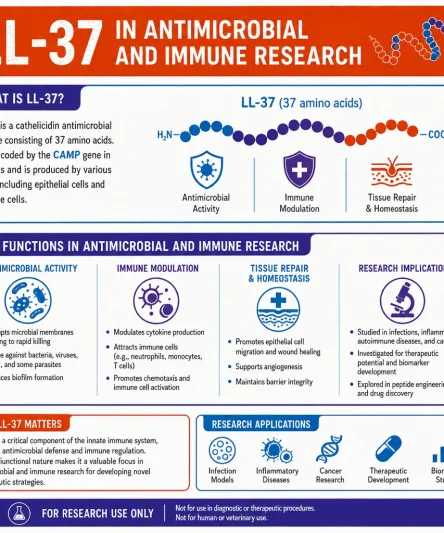
LL-37 is the 37-residue antimicrobial peptide released from hCAP18, the precursor encoded by the only cathelin-family gene in the human genome. This listing is a preloaded autoinjector pen holding 10 mg of LL-37 in 3 mL of solution. Research on the peptide covers how it kills bacteria, how its helical structure forms against membranes, its signalling roles in the immune system and a disputed part in cancer biology.
Specifications
| Property | Value |
|---|---|
| Compound | Human cathelicidin LL-37 (37 residues) |
| CAS number | 154947-66-7 |
| Molecular formula | C205H340N60O53 |
| Contents | LL-37: 10 mg per 3 mL pen (0.33% w/v) |
| Form | Sterile aqueous solution in bacteriostatic water (0.9% benzyl alcohol), supplied in a 3 mL glass cartridge inside a preloaded autoinjector pen fitted with a needle |
| Storage, sealed | Store at 2–8 °C in the original carton, protected from light |
| Safety data sheet | PL-SDS-105 |
What is in the pen
The listing describes a 3 mL pen containing 10 mg of LL-37, which works out to about 3.3 mg/mL. That is all the product record states about the contents. PrymaLab has not yet published a safety data sheet for this pen, so the solvent, any preservative, the counter-ion and the storage temperature are not given here; ask PrymaLab for them before the pen is used. With no certificate figures in the record, this page also gives no theoretical mass or molar amount.
The general differences between peptides supplied in pens and as freeze-dried vials are covered in peptide pen vs vial, and peptide storage and stability covers peptide solutions more broadly.
Handling notes
LL-37’s shape depends on what it is dissolved in. Johansson and colleagues found it disordered at micromolar concentration in plain water, and helical once bicarbonate, sulfate or trifluoroacetate was added at 15 mM, while 160 mM chloride was less effective1. Helix content also rose with peptide concentration, consistent with oligomers forming, fell below pH 5 and was lost entirely at pH 21. Antibacterial activity tracked helicity, and human serum inhibited both the antibacterial and the cytotoxic activity1. In practice the buffer, salt, pH and serum content of an assay can all change how a given amount of LL-37 behaves, so conditions in a published experiment will not necessarily match the solution in the pen.
What the research covers
LL-37 was pinned down in 1996, when Gudmundsson and colleagues sequenced FALL39, the single cathelin-family gene in the human genome, and isolated the mature peptide from granulocytes after degranulation2. Synthetic LL-37 was a potent antibacterial peptide in their assays2. Its structure in membrane-like conditions was solved by NMR in 2008. In detergent micelles it formed a curved amphipathic helix-bend-helix spanning residues 2 to 31, with the bend between Gly-14 and Glu-16 and a disordered C-terminal tail, and the whole helix associated with anionic lipid micelles3. The same work identified KR-12, residues 18 to 29, as the smallest antibacterial fragment, toxic to bacteria but not to human cells3.
LL-37 also acts on human cells. A 2010 review described it as part of both innate and adaptive immunity, killing microbes directly and modulating host immune responses4. The same review found its role in cancer contradictory: overexpression has been implicated in the development or progression of breast, ovarian and lung cancers, yet LL-37 suppressed tumorigenesis in gastric cancer, and the reasons for the difference between tissues were unexplained4.
Most of this evidence is from cell and animal work. No study cited here used a preloaded solution or reported how long LL-37 remains intact once dissolved. The LL-37 research guide covers the immune signalling, endotoxin and wound-model literature in more depth.
How each lot is tested
Every lot is tested in PrymaLab’s own laboratory in Ashland, Kentucky before release: RP-HPLC for purity, LC-MS for identity, Karl Fischer titration for water, LAL for endotoxin and USP <71> for sterility. Published certificates are listed on the results page and can be checked by number and key on the verify page. The certificate covers the peptide lot used to fill the pen, not the finished solution. These are in-house results from PrymaLab Analytical, not an independent test, and the lab is not accredited to ISO 17025. The third-party testing guarantee on this page still applies: if any independent laboratory finds the wrong compound, or less than the stated purity or amount, the order is refunded and the cost of the test is reimbursed.
Frequently asked questions
What is LL-37?
The only human cathelicidin: a 37-residue peptide released from the precursor protein hCAP18 and found in granulocytes, among other cells. It kills bacteria directly and also signals to immune cells, which is why it is studied in both microbiology and immunology.
How much LL-37 is in the pen?
The listing gives 10 mg in a 3 mL pen, about 3.3 mg/mL. No safety data sheet has been published for the pen yet, so the diluent and storage conditions are not stated on this page; contact PrymaLab for them.
Do salt, pH or serum affect LL-37 in an assay?
Yes, according to Johansson and colleagues. The peptide was unstructured in plain water and became helical with added anions, lost its helix at low pH, and its antibacterial activity followed its helix content. Human serum blocked both its antibacterial and its cytotoxic effects.
What does the certificate cover?
The LL-37 peptide lot used to fill the pen, not the finished solution in the cartridge. Published certificates are on the testing results page and can be confirmed by number and key on the verify page.
Is the pen for human use?
No. It is sold for laboratory research only and is not approved by the FDA or any other authority for human or veterinary use. It must not be given to people or animals.
References
- Johansson J, Gudmundsson GH, Rottenberg ME, et al. Conformation-dependent antibacterial activity of the naturally occurring human peptide LL-37. J Biol Chem. 1998;273(6):3718-24. DOI · PubMed
- Gudmundsson GH, Agerberth B, Odeberg J, et al. The human gene FALL39 and processing of the cathelin precursor to the antibacterial peptide LL-37 in granulocytes. Eur J Biochem. 1996;238(2):325-32. DOI · PubMed
- Wang G. Structures of human host defense cathelicidin LL-37 and its smallest antimicrobial peptide KR-12 in lipid micelles. J Biol Chem. 2008;283(47):32637-43. DOI · PubMed
- Wu WK, Wang G, Coffelt SB, et al. Emerging roles of the host defense peptide LL-37 in human cancer and its potential therapeutic applications. Int J Cancer. 2010;127(8):1741-7. DOI · PubMed
Research use only
For laboratory research use only. This product is not a drug, food, cosmetic or dietary supplement, is not approved by the FDA or any comparable authority for human or veterinary use, and must not be given to people or animals. It is sold to qualified researchers and institutions, and the buyer is responsible for lawful handling and disposal.








Reviews
There are no reviews yet.