

Description
PrymaLab · Research use only
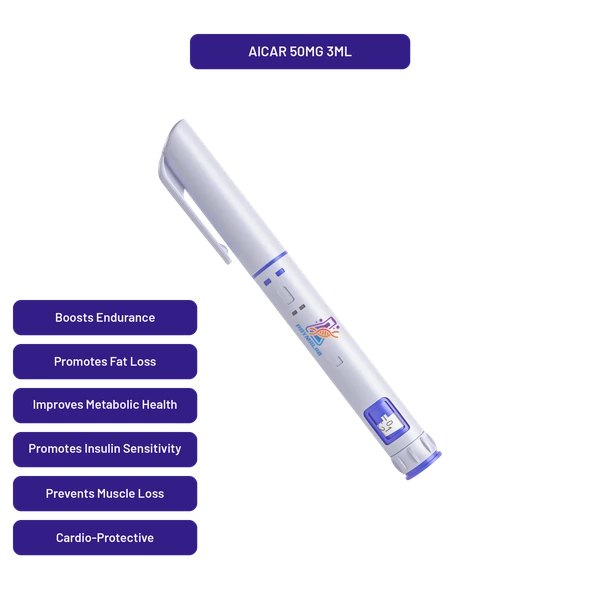
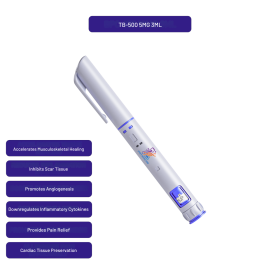
Preloaded Autoinjector | AICAR | 3ml Pen | 50mg
Acadesine in solution: 50 mg in 3 mL of bacteriostatic water, in a preloaded pen
AICAR is acadesine, a small nucleoside of 258.2 Da that cells phosphorylate into ZMP, a mimic of AMP that switches on AMP-activated protein kinase. It is not a peptide. This preloaded autoinjector pen holds 3 mL of sterile solution containing 50 mg of AICAR, so there is no powder to reconstitute. The studies behind its reputation are biochemical and animal work on AMPK and muscle metabolism, along with human trials in cardiac surgery that ended without an approval.
Specifications
| Property | Value |
|---|---|
| Compound | AICAR Acadesine; 5-aminoimidazole-4-carboxamide-1-β-D-ribofuranoside; nucleoside, not a peptide |
| CAS number | 2627-69-2 |
| Molecular formula | C9H14N4O5 |
| Theoretical mass | 258.2 Da |
| Sequence / structure | Purine-precursor nucleoside (AMPK activator); phosphorylated intracellularly to ZMP. |
| Contents | AICAR: 50 mg per 3 mL pen (1.7% w/v) |
| Form | Sterile aqueous solution in bacteriostatic water (0.9% benzyl alcohol), supplied in a 3 mL glass cartridge inside a preloaded autoinjector pen fitted with a needle |
| Storage, sealed | Store at 2–8 °C in the original carton, protected from light |
| Safety data sheet | PL-SDS-010 |
What is in the pen
Each pen carries a 3 mL glass cartridge of sterile aqueous solution. The safety data sheet gives the AICAR content as 50 mg per pen at 1.7% w/v, dissolved in bacteriostatic water containing 0.9% benzyl alcohol as an antimicrobial preservative. At a theoretical mass of 258.2 Da, 50 mg is about 194 µmol, or roughly 65 mM across the 3 mL.
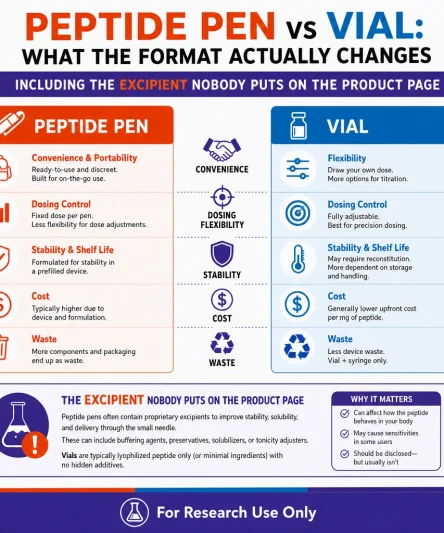
The sheet lists hazard classes for each ingredient. AICAR is classed as a skin irritant, a serious eye irritant and a possible cause of respiratory irritation; benzyl alcohol as harmful if swallowed or inhaled, an eye irritant and a skin sensitiser. Keep the pen at 2 to 8 °C in its carton, away from light, and capped once it is in use. Do not freeze it, and discard any pen whose solution has frozen, discoloured or turned cloudy. The same 50 mg is sold as dry powder in the AICAR 50 mg vial, and the general differences between the two formats are covered in peptide pen vs vial.
What the research covers
Inside a cell, AICAR is phosphorylated to ZMP. In rat liver cells ZMP reproduced both routes by which AMP activates AMPK, direct allosteric activation and increased phosphorylation by the upstream kinase, without altering the cells’ own ATP, ADP or AMP1. The kinase, once on, shut down fatty acid and sterol synthesis in those cells1.
The endurance claims attached to AICAR go back to a single mouse paper. In 2008 Narkar and colleagues found that AICAR switched on metabolic genes in sedentary mice and lengthened their treadmill running by 44% with no exercise training at all2. According to the AICAR (acadesine) guide, no endurance or performance trial of AICAR has been run in people.
Human studies of acadesine went in another direction, towards protecting the heart during surgery. The RED-CABG trial randomly assigned intermediate- to high-risk patients undergoing on-pump bypass surgery, across 300 sites in 7 countries, to acadesine or placebo3. The guide reports that it enrolled 3,080 patients and failed, and the compound has never been approved anywhere.
Nothing in this literature tested AICAR kept in solution in a pen, and the abstracts say nothing about its stability in bacteriostatic water. The guide carries the rest of the record, including the leukaemia trials, the safety findings and the experiments in which effects of AICAR persisted without AMPK.
How each lot is tested
Every lot is tested in PrymaLab’s own laboratory in Ashland, Kentucky before release: RP-HPLC for purity, LC-MS for identity, Karl Fischer titration for water, LAL for endotoxin and USP <71> for sterility. Published certificates are listed on the results page and can be checked by number and key on the verify page. The certificate covers the peptide lot used to fill the pen, not the finished solution. These are in-house results from PrymaLab Analytical, not an independent test, and the lab is not accredited to ISO 17025. The third-party testing guarantee on this page still applies: if any independent laboratory finds the wrong compound, or less than the stated purity or amount, the order is refunded and the cost of the test is reimbursed.
Frequently asked questions
How much AICAR is in the pen, and in what?
50 mg of AICAR in 3 mL of sterile bacteriostatic water with 0.9% benzyl alcohol, given on the safety data sheet as 1.7% w/v. That is roughly 194 µmol of the compound. The AICAR vial holds the same 50 mg as dry powder instead.
How should the pen be stored?
At 2 to 8 °C in the original carton, protected from light, and never frozen. Discard a pen whose solution has frozen or looks discoloured or cloudy, and keep it capped once in use. These instructions come from the pen's safety data sheet.
Does the published research apply to the pen?
Only as background on the compound. The studies used AICAR in liver cells, perfused muscle, mice and hospital trials, and none used a preloaded pen or reported on AICAR stored in bacteriostatic water. The certificate covers the AICAR lot used to fill the pen.
Is the pen for human use?
No. It is sold for laboratory research only. Acadesine has no approval for any use in any country, and the pen must not be used in people or animals.
References
- Corton JM, Gillespie JG, Hawley SA, et al. 5-aminoimidazole-4-carboxamide ribonucleoside. A specific method for activating AMP-activated protein kinase in intact cells?. Eur J Biochem. 1995;229(2):558-65. DOI · PubMed
- Narkar VA, Downes M, Yu RT, et al. AMPK and PPARdelta agonists are exercise mimetics. Cell. 2008;134(3):405-15. DOI · PubMed
- Newman MF, Ferguson TB, White JA, et al. Effect of adenosine-regulating agent acadesine on morbidity and mortality associated with coronary artery bypass grafting: the RED-CABG randomized controlled trial. JAMA. 2012;308(2):157-64. DOI · PubMed
Research use only
For laboratory research use only. This product is not a drug, food, cosmetic or dietary supplement, is not approved by the FDA or any comparable authority for human or veterinary use, and must not be given to people or animals. It is sold to qualified researchers and institutions, and the buyer is responsible for lawful handling and disposal.







Reviews
There are no reviews yet.