Description
PrymaLab · Research use only
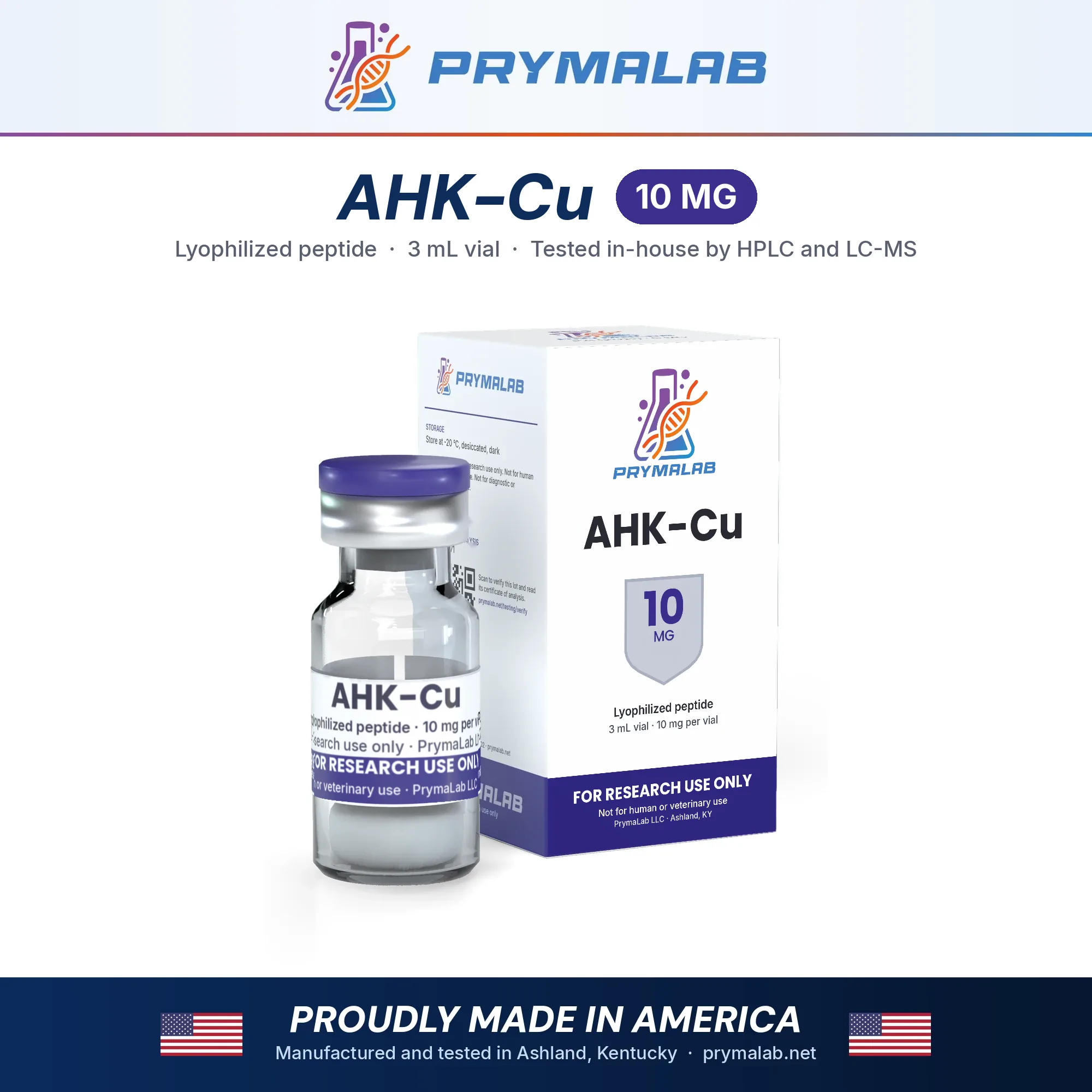
AHK-Cu 10mg
Alanyl-histidyl-lysine copper(II), the alanine analogue of GHK-Cu, 10 mg freeze-dried
AHK-Cu is the tripeptide Ala-His-Lys bound to copper(II): GHK-Cu with alanine in place of glycine. It is a synthetic analogue, not a peptide found in plasma. This listing is the 10 mg vial of freeze-dried powder, the main fill; a 5 mg and a 20 mg vial are also sold. The published work on AHK-Cu itself is a single ex vivo study of human scalp hair follicles and dermal papilla cells; everything else written about it borrows from GHK-Cu.
Specifications
| Property | Value |
|---|---|
| Compound | AHK-Cu, L-alanyl-L-histidyl-L-lysine copper(II) complex; synthetic GHK-Cu analogue |
| CAS number | 682809-81-0 (AHK-Cu, HCl record); 126828-32-8 (Ala-His-Lys) |
| Molecular formula | C15H26N6O4 (free tripeptide); C15H24ClCuN6O4 (complex, HCl) |
| Theoretical mass | 354.4 Da (free tripeptide); 451.4 Da (Cu(II) complex hydrochloride) |
| Sequence / structure | H-Ala-His-Lys-OH : Cu(II). Tripeptide, all L-amino acids, free termini, 1:1 copper(II) complex; no disulfides. |
| Label claim | 10 mg per vial |
| Form | Lyophilized (freeze-dried) powder or cake in a sealed glass vial with a rubber stopper and aluminium crimp cap |
| Storage, sealed | −20 °C, desiccated, dark |
| Purity specification | 99.0% or higher by RP-HPLC |
| Lot certificate | Certificate for the first lot: in preparation. Published certificates appear on the results page and can be checked on the verify page. |
Fills in this range
AHK-Cu is sold in 3 fills. The compound and the testing are the same in every fill; only the amount in the vial changes.
| Fill | Listing |
|---|---|
| 5 mg | AHK-Cu 5mg |
| 10 mg | AHK-Cu 10mg (this page) |
| 20 mg | AHK-Cu 20mg |
What the structure is
The peptide part is Ala-His-Lys, three L-amino acids with a free N-terminus and a free C-terminal acid. The metal-free tripeptide is C15H26N6O4, 354.4 Da (PubChem CID 7408502, CAS 126828-32-8). Complexed 1:1 with copper(II) and supplied as a hydrochloride, the formula becomes C15H24ClCuN6O4 at 451.4 Da (PubChem CID 168431292, CAS 682809-81-0). By analogy with GHK-Cu, the copper sits on the N-terminal amine, a deprotonated backbone amide and the histidine imidazole, with one labile site left over; no crystal structure for AHK-Cu itself has been published. Solutions of the complex are blue-violet.
Vendors differ in whether they weigh the free peptide, the complex or the salt, so the lot certificate states which form the label claim refers to. AHK-Cu is not Pal-AHK (a palmitoylated, metal-free cosmetic peptide) and not the vitamin C-AHK conjugate studied in osteoblast work.
What the research covers
Human hair follicle organ culture and dermal papilla cells
Pyo et al. cultured human scalp hair follicles ex vivo and human dermal papilla cells (DPCs) in vitro with AHK-Cu at 10^-12 to 10^-9 M1. AHK-Cu stimulated elongation of the hair follicles and increased DPC proliferation over this concentration range1. The authors proposed that the effect on follicle growth is mediated through the dermal papilla, the specialised fibroblast population that drives follicle morphogenesis and cycling1. A 2026 review tabulates this as the only experimental dataset for AHK-Cu in hair research and notes that its signalling mechanism is less characterised than that of GHK-Cu3.
Apoptosis markers in dermal papilla cells
In the same study, annexin V/propidium iodide flow cytometry showed fewer apoptotic DPCs after 10^-9 M AHK-Cu, but the reduction did not reach statistical significance1. Western blotting showed a higher Bcl-2/Bax ratio and lower levels of cleaved caspase-3 and cleaved PARP in AHK-Cu-treated DPCs1. These are in vitro protein-marker changes in cultured cells, not outcomes in animals or people1,3.
Vitamin C-conjugated AHK and osteoblast differentiation (derivative, not AHK-Cu)
Jung et al. studied a vitamin C-linker-conjugated AHK tripeptide (Vit C-AHK), a metal-free derivative originally developed for cosmetic collagen-synthesis products, in mouse C2C12 myoblasts2. Vit C-AHK increased C2C12 proliferation, increased BMP-2-induced alkaline phosphatase activity and mRNA for ALP, BMP-2, osteocalcin and Runx2, and increased phosphorylation and nuclear translocation of Smad1/5/8 and phosphorylation of ERK1/2 and p382. The compound tested is not the copper complex, so these data describe the AHK scaffold rather than AHK-Cu itself2.
Class context: copper tripeptide chemistry and GHK-Cu biology
GHK, the parent sequence, binds Cu(II) in solution through its N-terminal amine, a deprotonated amide nitrogen and the histidine imidazole, with a labile fourth equatorial site; the related albumin motif DAHK binds copper more tightly through an additional amide and exchanges copper much more slowly6. GHK-Cu has an extensive preclinical literature on collagen and glycosaminoglycan synthesis, angiogenesis, nerve outgrowth and wound repair, mostly in cultured cells and rodents5. A 2026 systematic evidence-mapping review classifies AHK-Cu as a non-GHK copper peptide that ‘shares the motif but rests on a thin, poorly characterized evidence base’, and cautions against treating different copper peptides as interchangeable because speciation, stability and labile copper differ between them4. This class-level information should not be read as data on AHK-Cu.
What is not established
The primary AHK-Cu literature consists essentially of one ex vivo/in vitro study from a single Korean group (Pyo et al. 2007); no independent replication, no animal study, no controlled human study and no pharmacokinetic or toxicology data on AHK-Cu were found1,3,4. The anti-apoptotic flow-cytometry result in that study was not statistically significant1. Mechanism (receptor, copper delivery, gene-expression effects) has not been characterised for AHK-Cu, and claims about VEGF, TGF-beta1 or collagen derive from GHK-Cu work, not AHK-Cu1,4,5. The vitamin C-AHK osteogenic data concern a different, metal-free molecule2. None of the published work used material from this supplier.
Clinical and regulatory status
No clinical development found. AHK-Cu is not an approved drug in any jurisdiction identified; it appears only as a cosmetic ingredient and a research reagent3,4. The related GHK-Cu is likewise unapproved as a drug and is used in cosmetics4,5. This listing is a research-grade material, not for human or veterinary use.
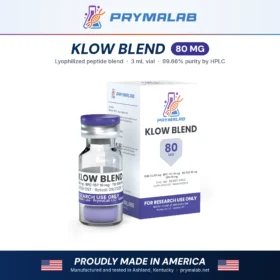
Related listings: GHK-CU 50MG, GHK-CU 100MG, GLOW BLEND 50MG, KLOW Blend (80mg). The skin, hair and beauty peptides category lists the rest of the range.
How each lot is tested
Every lot is tested in PrymaLab’s own laboratory in Ashland, Kentucky before release: RP-HPLC for purity, LC-MS for identity, Karl Fischer titration for water, LAL for endotoxin and USP <71> for sterility. Published certificates are listed on the results page and can be checked by number and key on the verify page. These are in-house results from PrymaLab Analytical, not an independent test, and the lab is not accredited to ISO 17025. The third-party testing guarantee on this page still applies: if any independent laboratory finds the wrong compound, or less than the stated purity or amount, the order is refunded and the cost of the test is reimbursed.
Frequently asked questions
What is AHK-Cu and how does it differ from GHK-Cu?
AHK-Cu is the tripeptide Ala-His-Lys complexed with copper(II). It differs from GHK-Cu only at the first residue (alanine instead of glycine). GHK-Cu is an endogenous plasma peptide with a large preclinical literature; AHK-Cu is a synthetic analogue with a single primary study in human hair follicle organ culture and dermal papilla cells.
What has the literature actually measured for AHK-Cu?
Hair follicle elongation in human scalp follicle organ culture, dermal papilla cell proliferation, annexin V/PI apoptosis staining, and Bcl-2, Bax, cleaved caspase-3 and cleaved PARP by western blot, all in vitro or ex vivo at 10^-12 to 10^-9 M. No animal or human outcome data were found.
Is AHK-Cu the same as Pal-AHK or vitamin C-AHK?
No. Pal-AHK (palmitoyl-Ala-His-Lys) and vitamin C-linker-AHK are metal-free derivatives used in cosmetics; the osteoblast-differentiation data of Jung et al. concern vitamin C-AHK in mouse C2C12 cells, not the copper complex.
How is the copper held in AHK-Cu?
No crystal structure specific to AHK-Cu was found. By analogy with GHK-Cu, Cu(II) is expected to coordinate the N-terminal amine, a deprotonated backbone amide and the histidine imidazole nitrogen, leaving a labile fourth equatorial position. Copper occupancy and speciation can vary between batches and formulations, which is one reason reviews warn against treating copper peptides as interchangeable.
How should the lyophilized material be stored and reconstituted?
Store the sealed vial at −20 °C, protected from light and moisture; allow it to reach room temperature before opening. Reconstitute in sterile water or buffer, keep solutions at 2 to 8 °C and use them promptly. The copper complex is coloured (blue-violet) in solution; loss of colour or precipitation suggests copper dissociation or pH change. These are supplier-standard handling notes, not literature-derived stability data.
Is there a CAS number and PubChem entry?
PubChem lists AHK-Cu under CID 168431292 as a hydrochloride record with CAS 682809-81-0; the free tripeptide Ala-His-Lys is CID 7408502, CAS 126828-32-8, C15H26N6O4, 354.41 Da. Check the certificate of analysis for which form the stated mass refers to.
References
- Pyo HK, Yoo HG, Won CH, Lee SH, Kang YJ, Eun HC, Cho KH, Kim KH The effect of tripeptide-copper complex on human hair growth in vitro. Archives of Pharmacal Research. 2007;30(7):834-839. DOI · PubMed
- Jung JI, Park KY, Lee Y, Park M, Kim J Vitamin C-linker-conjugated tripeptide AHK stimulates BMP-2-induced osteogenic differentiation of mouse myoblast C2C12 cells. Differentiation. 2018;101:1-7. DOI · PubMed
- Fan C, Chen Y, Huang Q, Ou WY, Zhang C, Sun Y, Wu T, Leung OY, Iu HC, Shi J Overview of Short Peptides for Hair Loss. Biomedicines. 2026;14(4):864. DOI · PubMed
- Mateescu DM, Gavrilescu DM, Mincioaga RI, Pah AM, Toma AO, Serban DV, Avram CA, Craciun ML, Enache B, Muresan CO GHK-Cu as a Bioactive Metallopeptide and Drug-Delivery Cargo: Coordination Chemistry, Formulation Science, Therapeutic Evidence, and a Translational Roadmap. Pharmaceutics. 2026;18(9):1077. DOI · PubMed
- Pickart L, Margolina A Regenerative and Protective Actions of the GHK-Cu Peptide in the Light of the New Gene Data. International Journal of Molecular Sciences. 2018;19(7):1987. DOI · PubMed
- Hureau C, Eury H, Guillot R, Bijani C, Sayen S, Solari PL, Guillon E, Faller P, Dorlet P X-ray and solution structures of Cu(II) GHK and Cu(II) DAHK complexes: influence on their redox properties. Chemistry – A European Journal. 2011;17(36):10151-10160. DOI · PubMed
Research use only
For laboratory research use only. AHK-Cu 10mg is not a drug, food, cosmetic or dietary supplement, is not approved by the FDA or any comparable authority for human or veterinary use, and must not be given to people or animals. It is sold to qualified researchers and institutions, and the buyer is responsible for lawful handling and disposal.







Reviews
There are no reviews yet.