15% fall discount applied automatically at checkoutFree USA shipping over $100Free worldwide shipping over $200
Sign in 0

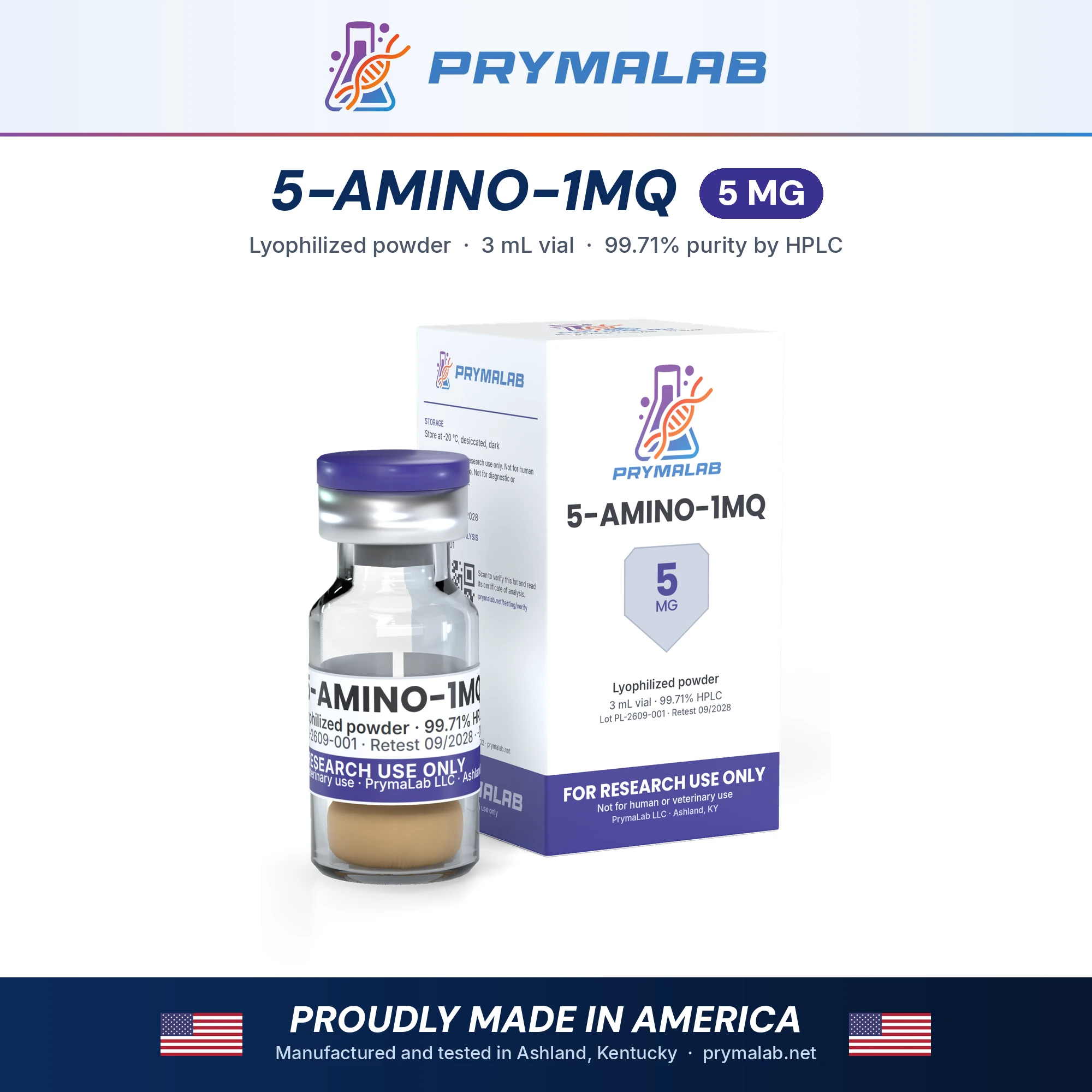
5-amino-1MQ 5MG

$19.99 or subscribe for $16.99/mo

Lot PL-2609-001 tested in our lab: 99.71% purity by HPLC Certificate PL-26-00001, analysed Sep 19, 2026 · LC-MS identity, endotoxin and sterility on the certificate · details and COA images
Third-party testing guarantee. Have this product tested by any independent laboratory. If the result does not come back as the compound named on the label, at the purity and amount stated, we refund your order in full and reimburse the cost of the test. Email the lab report and your order number to michael@prymalab.net.
Safety data sheet PL-SDS-001 GHS: Warning · H302, H315, H319, H335 · Read the SDS · PDF

Visa, Mastercard, Discover up to $1,000 per order (charged in MXN; your bank may add a foreign-transaction fee). Pay by Bank, Zelle, Cash App or crypto: 10% off.

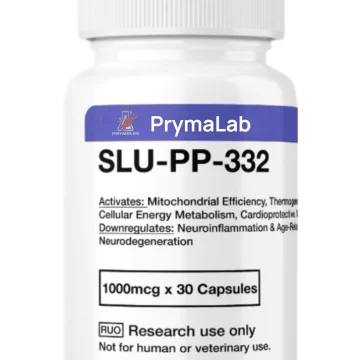
5-amino-1MQ 5 mg: 5-amino-1-methylquinolinium iodide, a small-molecule NNMT inhibitor rather than a peptide, as crystalline powder in a sealed vial. Each lot is tested in PrymaLab’s own laboratory and has its own certificate. Research use only.

Description

PrymaLab · Research use only

5-amino-1MQ 5MG

5-amino-1-methylquinolinium iodide, 5 mg in a vial, the small fill

5-amino-1MQ is a quinolinium small molecule that blocks the enzyme nicotinamide N-methyltransferase (NNMT); it is not a peptide. This vial holds 5 mg of the iodide salt, a tenth of the 50 mg main fill. Research on it has so far stayed in enzyme assays, cultured fat cells and mice, with a focus on NNMT activity and diet-induced obesity.

Specifications

5-amino-1MQ 5MG at a glance
Property Value
Compound 5-Amino-1MQ 5-Amino-1-methylquinolinium iodide (NNMT inhibitor); small molecule, not a peptide
CAS number 42464-96-0
Molecular formula C10H11IN2
Theoretical mass 286.1 Da
Sequence / structure Quinolinium salt (iodide); the 5-amino-1-methylquinolinium cation is 159.2 Da and is the species observed by ESI-MS.
Label claim 5 mg/vial
Form Lyophilized (freeze-dried) powder or cake in a sealed glass vial with a rubber stopper and aluminium crimp cap
Storage, sealed −20 °C, desiccated, dark
Purity specification 99.0% or higher by RP-HPLC
Lot certificate Results for the lot now shipping are in the certificate panel on this page
Safety data sheet PL-SDS-001

Other fills

This is the 5 mg fill. The 5-amino-1MQ 50MG page is the main listing for this compound, with the full research summary and every fill side by side. Other fills: 50 mg.

What the research covers

NNMT methylates nicotinamide with SAM as the methyl donor, and Kraus and colleagues found its expression raised in the fat and liver of obese, diabetic mice1. 5-amino-1MQ comes from a quinolinium series that inhibited the enzyme at low micromolar concentrations in a 2017 structure-activity study2. No human data appear in the references. The 5-amino-1MQ 50 mg vial page has the full research summary.

The 5-Amino-1MQ guide covers the literature in more depth.

How each lot is tested

Every lot is tested in PrymaLab’s own laboratory in Ashland, Kentucky before release: RP-HPLC for purity, LC-MS for identity, Karl Fischer titration for water, LAL for endotoxin and USP <71> for sterility. The results for the lot now shipping are in the certificate panel on this page, and the certificate number, key and QR code can be checked on the verify page. These are in-house results from PrymaLab Analytical, not an independent test, and the lab is not accredited to ISO 17025. The third-party testing guarantee on this page still applies: if any independent laboratory finds the wrong compound, or less than the stated purity or amount, the order is refunded and the cost of the test is reimbursed.

Frequently asked questions

Is the 5 mg vial the same compound as the 50 mg vial?

Yes. Both contain 5-amino-1-methylquinolinium iodide, C10H11IN2, theoretical mass 286.1 Da, and the label mass is the salt. In molar terms 5 mg is about 17.5 µmol, slightly less after the certificate's water content. The 5 mg fill has its own lot and certificate.

When is the small fill the better choice?

When only a few milligrams are needed, for example for a pilot experiment or a method check. A small fill also leaves less material sitting in an opened vial, which matters for a compound that is kept desiccated and dark.

Are there any handling hazards?

Yes. The safety data sheet classifies the compound as harmful if swallowed and as a skin, eye and respiratory irritant, and asks for it to be stored locked up. Keep the sealed vial at −20 °C, dry and dark, and bring it to room temperature before opening.

References

  1. Kraus D, Yang Q, Kong D, et al. Nicotinamide N-methyltransferase knockdown protects against diet-induced obesity. Nature. 2014;508(7495):258-62. DOI · PubMed
  2. Neelakantan H, Wang HY, Vance V, et al. Structure-Activity Relationship for Small Molecule Inhibitors of Nicotinamide N-Methyltransferase. J Med Chem. 2017;60(12):5015-5028. DOI · PubMed

Research use only

For laboratory research use only. 5-amino-1MQ 5MG is not a drug, food, cosmetic or dietary supplement, is not approved by the FDA or any comparable authority for human or veterinary use, and must not be given to people or animals. It is sold to qualified researchers and institutions, and the buyer is responsible for lawful handling and disposal.

Other formats of 5-amino-1MQ

5-amino-1MQ is also stocked as 5-Amino-1MQ 50mg (60 Capsules) and 5-Amino-1MQ 50mg/ml preloaded 3ml pen. Each listing states its own quantity and concentration, and the pen and vial comparison explains what changes between formats.
Additional information

Weight N/A
Dimensions N/A

Lot PL-2609-001 · Certificate of Analysis PL-26-00001

Every lot is tested in our own laboratory before it ships. These are the reference facts for this compound and the results for the lot currently shipping. Open the certificate page to verify it by QR code or number.

Compound5-Amino-1MQ
5-Amino-1-methylquinolinium iodide (NNMT inhibitor); small molecule, not a peptide
CAS number42464-96-0
Molecular formulaC10H11IN2
Theoretical mass286.1 Da
Sequence / structureQuinolinium salt (iodide); the 5-amino-1-methylquinolinium cation is 159.2 Da and is the species observed by ESI-MS.
AppearanceBrownish-orange crystalline powder
Storage−20 °C, desiccated, dark
Label claim5 mg/vial
Lot numberPL-2609-001
Certificate numberPL-26-00001
Date of analysis2026-09-19 (retest 2028-09-18)
Purity (RP-HPLC)99.71%
Identity (LC-MS)159.4 Da (quinolinium cation [M]⁺)
Water content (KF)1.6%
Endotoxin (LAL)0.04 EU/mg
SterilityNo growth; conforms
ConclusionPASS
Tested byPrymaLab Analytical (PrymaLab's own laboratory, Ashland, KY). In-house result, not an independent third-party test.
Third-party testing guarantee. Have this product tested by any independent laboratory. If the result does not come back as the compound named on the label, at the purity and amount stated, we refund your order in full and reimburse the cost of the test. Email the lab report and your order number to michael@prymalab.net.
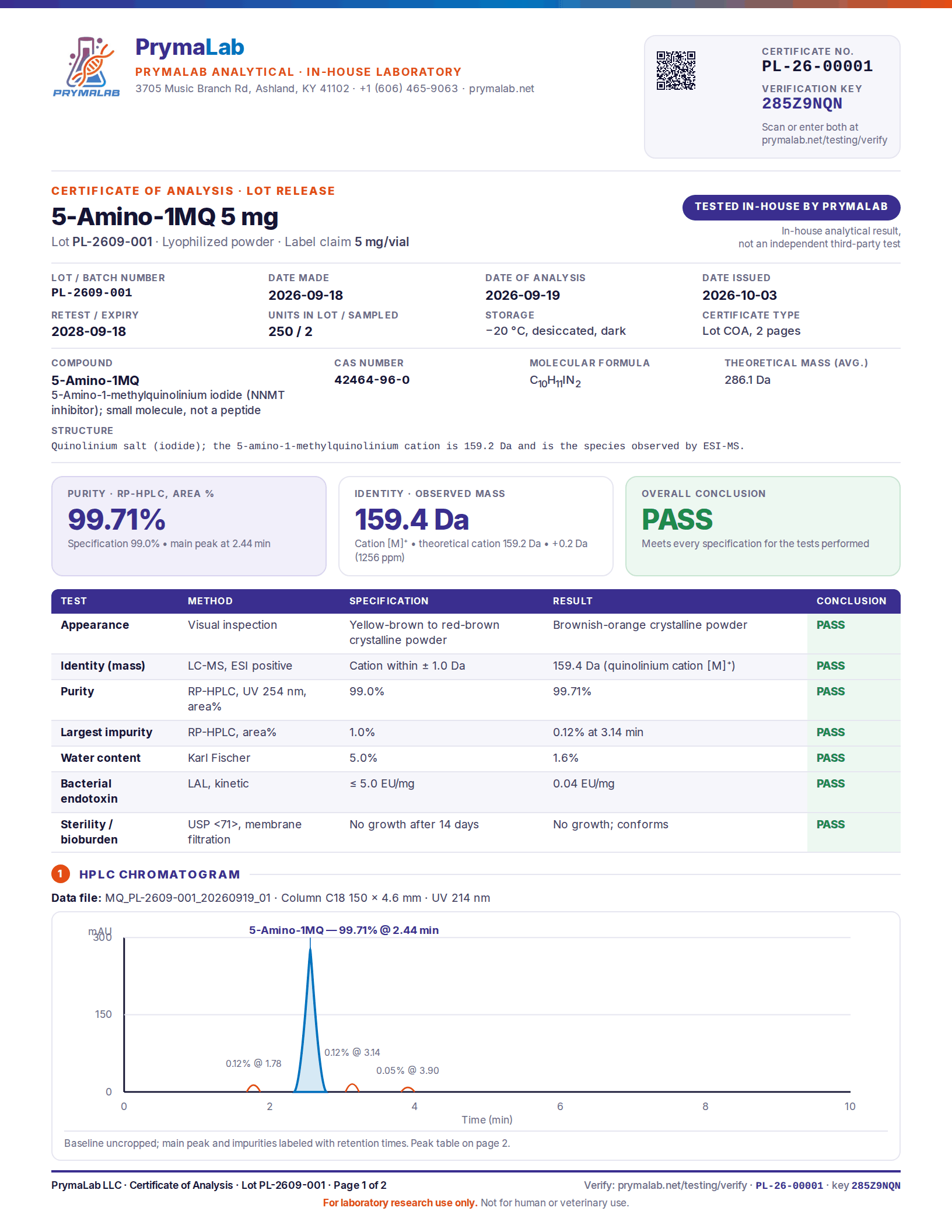
Certificate of analysis for lot PL-2609-001, page 1
Certificate page 1: results
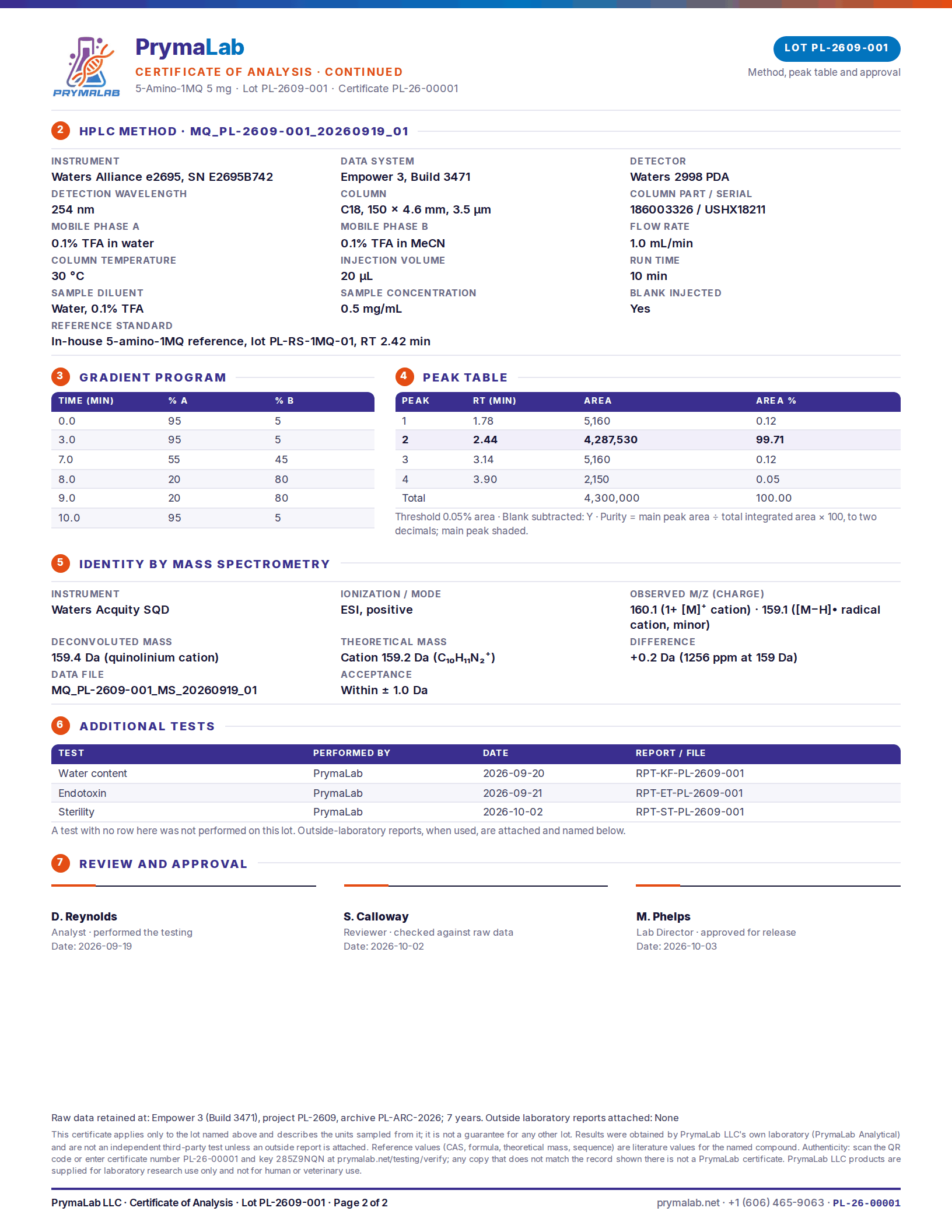
Certificate of analysis for lot PL-2609-001, page 2
Certificate page 2: method and approval

Safety data sheet PL-SDS-001 · 5-Amino-1MQ

GHS safety data sheet for this product (lyophilized powder, vial), revision 1.0 of October 3, 2026. Read all 16 sections or download the PDF to keep with the material.

Warning
  • H302 Harmful if swallowed.
  • H315 Causes skin irritation.
  • H319 Causes serious eye irritation.
  • H335 May cause respiratory irritation.
Composition5-Amino-1MQ (CAS 42464-96-0) · ≥ 95% (dry basis, as supplied), 5 mg, 50 mg per vial
ClassificationAcute toxicity, oral (Category 4); Skin corrosion/irritation (Category 2); Serious eye damage/eye irritation (Category 2A); Specific target organ toxicity, single exposure (respiratory tract irritation) (Category 3)
Physical stateSolid. Yellow-brown to red-brown crystalline powder.
Storage−20 °C (sealed vial), desiccated and protected from light; 2–8 °C acceptable for short periods
HandlingOpen vials only in a clean area. Avoid generating or inhaling dust; weigh or reconstitute inside a ventilated enclosure when the full contents are handled as a dry powder. Reconstitute by adding diluent slowly to the vial wall; do not shake. Wash hands after handling.
First aidEyes: Rinse cautiously with water for several minutes. Remove contact lenses if present and easy to do; continue rinsing. If eye irritation persists, get medical advice. Skin: Take off contaminated clothing. Wash the skin with plenty of soap and water. If irritation or a rash develops, get medical advice. Ingestion: Rinse mouth. Do not induce vomiting. Call a POISON CENTER or doctor if you feel unwell.
DisposalChemical waste through a licensed contractor; do not pour down the drain.
TransportNot regulated as a dangerous good (DOT / IATA / IMDG).

For laboratory research use only. Not for human or veterinary use.

Reviews

There are no reviews yet.

Only logged in customers who have purchased this product may leave a review.

Peptide Research Articles

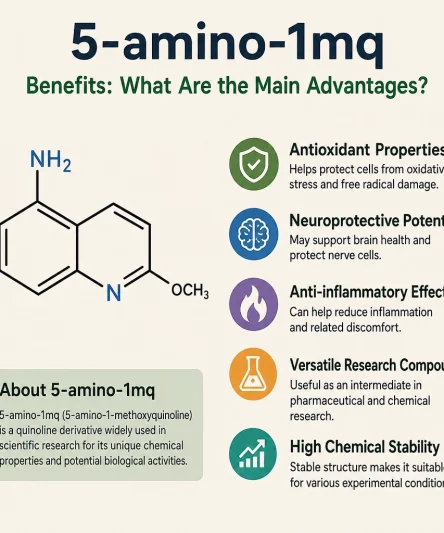
An educational infographic detailing the primary health benefits of 5-Amino-1MQ, listing key advantages such as NNMT enzyme inhibition, enhanced cellular metabolism, targeted fat loss, and muscle tissue preservation.

5-Amino-1MQ: What It Is, Capsules vs Vial and Research

What 5-amino-1MQ is, how NNMT inhibition is thought to drive fat metabolism and NAD+ support, what the (largely preclinical) research actually shows, the honest limitations, and how to source research-grade material.

SR9011 research library featured image: designed at Scripps in 2012 to set the body clock, injected into mice because it does not survive the gut, and named on the WADA list before anyone measured it in a person

SR9011 and SR9009: What a Rev-erb Agonist Does in Mice, What It Does Off-Target, and Why No Human Has Been Dosed

SR9011 and its sibling SR9009 (stenabolic) were built at Scripps in 2012 as tools to press harder on the brake in the body’s circadian clock. Injected into mice they shifted clock genes, raised energy expenditure and cut fat and lipids in obese animals, and in 2018 they killed cancer cells while sparing normal ones. They do not survive the gut, the mice lost their normal activity rhythm, SR9009 was shown in 2019 to act on cells with no Rev-erb receptor at all, and no human has ever been dosed in a published study. This reference sets out the mechanism, the animal record, the off-target problem and the WADA history, and how to tell the two compounds apart on a certificate.

24-hour support icon
24/7 Online support

support@prymalab.net info@prymalab.net

Quality guarantee badge icon
7-day returns

7-day returns on unopened, sealed products, plus our third-party testing guarantee.

Shipping truck icon
Free US shipping

Free USA shipping over $100 and free worldwide shipping over $200.

RealReviews.io Rate your experience with PrymaLab