

Pal-AHK and Follicular Cells: Copper-Peptide Signaling, Growth, and Apoptosis in Research Models
Pal-AHK is a palmitoylated alanine–histidine–lysine tripeptide with high affinity for copper ions, studied for how it interacts with dermal papilla cells and fibroblasts. This research-use-only review explains how the copper-bound peptide may shift apoptosis regulators toward survival, modulate VEGF and TGF-β1, and stimulate collagen synthesis in published in-vitro and ex-vivo models.
Research-use-only disclaimer: Pal-AHK is intended strictly for in-vitro and laboratory research use. It is not a drug, cosmetic, or supplement, and it is not intended for human or veterinary use. Every finding below is drawn from cell-culture or ex-vivo tissue models and is described in hedged, mechanistic terms. Nothing here is medical advice.

TL;DR
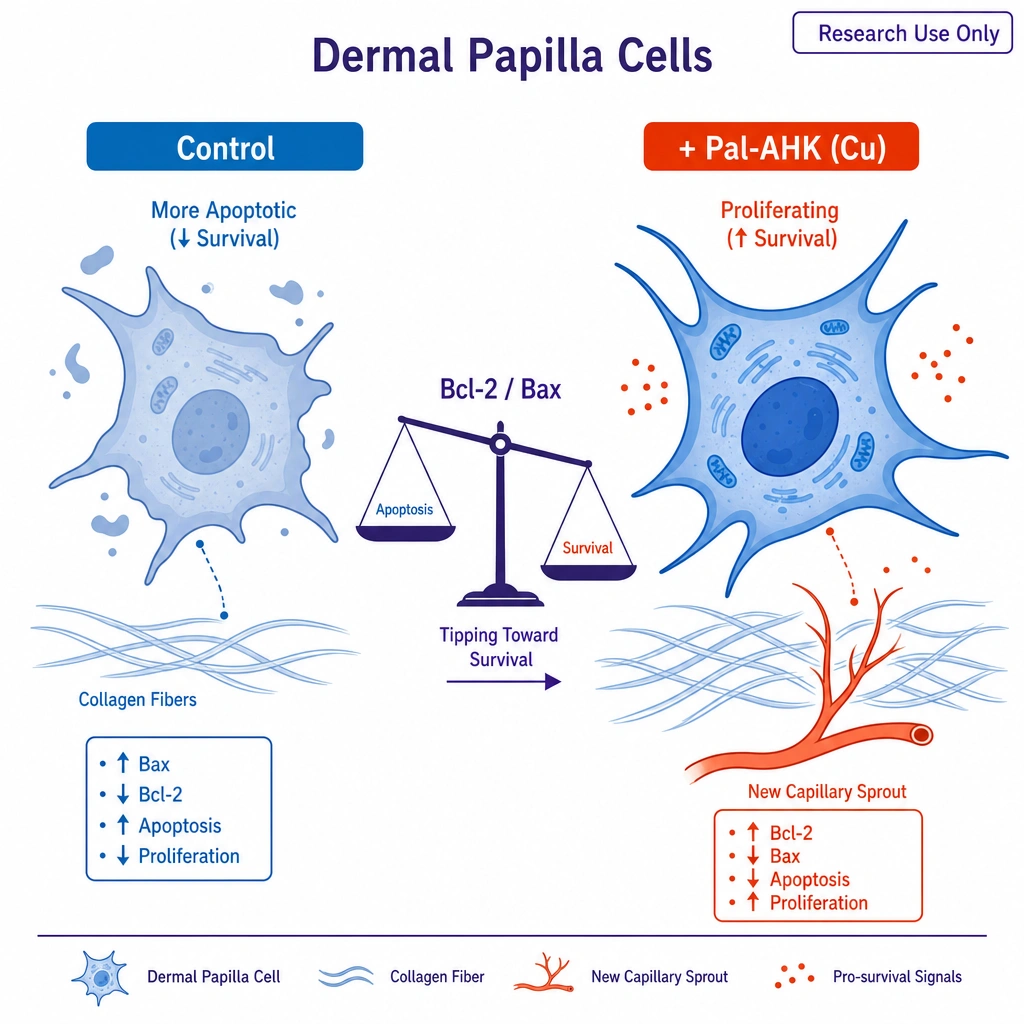
Pal-AHK is a palmitoylated Ala-His-Lys tripeptide that binds copper (as AHK-Cu / copper tripeptide-3). In dermal papilla cells and fibroblasts, research suggests it may reduce apoptosis (higher Bcl-2/Bax ratio; lower active caspase-3 and cleaved PARP), raise VEGF, lower TGF-β1, and stimulate type I collagen. All data are from research models; Pal-AHK is for laboratory use only.
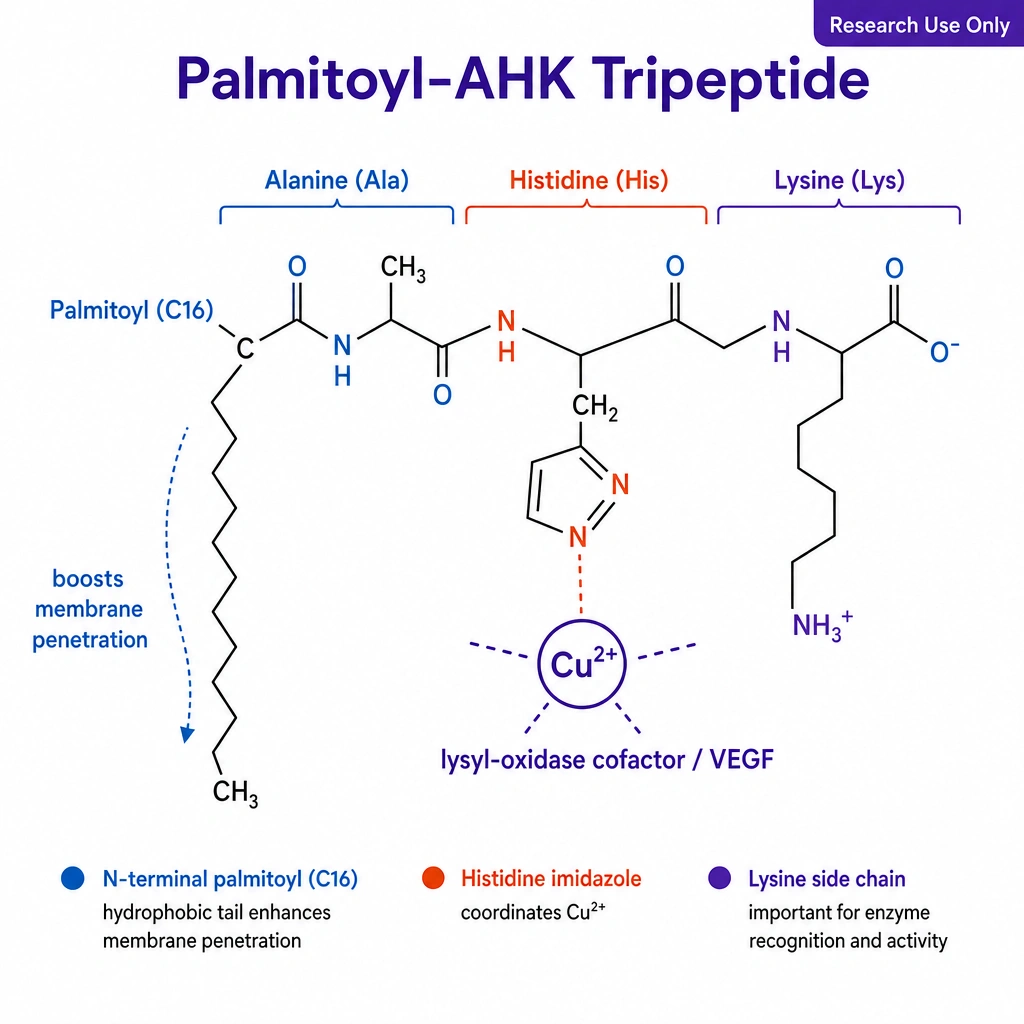
Structure: Ala-His-Lys tripeptide, palmitoylated (C16) at the N-terminus; copper-binding via the histidine imidazole.
Anti-apoptotic signature: reported ~3.48% reduction in apoptotic dermal papilla cells, ~42.7% lower active caspase-3, ~77.5% less cleaved PARP, with procaspase-3 unchanged.
Growth-factor shift: higher VEGF, lower TGF-β1; active across roughly 10-12–10-9 M in vitro.
Matrix effects: ~300% increase in type I collagen secretion in a fibroblast model; copper acts as a lysyl-oxidase cofactor.
Status: research-use-only; no human data and no approved use.
What Is Pal-AHK and How Is It Structured?
Pal-AHK is a tripeptide with the sequence alanine–histidine–lysine (AHK) that has been palmitoylated — a C16 fatty-acid chain is attached to the N-terminus of the sequence. The peptide backbone carries a high affinity for copper ions, while the palmitoyl group increases the compound's lipophilicity, helping it associate with lipid-rich structures such as cell membranes in culture. In its copper-bound form, the molecule is also referred to as AHK-Cu or copper tripeptide-3.
The naming gets crowded fast, so it helps to fix the map first. The AHK-Cu peptide is the copper-bound form; the Pal-AHK peptide is the palmitoylated backbone, which appears in cosmetic ingredient nomenclature as palmitoyl tripeptide-3. Its closest relative is GHK-Cu, catalogued as copper tripeptide-1, whose palmitoylated version Pal-GHK carries the name palmitoyl tripeptide-1. All four are copper-binding peptide constructs built on the same three-residue idea, and all four turn up in the cosmetic peptide literature, where the palmitoyl tail is added specifically to improve skin penetration.
The primary research focus is on dermal papilla cells (DPCs), which are widely regarded as the master regulatory cells of the hair follicle. Investigators study whether Pal-AHK can influence the growth factors and apoptosis pathways those cells use to control follicle cycling, vascularization, and matrix remodeling. The two readouts that recur most often are dermal papilla cell proliferation in culture and hair follicle growth in ex-vivo follicle organ culture.
How Does Pal-AHK Bind Copper, and Why Does It Matter?
Copper binding is the functional heart of the molecule. In-silico analysis by Kecel-Gunduza et al. suggests the AHK sequence coordinates Cu2+ primarily through the imidazole side chain of the histidine residue, with the amino group of lysine providing additional binding stabilization and alanine contributing structural flexibility.
Crucially, these residues appear to remain intact after palmitoylation, because the C16 chain is appended to the N-terminal alanine and leaves the histidine coordination site undisturbed. In other words, the modification that boosts membrane penetration does not compromise copper binding — a key design point for a peptide meant to act inside lipophilic tissue models.
Why does copper matter downstream? Beyond the peptide itself, Cu2+ is a cofactor for lysyl oxidase, the enzyme that crosslinks collagen and elastin, and copper signaling is associated with VEGF upregulation and angiogenesis. So the copper-binding function is not incidental — it plausibly links the peptide to matrix remodeling and vascular signaling.
Copper-tripeptide chemistry sits at the center of the older wound healing literature, where GHK-Cu was first characterized as a signal peptide that directed tissue repair rather than acting as a nutrient. That work reported increased synthesis of collagen, elastin, and glycosaminoglycans, alongside antioxidant behavior that limits damage from free radicals. Whether AHK-Cu reproduces the full tissue remodeling profile of GHK is an open question. The sequences are close, but the published datasets are not the same size.
How Might Pal-AHK Affect Apoptosis in Dermal Papilla Cells?
Research suggests Pal-AHK, in its copper-bound form, may shift dermal papilla cells away from programmed cell death. The most detailed data come from the tripeptide-copper study by Pyo et al. (2007), which reported an anti-apoptotic profile in cultured human DPCs.
At the protein level, the peptide appeared to shift the balance between pro- and anti-apoptotic regulators within the Bcl-2 family, raising the Bcl-2/Bax ratio toward survival. This detail matters for follicle biology: Bcl-2 expression is reported to be dominant during the telogen-to-anagen transition, so a Bcl-2-favoring shift may be mechanistically relevant to hair-cell cycle re-entry in these models. The modest magnitude of the cell-count change, paired with clearer protein-level shifts, is why the authors framed the effect as mechanistically reproducible even where it was not yet statistically robust at the whole-population level. Both markers sit on the same executioner branch, so the pattern reads as one shift in the apoptotic pathways rather than two independent findings.
Does Pal-AHK Modulate VEGF and TGF-β1?
Yes — growth-factor modulation is one of the most consistent themes in the copper-tripeptide literature. Because AHK is structurally similar to GHK, researchers have examined whether Pal-AHK shares GHK-like effects on the signals that govern follicle size and vascularity. According to Sadgrove & Simmonds (2021), the main mechanisms include "reduced expression of TGF-β1 and increased hair shaft elongation, increased expression of vascular endothelial growth factor and reduced negative growth factors."
The directional logic is coherent: VEGF may support perifollicular vascularity and follicle size, while androgen-inducible TGF-β1 (transforming growth factor-beta1) derived from dermal papilla cells has been implicated in suppressing epithelial cell proliferation. Raising the former and lowering the latter is the kind of two-sided shift researchers look for when probing follicle-growth signaling. Reports also describe increased superoxide dismutase (SOD) activity, pointing to a possible antioxidant contribution that could reduce oxidative stress in the follicular microenvironment.
It is worth naming what this research does not cover, because the surrounding market moves faster than the literature. Androgenetic alopecia, or pattern hair loss, is driven substantially by follicular sensitivity to DHT, and the established hair regrowth treatments work on that axis or on the growth cycle directly: minoxidil prolongs anagen and improves perifollicular circulation, while 5-alpha-reductase inhibitors lower local DHT. Copper tripeptides such as AHK-Cu are not DHT blockers, and no controlled study has compared Pal-AHK with minoxidil for hair density in people. The consumer category around scalp health, where caffeine, biotin, conditioner formats, and microneedling are the familiar tools, is a separate conversation from the cell-culture work described here.
The follicle-biology overlap is still real. TGF-β1 is one of the mediators implicated in androgen-driven follicle miniaturization, the process behind visible hair thinning in androgenetic alopecia, so a peptide that lowers TGF-β1 and raises VEGF in culture is probing the same signaling that hair loss research cares about. Whether any of it survives outside the dish is exactly what has not been tested. PrymaLab supplies Pal-AHK for laboratory work, not as a treatment for hair loss or thinning hair.
What Does Pal-AHK Do in Fibroblasts and Collagen Synthesis?
Beyond the follicle, the copper tripeptide is studied in dermal fibroblasts, the principal cellular source of collagen and other extracellular-matrix proteins. Laboratory research referenced via Patt & Procyte suggests the peptide "increases the growth and viability of dermal fibroblasts while stimulating the production of collagen" when bound to copper.
Because fibroblast proliferation and viability are upstream of matrix output, these effects may be prerequisites for downstream remodeling. The copper affinity of the sequence adds a second route to matrix change: as a cofactor for lysyl oxidase, copper supports crosslinking of elastin and collagen, and the literature also links copper peptides to activation of matrix metalloproteinases (MMPs) and to angiogenesis via VEGF upregulation.
Those matrix endpoints are why copper peptides became a fixture in cosmetic formulation. Collagen and matrix turnover underpins skin elasticity; matrix and lipid organization underpin skin barrier function, hydration, and the surface properties people describe as skin texture and skin tone. None of it has been measured for AHK-Cu in a controlled human trial. The fibroblast data say the copper-bound peptide moves collagen output in culture, and that is the extent of the claim available here.
What Is the "Dual-Acting" Copper-Peptide Concept?
A useful framing from Sadgrove & Simmonds (2021) is the idea of "dual-acting" (2-for-1) peptides — molecules studied for both dermal antiaging (collagen, matrix) and hair-health (follicle) signaling from the same sequence. In that review, an important distinction is that such peptides may act largely independently of TGF-β2, the pathway through which retinoids can inadvertently suppress hair growth. Pal-AHK's combined fibroblast-and-follicle profile places it squarely in this dual-acting category for research purposes.
| Marker / readout | Reported direction | Model |
|---|---|---|
| Apoptotic cell fraction | ↓ ~3.48% | Human dermal papilla cells |
| Active caspase-3 | ↓ ~42.7% | Dermal papilla cells |
| Cleaved PARP | ↓ ~77.5% | Dermal papilla cells |
| Bcl-2 / Bax ratio | ↑ (pro-survival) | Dermal papilla cells |
| VEGF | ↑ | DPC / fibroblast |
| TGF-β1 | ↓ | DPC / fibroblast |
| Type I collagen | ↑ ~300% | Dermal fibroblasts |
| SOD (antioxidant) | ↑ | Follicular models |
How is research-grade Pal-AHK characterized?
For cell and ex-vivo work, identity and purity are what matter. Research-grade Pal-AHK is typically confirmed by reversed-phase HPLC for purity and mass spectrometry for identity, with attention to copper-complex consistency, shipped as a lyophilized powder, and supplied strictly for laboratory use. Formulation choice matters for anyone designing an assay: liposomal carriers are common across the published copper-peptide work because a liposomal vehicle keeps palmitoylated AHK-Cu dispersed and changes how much reaches the cells, so a lyophilized stock reconstituted in buffer and the same peptide in a liposomal preparation are not interchangeable inputs. At PrymaLab, every lot is tested in PrymaLab's own laboratory (RP-HPLC purity, LC-MS identity) so experimental results reflect the peptide rather than a contaminant; certificates can be checked at https://prymalab.net/testing/verify/, and the third-party testing guarantee refunds the order and reimburses the test if any independent laboratory finds the wrong compound or less than the stated purity or amount. No specific lot data are asserted in this general reference.
Frequently Asked Questions
What is Pal-AHK?
Pal-AHK is a palmitoylated alanine-histidine-lysine tripeptide that binds copper (as AHK-Cu / copper tripeptide-3). It is studied in dermal papilla cells and fibroblasts and is intended for laboratory research use only.
How does Pal-AHK affect dermal papilla cells?
In research models AHK-Cu has been associated with increased proliferation, a pro-survival shift in apoptosis regulators (higher Bcl-2/Bax; lower active caspase-3 and cleaved PARP), higher VEGF, and lower TGF-β1, across roughly a 10-12–10-9 M window.
Why does copper binding matter?
Histidine anchors Cu2+ with lysine stabilization; palmitoylation leaves this site intact. Copper is a lysyl-oxidase cofactor and is linked to VEGF and angiogenesis, connecting the peptide to matrix and vascular signaling.
Does Pal-AHK stimulate collagen?
In a fibroblast model referenced by Patt & Procyte, the copper-bound tripeptide increased fibroblast growth and viability and raised type I collagen secretion by roughly 300% versus control.
Is Pal-AHK approved for human use?
No. Pal-AHK is a research-use-only compound with no human data and no approved use. All findings are from in-vitro and ex-vivo models.
How do AHK and GHK peptides differ?
Both are copper-binding tripeptides that coordinate Cu2+ via histidine; AHK uses alanine where GHK uses glycine. Their structural similarity is why AHK is investigated for GHK-like growth-factor effects.
Related reading
References
- Pyo HK, Yoo HG, Won CH, et al. The effect of the tripeptide-copper complex on human hair growth in vitro. Arch Pharm Res. 2007;30(7):834–839. PMID:17703734
- Sadgrove NJ, Simmonds MSJ. Topical and nutricosmetic products for healthy hair and dermal antiaging using "dual-acting" (2 for 1) plant-based peptides, hormones, and cannabinoids. FASEB BioAdv. 2021;3(8):601–610. doi:10.1096/fba.2021-00022
- Kecel-Gunduza S, Koc B, Bicak B, et al. In silico analysis for characterizing the structure and binding properties of Ala-His-Lys (AHK) tripeptide. The Online Journal of Science and Technology. 2020;10(3). Reference listing
- Kapoor R, Shome D, Vadera S, et al. QR678 & QR678 Neo Hair Growth Formulations: A Cellular Toxicity & Animal Efficacy Study. Plast Reconstr Surg Glob Open. 2020;8(8):e2843. PMC7489598
- Patt LM, Procyte. Neova DNA Repair Factor Nourishing Lotion Stimulates Collagen and Speeds Natural Repair Process. (Copper-peptide fibroblast collagen data, as cited in Sadgrove & Simmonds 2021.)
Final disclaimer: This article is an educational research reference. Pal-AHK is sold and studied for laboratory research use only and is not approved by any regulatory authority for human or veterinary use. Statements about Pal-AHK have not been evaluated by the FDA. Nothing here should be interpreted as medical or cosmetic advice or as a recommendation to apply or administer any peptide.
Descriptions of mechanisms are hypotheses and observations from in-vitro and ex-vivo models; they may not generalize. Always verify the legal status of any research compound in your jurisdiction before purchase or use.