

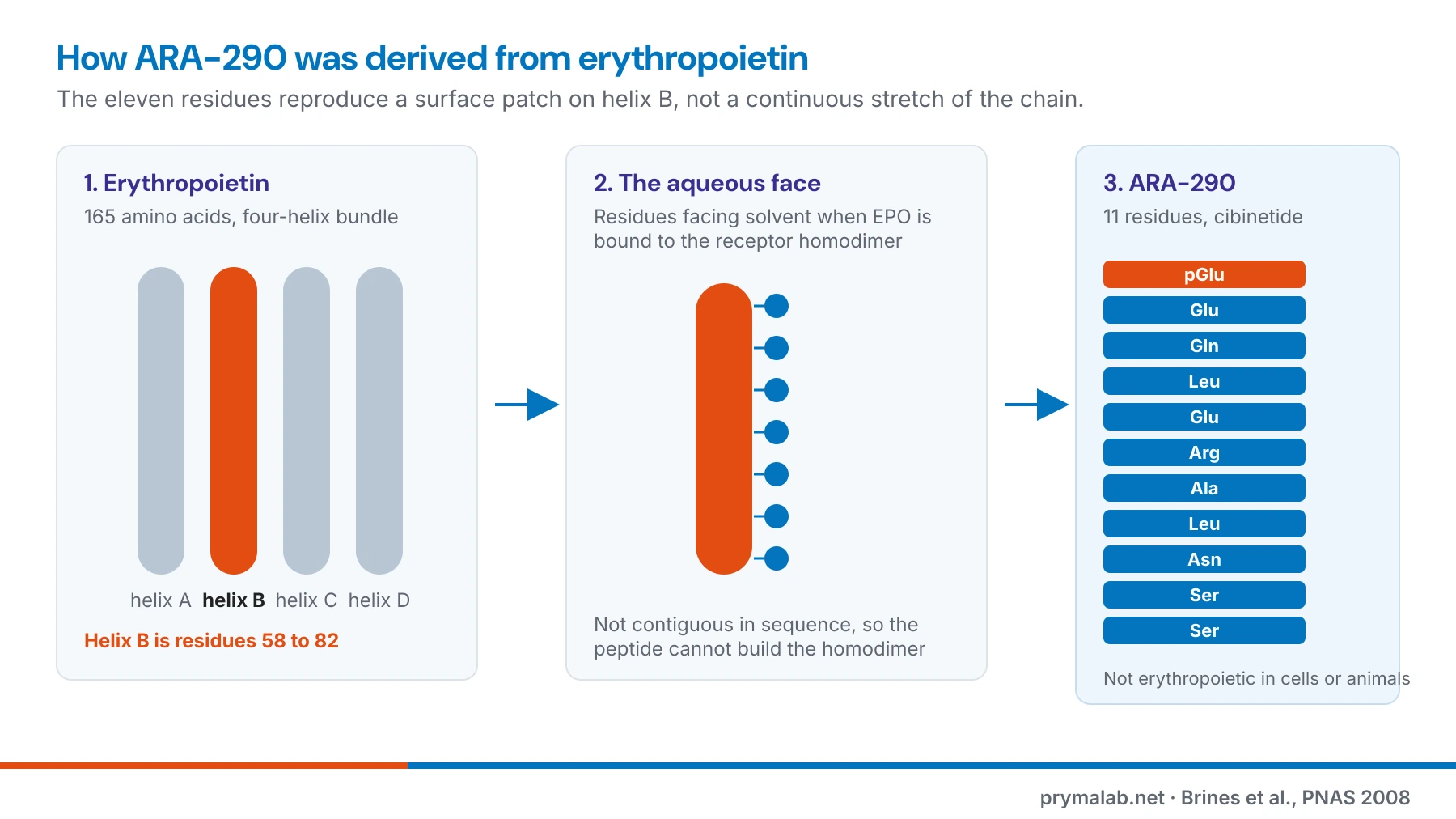
The ARA 290 peptide, international non-proprietary name cibinetide, is an 11-residue synthetic peptide copied from the solvent-facing surface of helix B of erythropoietin, built to switch on the tissue-protective side of erythropoietin signalling without raising red cell counts. It has never been approved anywhere, and PrymaLab stocks it for laboratory research only as an ARA-290 10 mg vial.
- The sequence is pGlu-Glu-Gln-Leu-Glu-Arg-Ala-Leu-Asn-Ser-Ser, eleven residues, with a cyclised N-terminal pyroglutamate.
- The origin is a 2008 paper from Warren Pharmaceuticals that mapped erythropoietin's protective activity to helix B, residues 58 to 82.
- The human record is five trials, the largest with 64 subjects, all of them 28 days of dosing or less except one 12-week eye study that was stopped early.
- The regulatory position is no approval in any country, two European orphan designations with no marketing authorisation behind them, and FDA category 3 on the 503A compounding list.
| ARA-290 | Erythropoietin | |
|---|---|---|
| Length | 11 residues | 165 residues |
| Raises red cell mass | No, in cells and animals | Yes |
| Approved for human use | No | Yes, for anaemia |
| Phase 3 trials | None ever registered | Many |
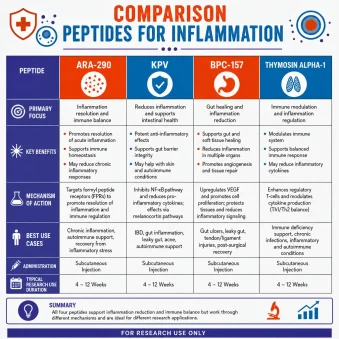
See the peptides for inflammation research overview for how ARA-290 sits beside the other anti-inflammatory compounds in the catalogue.
Also known as: cibinetide (INN), pHBSP, pyroglutamate helix B surface peptide, PH-BSP, ARA290, CAS 1208243-50-8.
I sell the ARA 290 peptide, so you should discount what I say about it accordingly. What follows is the opposite of a sales page. I went through every human trial, every registry record and the posted results data, and the picture is thinner and stranger than the clinic pages suggest. Two of the preclinical papers people cite have been retracted. The headline nerve-regrowth numbers come from within-group tests rather than comparisons against placebo. And in the largest trial, the skin biopsy endpoint came out better in the placebo arm than in any dose of drug.
Research-use-only disclaimer: ARA-290 is sold for laboratory research only. It is not a medicine, not a supplement and not approved for human or veterinary use anywhere. This article describes published study designs and reported results. It contains no dosing, reconstitution or administration guidance, and it makes no treatment or benefit claims.

TL;DR
ARA-290 is an eleven-amino-acid peptide taken from one face of one helix of erythropoietin. Michael Brines and Anthony Cerami designed it to hit a proposed second erythropoietin receptor that protects tissue without making red cells. Five human trials exist, with 9 to 64 subjects each. The most replicated finding is an increase in corneal nerve fibre measurements in sarcoidosis patients. The skin biopsy endpoint failed repeatedly, the diabetic eye trial was null on every objective measure, and development stopped after phase 2.
The receptor model is not settled science. A 2018 biophysics paper tested the two receptor pieces directly, with and without ARA-290, and found they do not associate. Two preclinical papers in the ARA-290 literature have since been retracted, one of them in February 2026.
Identity is pGlu-Glu-Gln-Leu-Glu-Arg-Ala-Leu-Asn-Ser-Ser, CAS 1208243-50-8, PubChem CID 91810664, formula C51H84N16O21, average mass 1257.3.[1]
Best evidence is a 64-subject phase 2b trial in sarcoidosis where one of three dose arms met a corneal imaging endpoint.[2]
Weakest link is the receptor model, which one biophysical study tested directly and could not confirm.[3]
Two retractions sit in the preclinical literature, in 2024 and 2026.[4][5]
Status is research use only. No approval in any country, and no phase 3 trial has ever been registered.
What is the ARA 290 peptide?
The ARA 290 peptide is an eleven-residue synthetic peptide, sequence pGlu-Glu-Gln-Leu-Glu-Arg-Ala-Leu-Asn-Ser-Ser, that copies the water-facing surface of helix B of human erythropoietin. Its international non-proprietary name is cibinetide. It was designed to activate the protective, anti-inflammatory arm of erythropoietin signalling while leaving red cell production alone.[6]
The chemistry is unambiguous and easy to check. PubChem holds it as CID 91810664 with CAS number 1208243-50-8, UNII 9W5677JKDA, molecular formula C51H84N16O21, average mass 1257.3 and monoisotopic mass 1256.5997.[1] I mention the formula because a formula of C55H84N16O21 circulates in several summaries of this compound, including one I was handed while researching this page. It is wrong. The monoisotopic mass of 1256.5997 is only consistent with 51 carbons.
Two structural details matter later. The N-terminal residue is pyroglutamate, a cyclised glutamine or glutamate that blocks that end of the chain against aminopeptidase trimming. And the peptide is linear and short, which is why the material used in the published trials had a molecular weight of about 1257 daltons and was made by standard solid-phase synthesis rather than in cell culture.[13]
Where did the sequence come from?
It came from a 2008 paper in PNAS by Michael Brines, Anthony Cerami and colleagues at Warren Pharmaceuticals, who were trying to separate erythropoietin's two jobs.[6] Erythropoietin drives red cell production, and it also protects injured tissue. The second job had obvious clinical appeal and the first one carried thrombotic risk, so the question was whether the protective activity could be isolated.
Their earlier attempt was chemical. Carbamylating erythropoietin produced a molecule that was tissue protective and not erythropoietic, reported in Science in 2004.[8] The 2008 work went further and asked which part of the protein was responsible. They narrowed it to helix B, residues 58 to 82, which faces the surrounding water when erythropoietin is bound to its classical receptor pair. Helix B is therefore not part of the interface that drives erythropoiesis.
From helix B they took eleven amino acids forming its aqueous face. In the original experiments neither helix B nor the eleven-residue peptide raised red cell indices in cells or in animals, and the peptide was active in models of ischaemic stroke and renal ischaemia-reperfusion.[6] That paper carries a conflict-of-interest statement noting that six of the seventeen authors were Warren Pharmaceuticals employees at the time, and that the company was developing erythropoietin analogues commercially.[6]
The composition claims sit in US patent 8,853,358 B2, assigned to Araim Pharmaceuticals, with Cerami and Brines as inventors, priority date 22 January 2008 and grant date 7 October 2014. Google Patents shows an adjusted expiry of 16 May 2030, with a note that this is an estimate rather than a legal determination.[38]
How well established is the innate repair receptor?
Less well than almost every page selling this peptide implies. The innate repair receptor is a hypothesis with supporting functional data and at least one direct experimental contradiction, and the contradiction has never been resolved in the published literature.
The hypothesis is Brines and Cerami's, set out at length in Molecular Medicine in 2012.[7] Erythropoietin performs erythropoiesis through a homodimer of its own receptor. Tissue protection, they argued, runs through a different assembly: one erythropoietin receptor subunit paired with the beta common receptor, CD131, a signalling subunit shared with the receptors for GM-CSF, interleukin-3 and interleukin-5. Their paper describes this tissue-protective receptor as absent from healthy tissue and switched on by injury, hypoxia and metabolic stress.[7] That claim does useful work: if the target only appears where there is damage, a drug aimed at it should be quiet everywhere else, which is the explanation offered for ARA-290's clean safety profile.
Functional evidence exists. Knocking out or silencing the beta common receptor removes the analgesic and tissue effects of ARA-290 in rodent neuropathic pain models.[18] That is a real result and it is reproducible within the group that produced it.
The problem is that a knockout tells you the subunit is needed for the effect. It does not tell you the two receptor pieces physically join. In 2018 a group at St Vincent's Institute and the University of Melbourne went looking for that physical association directly. They examined the extracellular regions of the erythropoietin receptor and the beta common receptor computationally and in vitro, with and without erythropoietin, and with and without ARA290 specifically. Their computational and genomic work suggested an interaction was possible. Their biophysical measurements did not find one. They concluded that the extracellular regions of the two receptors do not specifically associate, and separately that mice have no requirement for the beta common receptor gene under anaemic stress.[3] That paper carries a 2019 erratum.[32]
There is also an awkward control. The same Leiden group that showed ARA-290 analgesia disappears in CD131 knockouts later showed that ketamine analgesia also disappears in those mice.[19] Ketamine is not an erythropoietin derivative and has no proposed relationship to this receptor. If a knockout abolishes the effect of an unrelated analgesic in the same assay, the knockout result is weaker evidence for a specific receptor than it first looks.
The European Medicines Agency describes cibinetide in its orphan designation record as attaching to and activating a receptor called the innate repair receptor.[34] That is a regulator repeating a sponsor's mechanistic claim in a designation document, which is not the same as a regulator having evaluated it.
My reading is that the non-erythropoietic part is well supported and the receptor part is not. ARA-290 does something in a lot of injury models, and it does not raise haematocrit. Whether it does so through a physically distinct erythropoietin receptor and CD131 heterodimer is an open question that one group answers yes and another group's biophysics answers no.
What do the animal and cell studies show?
They show activity across an unusually wide spread of injury models, almost all of them rodent, and almost all of them from a small number of connected laboratories. The breadth is the selling point and also the reason to be careful.
The neuropathic pain work is the most developed. In spared nerve injury rats, ARA-290 reduced mechanical and cold allodynia with effects outlasting the dosing period, alongside suppression of spinal microglial activation.[18] In Akita diabetic mice, a model of autonomic neuropathy, the peptide acted on established neuritic dystrophy in sympathetic ganglia.[20] In a rat model of diabetic retinopathy it reduced vascular leakage and protected retinal neuroglia.[21]
Cardiac work came from a separate group at the National Institute on Aging: protection against ischaemic myocardial damage in rats,[22] and amelioration of post-infarction dilated cardiomyopathy on chronic administration.[23] A 2010 PNAS paper reported cardioprotection from a peptide mimicking the three-dimensional structure of erythropoietin.[24] Burn injury work in PNAS reported reduced secondary microvascular thrombosis in cutaneous burns.[25] Hemorrhagic shock work reported reduced organ injury and inflammation.[26] Renal ischaemia-reperfusion has two surviving papers in Journal of Translational Medicine.[29][30]
More recent and more independent work exists. Cibinetide dampened innate immune cell function in experimental colitis,[39] protected isolated human islets under stress and improved engraftment,[40] improved islet allograft function,[41] inhibited osteoclastogenesis in vitro,[42] and altered monocyte behaviour in an Alzheimer's model.[43] One 2016 paper proposed an entirely different route, reporting that ARA 290 relieves pain by antagonising the TRPV1 channel.[44]
Here is the honest summary. A compound that works in neuropathy, retinopathy, myocardial infarction, burns, shock, kidney injury, colitis, islet transplantation, bone and Alzheimer's models is either a general-purpose anti-inflammatory with a very wide therapeutic reach, or it is a compound whose positive results have been easier to publish than its negative ones. I cannot tell you which from the literature, because the literature does not contain the negative results. What I can tell you is that several of the therapeutic areas listed above, including cardiac, burns, bone and kidney, have no corresponding human trial at all.
Which papers have been retracted or corrected?
Two papers in the ARA-290 preclinical literature are retracted. I did not find this stated on any page currently ranking for this compound, and one of the two retractions is recent enough that most summaries predate it.
The first is Collino and colleagues, British Journal of Pharmacology 2014, reporting that a non-erythropoietic peptide derivative of erythropoietin decreased susceptibility to diet-induced insulin resistance in mice.[28] It was retracted in April 2024.[4] That paper matters more than its subject suggests, because Brines and colleagues cite it in their 2015 human diabetes trial as the preclinical support for ARA-290 acting on insulin resistance.[13] The mechanistic rationale offered for the human metabolic findings now rests partly on a retracted paper.
The second is Patel and colleagues, Molecular Medicine 2012, on delayed administration of pyroglutamate helix B surface peptide in acute kidney injury.[27] The retraction notice was published on 26 February 2026.[5] Brines and Cerami are among the co-authors of the retracted paper.
Separate from the retractions, there is a published disagreement about the cardiac work. A 2011 letter in PNAS questioned the antiapoptotic claims made for helix B surface peptide in heart disease, and the original authors replied in the same pages.[31] Exchanges like that are normal and healthy. They are also invisible if you read only the original paper, which is what most summaries do.
Corrections sit on several other papers in this literature: an erratum on a 2014 PLoS One autoimmune neuritis paper recording a dosage error in the article text, an erratum on a 2016 Cardiology paper, one on a 2020 Bioorganic Chemistry radiotracer paper, and one on a 2023 Frontiers in Immunology kidney paper. None of those is a retraction, and I list them because a reader checking my work should know they exist.
The clinical side has its own correction history. The 2013 sarcoidosis trial carries both an erratum published in 2016[11] and a published Comment in the same issue as the original.[12] If you have only ever read the abstract, you have not seen either.
How many human trials exist?
Five, and I can list all of them in one table. Between them they enrolled fewer than 200 people. The largest had 64 subjects, the smallest had nine, and every one of them was phase 2 or earlier. No phase 3 trial of ARA-290 has ever been registered anywhere.
| Trial | Design | Population | Enrolled | Duration | Primary endpoint | Outcome |
|---|---|---|---|---|---|---|
| Heij 2012 | Randomised, double-blind, placebo-controlled pilot | Sarcoidosis with small fibre neuropathy symptoms | 22 | 4 weeks | Symptom scale change and safety | Symptom scale favoured drug; pain and fatigue scales improved equally in both arms[9] |
| Dahan 2013 | Randomised, double-blind, placebo-controlled | Sarcoidosis-associated small nerve fibre loss | 38 | 28 days | Nerve fibre density, sensory testing, visual measures | Skin biopsy density not significant; corneal density moved within group only[10] |
| Brines 2015 | Randomised, double-blind, placebo-controlled | Type 2 diabetes with painful neuropathy | 49 enrolled, 48 analysed | 28 days plus 28 days follow-up | Safety, HbA1c, symptom scales | HbA1c and one pain scale favoured drug; the main neuropathy symptom scale did not move[13] |
| Culver 2017 | Randomised, double-blind, placebo-controlled, three dose arms, two centres | Sarcoidosis-associated small nerve fibre loss with neuropathic pain | 64 | 28 days | Change in corneal nerve fibre area at day 28 | One of three dose arms met it; the other two did not[2] |
| Lois 2020 | Open-label exploratory pilot | Diabetic macular oedema | 9 recruited, 8 completed | 12 weeks | Change in best corrected visual acuity at week 12 | Null on every objective endpoint; terminated early[14] |
Four of the five were run at Leiden University Medical Center or with Leiden investigators, and Araim Pharmaceuticals staff appear as authors on four of the five. In the 2015 paper, Brines, Dunne and Cerami are listed as officers of Araim who own stock or stock options.[13] In the 2020 eye paper, four of the twelve authors are Araim officers or shareholders and a fifth is a company consultant.[14] None of this is misconduct. Sponsor-authored phase 2 work is ordinary. It does mean there is no independent confirmatory trial of this compound by anybody.
There are also registry records with no published results. A complex regional pain syndrome study and a rheumatoid arthritis study sit on the EU register listed as ongoing with nothing posted. A Karolinska study of glucose tolerance in prediabetes and early type 2 diabetes, NCT01933529, is still showing status unknown with its last update in September 2015 and no results.[17]
What happened in the sarcoidosis programme?
Three trials, and the pattern across them is that patient-reported symptom scores and corneal imaging moved while the skin biopsy measure did not. That split is the single most informative thing in the ARA-290 human record, and most summaries collapse it.
The 2012 pilot enrolled 22 patients with sarcoidosis and small fibre neuropathy symptoms, 12 on drug and 10 on placebo, dosed intravenously three times a week for four weeks.[9] The small fibre neuropathy screening list fell further on drug than placebo, a change of 11.5 against 2.9, p below 0.05. Those figures are standard errors of the mean, not standard deviations, which matters if you are trying to judge the spread. In the same trial the Brief Pain Inventory and the Fatigue Assessment Scale both improved significantly, and both improved by about the same amount in the placebo group. The depression inventory did not change at all.[9]
The 2013 trial was larger, 38 patients, 21 on drug and 17 on placebo, 28 days of subcutaneous dosing.[10] Its primary endpoints were structural and sensory: nerve fibre density in skin or cornea, quantitative sensory testing, and visual acuity or retinal oedema. The symptom scale and the walk test were secondary. Skin intraepidermal nerve fibre density did not reach significance: the drug arm gained 0.38 fibres per millimetre in the distal leg against a 0.06 loss on placebo, and thigh density fell in both arms.[10] The symptom scale separated between groups at week five with p equal to 0.005, and still separated at the twelve-week follow-up with p equal to 0.037. The six-minute walk test gained 18.7 metres on drug and lost 15.1 metres on placebo, p equal to 0.049.[10]
Then there is the corneal result, which is the one everybody quotes. Corneal nerve fibre density rose by a median 14.5 per cent, about 185 square micrometres, p equal to 0.022. Placebo changed by minus 5.3 per cent, p equal to 0.462. Both of those are within-group Wilcoxon tests against each arm's own baseline. The paper's discussion describes a significant difference between the groups, but no between-group p value for that endpoint appears in it.[10] A within-group test tells you an arm changed from where it started. It does not tell you the arms differ from each other, which is what a placebo-controlled trial exists to establish.
The 2017 phase 2b is the best-designed study in the whole programme: 64 subjects, three ascending dose arms against placebo, two centres, with corneal nerve fibre area at day 28 as a pre-specified primary endpoint.[2] The placebo-corrected change was 109 square micrometres in the lowest arm with a confidence interval from minus 429 to 647, 697 in the middle arm with an interval of 159 to 1236 and p equal to 0.012, and 431 in the highest arm with an interval of minus 130 to 992. Only the middle arm met the endpoint. Regenerating intraepidermal fibres marked by GAP-43 rose in that same middle arm, p equal to 0.035.[2]
The pain result in that trial deserves a careful reading. The abstract states that pain improved significantly in all groups, including placebo, and that subjects with moderate to severe pain in the middle dose arm had a clinically meaningful placebo-corrected decrease in pain intensity, at p equal to 0.157.[2] A p value of 0.157 is not significant by any conventional threshold. Calling the same result clinically meaningful is a judgement about effect size, and readers are entitled to weigh it themselves.
What happened in the diabetes trial?
The 2015 trial in type 2 diabetes with painful neuropathy produced a positive metabolic signal, a positive result on one pain questionnaire, and nothing on the symptom scale that the sarcoidosis trials had used as their headline measure.[13]
Sixty-one people were screened, 49 enrolled and 48 analysed after one withdrawal, split 24 and 24. Dosing was subcutaneous and self-administered daily for 28 days, with a further 28 days of observation. The trial is registered in the Netherlands Trial Register as NTR3858.[13]
Glycated haemoglobin was the strongest result, p equal to 0.002 by repeated-measures analysis of variance. The arithmetic behind it is worth seeing. The drug arm fell 0.16 per cent at day 28 and 0.21 per cent at day 56. The placebo arm fell 0.01 per cent at day 28 and then rose 0.21 per cent at day 56.[13] Roughly half the separation at the end of the study comes from placebo getting worse rather than drug getting better. The authors note themselves that the magnitude of change is small and that these subjects started with good glycaemic control.[13] Lipids moved too: the cholesterol to HDL ratio at p equal to 0.039 and triglycerides at p equal to 0.043, though HDL on its own reached only p equal to 0.066 and so did not separate.[13]
On symptoms, the PainDetect questionnaire improved with p equal to 0.037 in the text of the paper, while figure 4 of the same paper states p equal to 0.03 in its caption. The small fibre neuropathy screening list, the measure that carried the 2012 and 2013 sarcoidosis results, did not change significantly in either arm at day 28 or day 56.[13] The Neuropathic Pain Symptom Inventory improved about 20 per cent in both arms, and the placebo arm's improvement reached a lower p value than the drug arm's. By day 56 neither arm was significantly improved on that measure. The six-minute walk test gained 3.5 per cent on drug at p equal to 0.09, which is not significant, against 1.1 per cent on placebo. Quantitative sensory testing showed no significant differences after treatment in either group.[13]
Corneal nerve fibre density in the whole group rose 1.1 fibres per square millimetre on drug against 0.1 on placebo, and that difference was not significant. The result people quote comes from a subgroup. Eleven of the diabetic subjects had corneal density within one standard deviation of normal and so could not be called abnormal, and the authors ran a post hoc analysis restricted to the subjects more than one standard deviation below normal. In that subgroup the drug arm gained 2.6 fibres per square millimetre, n of 18, p equal to 0.02 by paired t test, against 0.7 on placebo, which was not significant.[13] The paper's own statistical methods section labels this analysis post hoc. A paired t test compares an arm with itself.
What happened in the eye study?
It was null and it was stopped early because the drug supply expired. This is the trial that vendor pages leave out.
The study ran at the Belfast Health and Social Care Trust, recruiting between May 2016 and April 2017, in patients with diabetic macular oedema and central retinal thickness above 400 micrometres.[14] Nine patients were recruited and eight completed twelve weeks of daily subcutaneous self-administration. The primary outcome was mean change in best corrected visual acuity at week 12.
Nothing moved. Visual acuity changed by minus 2.9 with a standard deviation of 5.0. Central retinal thickness changed by 10 micrometres against a standard deviation of 94.6. Central retinal sensitivity changed by minus 0.53 decibels and tear production by minus 0.13 millimetres. The only measure that moved in a favourable direction was a quality-of-life questionnaire, up 2.7 points on the National Eye Institute Visual Function Questionnaire composite.[14] There were no serious adverse events and no anti-cibinetide antibodies. The authors concluded that the course was safe and that improvements seen in some participants warranted further investigation.[14]
The registry entry carries the detail the paper does not emphasise. ClinicalTrials.gov lists NCT06626971 as terminated, and the reason recorded is the expiry of study drug with no replacement available.[16] A tenth patient was never recruited.
That registry record has a second oddity. The trial finished in May 2017 and the paper appeared in July 2020, but the ClinicalTrials.gov entry was first posted on 4 October 2024.[16] The study was registered on the EU register and on ISRCTN at the time it ran, so it was not unregistered.[14] It was added to the American registry seven years after it ended.
A programme whose sponsor cannot supply replacement drug for a nine-patient pilot is a programme in trouble. I think that detail says more about where ARA-290 development stood by 2017 than any of the efficacy numbers do.
What do the posted results show that the papers do not?
Araim posted full results for the 2017 phase 2b on ClinicalTrials.gov, and the posted tables contain two things the published abstract does not make obvious: the skin nerve density endpoint came out better on placebo than on any active arm, and the walk test produced the same answer at every dose.[15]
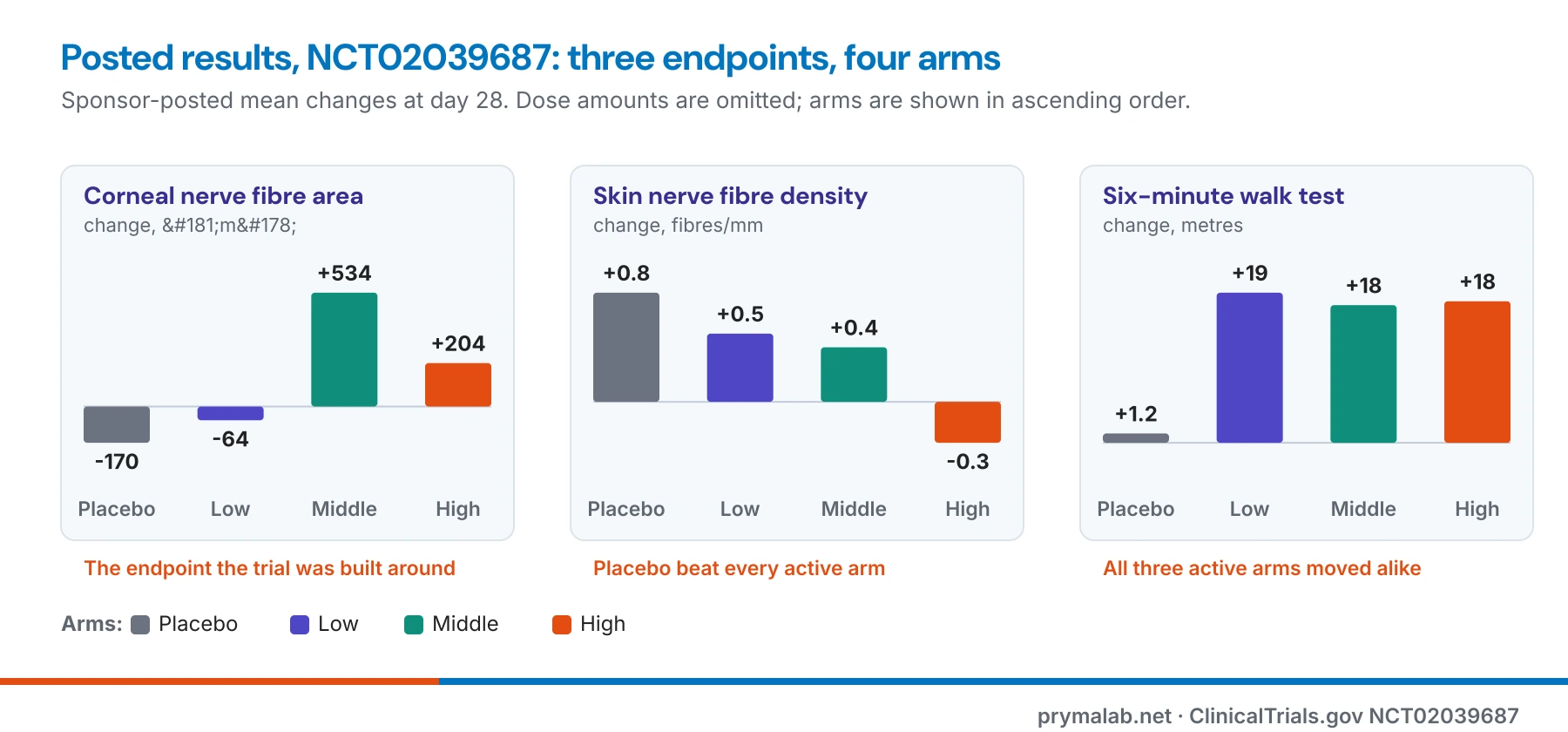
Take them in order. Corneal nerve fibre area changed by minus 170 square micrometres on placebo, minus 64.3 in the lowest arm, 533.8 in the middle arm and 203.8 in the highest.[15] That is the endpoint the trial was built around, and it does separate from placebo. It also rises and then falls as dose increases, which can happen with a real drug but is usually taken as a reason to run another trial rather than as confirmation.
Intraepidermal nerve fibre density, measured from skin biopsies, changed by 0.8 fibres per millimetre on placebo, 0.5 in the lowest arm, 0.4 in the middle arm and minus 0.3 in the highest.[15] Placebo did better than every dose of drug. The published abstract records that there was no between-group difference on this endpoint, which is accurate and considerably less vivid than the numbers.[2]
The six-minute walk test changed by 1.2 metres on placebo against 19.3, 17.7 and 18.2 metres across the three active arms.[15] Every active arm did the same thing. A compound with a dose-dependent biological effect on walking capacity should separate those arms. One with a ceiling effect, or an effect driven by being in the active group rather than by how much drug was given, would look exactly like this.
The symptom questionnaires in the posted data run the same way. On the Brief Pain Inventory the placebo arm changed by minus 1.732 against minus 1.657 in the middle active arm. On the small fibre neuropathy screening list placebo changed by minus 12.88 against minus 14.50 in the middle arm.[15] Placebo matched or beat the drug on several patient-reported measures in the best-designed trial in the programme.
I want to be fair about what this does and does not mean. The trial met its pre-specified primary endpoint in one arm, and there is a published argument that corneal confocal microscopy has comparable diagnostic power to skin biopsy and better ability to detect nerve regeneration.[45] A compound can genuinely regrow corneal nerve fibres without that showing up in a leg biopsy over 28 days.
Two things temper that argument. The paper making it has Michael Brines as first author with an Araim Pharmaceuticals affiliation, it analyses patients who received cibinetide, and its competing-interests statement declares none.[45] And whichever measure you prefer, a page that tells you ARA-290 regenerates nerves, full stop, is using one endpoint from one arm of one trial while omitting the endpoint that went the other way in the same subjects.
What is in the safety record?
Across roughly 180 people dosed for 28 days or less, no pattern of drug-attributable harm appeared, and no anti-drug antibodies were detected in any trial that looked for them. That is the honest summary, and it comes with a sample size caveat that cannot be argued away.
The 2012 pilot reported no safety concerns from clinical or laboratory assessment.[9] The 2013 trial reported no serious adverse events during dosing or the twelve-week follow-up, and no anti-ARA 290 antibodies in any post-exposure sample.[10] The 2020 eye pilot reported no serious adverse events or reactions and no antibodies.[14]
The 2015 diabetes trial is the one worth reading in full, because it contains more than the summaries carry. Four serious adverse events occurred in the drug arm. Two were judged unlikely to be related. Two were judged possibly related by the investigators. In one, a subject already on diuretic therapy had the dose increased mid-trial and borderline renal insufficiency worsened, with creatinine rising from 119 to 159 micromoles per litre; the safety committee stopped study drug, the diuretic continued at the higher dose and renal function did not recover over six weeks of follow-up. In the other, a 70-year-old man developed severe cellulitis requiring hospitalisation two weeks after his last dose and died of a myocardial infarction, which the safety committee judged unrelated to treatment.[13] Adverse event counts by severity were otherwise similar between arms, and the placebo group actually had more events rated as possibly related to study drug than the active group did.[13]
The posted phase 2b data record serious treatment-emergent adverse events in two subjects in the lowest arm, none in the middle arm, one in the highest arm and none on placebo.[15]
Immunogenicity deserves a separate line because it is the risk you would expect from a peptide. Three trials tested for anti-drug antibodies and three trials found none.[10][13][14] For an eleven-residue sequence taken from a human protein, that is the expected result, and it is one of the few safety questions this programme answered cleanly.
What the trials measured, and what they cannot support
Every trial measured something narrower than the claim built on top of it. This table puts the measurement next to the claim so you can see the gap.
| What was measured | How it was measured | What it supports | What it cannot support |
|---|---|---|---|
| Corneal nerve fibre area or density | Corneal confocal microscopy, manual quantification by a blinded analyst | A structural change in sub-basal corneal nerves over 28 days[2][10] | Systemic nerve regeneration, symptom relief, or any durable change; the measure returns toward baseline after dosing stops |
| Intraepidermal nerve fibre density | Skin punch biopsy, fibres per millimetre | Nothing in these trials; it failed to separate in 2013 and favoured placebo in the posted 2017 data[10][15] | Any claim that ARA-290 restores peripheral small fibres in skin |
| Small fibre neuropathy screening list | Patient-reported questionnaire, Dutch-validated | Reduced self-reported symptom burden in two sarcoidosis trials[9][10] | Any effect in diabetes, where it did not move, or an objective measure of nerve function[13] |
| Six-minute walk test | American Thoracic Society protocol | A between-group difference in one trial[10] | A dose-dependent effect; the posted data show all three active arms moving equally[15] |
| Glycated haemoglobin | Serial laboratory measurement over 56 days | A small separation from placebo in 48 well-controlled subjects[13] | Glycaemic benefit in poorly controlled diabetes, or any effect beyond 56 days |
| Visual acuity and retinal thickness | Best corrected acuity, optical coherence tomography | Nothing; the pilot was null on all of them[14] | Any ocular benefit claim |
| Quantitative sensory testing | Thermal and vibration thresholds, German research network protocol | Changes in some temperature domains in one sarcoidosis trial[10] | Sensory function change in diabetes, where no significant differences appeared[13] |
| Anti-drug antibodies | Serum sampling before and after dosing | No immunogenicity over 28 days in three trials[10][13][14] | Immunogenicity on repeated or long-term exposure, which has not been studied |
The pattern across the table is that structural corneal imaging and patient questionnaires moved, and the measures that are harder to influence, skin biopsy density, sensory thresholds and visual acuity, did not. That is consistent with a modest real effect on a sensitive structural measure. It is also consistent with the corneal measure being the one that happened to move in small samples. Another properly powered trial would tell you which. Nobody has run one.
How does it differ from the other erythropoietin derivatives?
ARA-290 is the smallest and the most selective of them by design, and it is the only one in the family that is a short synthetic peptide rather than a modified protein.
| ARA-290 | Carbamylated EPO | Asialo EPO | Erythropoietin | |
|---|---|---|---|---|
| Type | Synthetic 11-mer peptide | Chemically modified protein | Desialylated protein | Glycoprotein hormone |
| Derived how | Surface of helix B[6] | Carbamylation of lysines[8] | Removal of sialic acid | Native |
| Raises red cell mass | No[6] | No[8] | No | Yes |
| Named on the WADA Prohibited List | No[36][37] | Yes, under S2.1.5[36] | Yes, under S2.1.5[36] | Yes, under S2.1.1[36] |
| Human trials completed | Five, all phase 2 or earlier | Phase 1 and 2 | Preclinical mainly | Decades of phase 3 |
| Approved anywhere | No | No | No | Yes |
The sport status row is the one that surprises people and I come back to it below. Two of ARA-290's close relatives are named by WADA as examples of innate repair receptor agonists. ARA-290 is not named, which is a fact about the text of the list rather than a statement about whether it is permitted.[36][37]
Within the peptide catalogue, the nearest comparison is not another erythropoietin derivative at all. It is the other compounds people research for inflammation and tissue repair, covered in the peptides for inflammation research overview and the injury recovery reference. On registry evidence ARA-290 is ahead of most of that shelf. It has five completed human trials with published results. A ClinicalTrials.gov search in November 2026 returns four records for BPC-157, none above phase 2 and none with posted results, and zero records for KPV.[46] Being ahead of that comparison is a low bar, and ARA-290's own trials were small and mixed. For a compound that got further, the closer analogue is elamipretide, which has four registered phase 3 trials,[46] and for immune signalling it is thymosin alpha-1.
What is its legal and regulatory status in 2026?
ARA-290 is not approved as a medicine in any country, it holds two European orphan designations that never led to a marketing authorisation, and the FDA has placed it in the weakest of its three compounding categories. It is sold legally as a research chemical and nothing else.
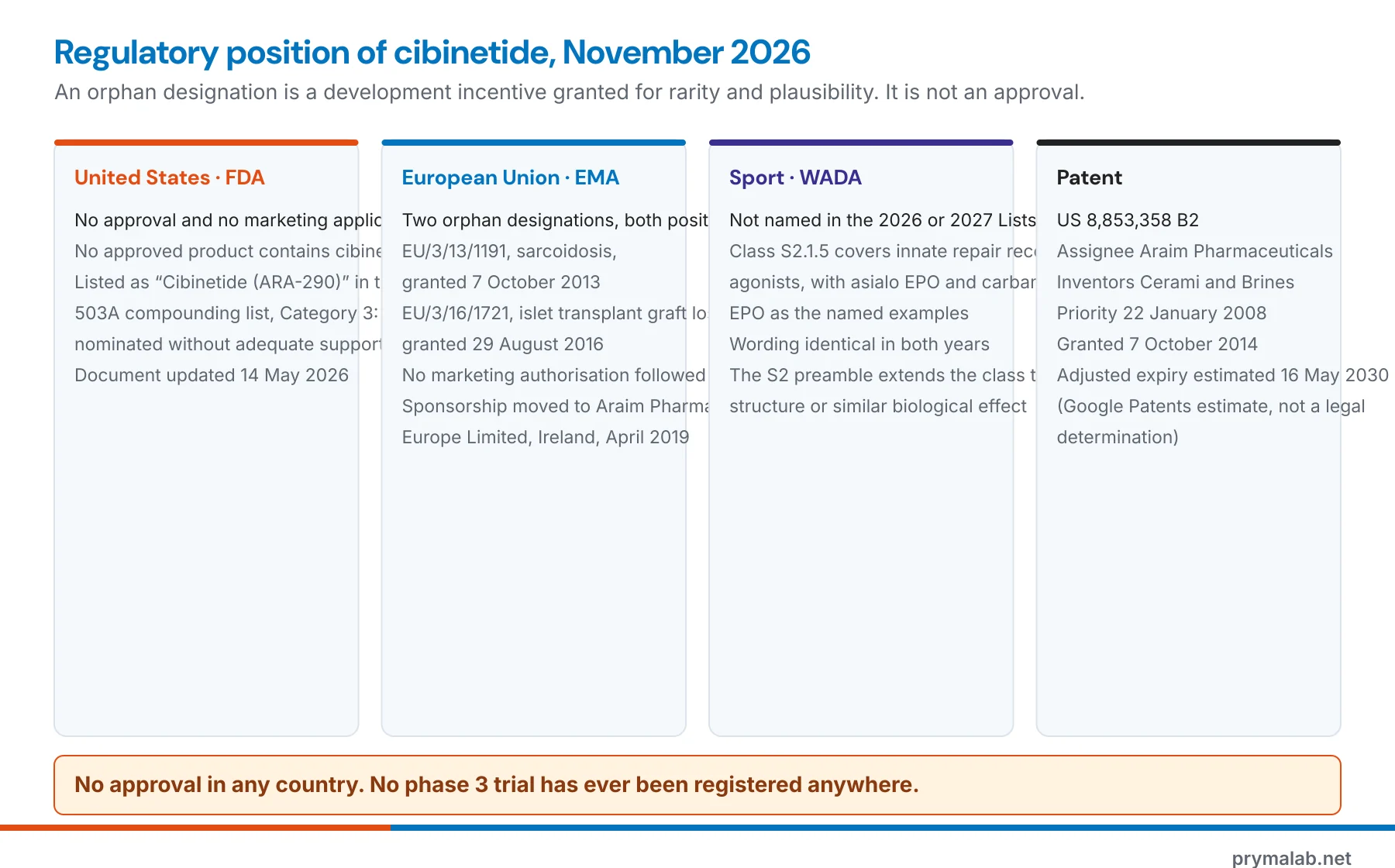
On the American side there is no approval, no pending marketing application and no approved product containing cibinetide. What does exist is an entry on the FDA's list of bulk drug substances nominated for compounding under section 503A. The entry reads "Cibinetide (ARA-290)" and it sits in category 3, which the agency defines as substances nominated without adequate support. The document carrying that entry was updated on 14 May 2026.[33] Category 3 is the bottom of three tiers. Category 1 substances may be used in compounding under the agency's interim policy; category 3 substances fall outside it.
In Europe the record is cleaner to read. The European Commission granted orphan designation EU/3/13/1191 on 7 October 2013 for treatment of sarcoidosis, and EU/3/16/1721 on 29 August 2016 for prevention of graft loss in pancreatic islet transplantation. Both are recorded as positive. Sponsorship of both transferred from the United Kingdom entity to Araim Pharmaceuticals Europe Limited in Ireland in April 2019.[34][35] No EU marketing authorisation followed either one.
People read "orphan designation" and "fast track" as regulatory endorsement. They are the opposite of a finish line. Both are incentives granted early to encourage development of drugs for small populations, and both were granted to ARA-290 more than a decade ago without any approval following.
On the corporate side I have to tell you what I could not establish. Claims circulate that Araim Pharmaceuticals ceased operations or has been dormant since around 2020. I looked for a primary source, a filing, a company statement, a regulatory notice, and found none. What I can verify is that the EMA records still list Araim as sponsor of both designations, that the latest company address on those records is in Dublin, and that no ARA-290 trial has started since the Belfast study ended in 2017. Describe the programme as stalled after phase 2 and you are on firm ground. Describe the company as defunct and you are repeating something nobody has sourced.
Is ARA-290 prohibited in sport?
ARA-290 is not named anywhere in the WADA Prohibited List. Its close chemical relatives are, and the class that names them is written to capture substances like it. I checked the official PDFs for both the current list and the one taking effect in January, and neither contains the words cibinetide or ARA-290 at any point.[36][37]
Here is the text that matters. Section S2.1.5 reads "Innate repair receptor agonists, e.g. asialo EPO; carbamylated EPO (CEPO)." The wording is identical in the 2026 list and the 2027 list.[36][37] Above it, the S2 class preamble prohibits the listed substances "and other substances with similar chemical structure or similar biological effect(s)."[36]
Read those two sentences together. The named examples under S2.1.5 are both non-erythropoietic erythropoietin derivatives developed for tissue protection, which is precisely what ARA-290 is and precisely the biological effect its developers claim for it. The class is open, not closed.
I am not an anti-doping authority and this page is not an eligibility determination. If you compete under the World Anti-Doping Code, the only answer that counts comes from your own anti-doping organisation, and asking them is free.
One related detail from the same document, since it comes up constantly: BPC-157 is named explicitly in class S0, non-approved substances.[36] That class covers any pharmacological substance not addressed elsewhere on the list and with no current approval by any governmental regulatory health authority for human therapeutic use. ARA-290 has no such approval either, which means that if a reader concludes S2.1.5 does not reach it, S0 is waiting underneath.
What do the different names refer to?
They all refer to the same eleven-residue peptide. ARA-290 is the development code, cibinetide is the international non-proprietary name, and pHBSP is the descriptive abbreviation used in most of the preclinical literature. If a supplier uses one of these names and not the others, that tells you which literature they read, not that they have a different molecule.
- Cibinetide is the INN and the name used in the EMA orphan records, the FDA compounding entry and most work after about 2016.[33][34]
- ARA-290, ARA290 and ARA 290 are the Araim development code, written three ways across the literature. PubMed indexes all three spellings separately, which is why a search for one misses papers using another.
- pHBSP stands for pyroglutamate helix B surface peptide. Searching for it also returns 1990s papers on a plasma hyaluronan binding serine protease, which is a different molecule entirely and a trap for anyone counting publications.
- HBSP without the pyroglutamate prefix usually means the same peptide in the kidney and cardiac literature, particularly from groups in China.
- CAS 1208243-50-8 is the free base. Material is frequently supplied as the acetate salt, which carries a different CAS number and a different mass.
The practical consequence is for anyone comparing a certificate of analysis against a reference. If the COA reports a mass matching the acetate and the reference value you are checking against is the free base, the numbers will not agree and nothing is wrong. The free base has an average mass of 1257.3 and a monoisotopic mass of 1256.5997.[1]
What can a certificate of analysis settle?
A certificate of analysis answers two questions: is this the right molecule, and how much of the vial is that molecule rather than something else. It answers nothing about whether the compound does anything.
For an eleven-mer like this, identity normally comes from mass spectrometry and purity from reversed-phase HPLC with ultraviolet detection. Two features of this particular sequence shape what the analysis can see. The N-terminal pyroglutamate blocks the free alpha-amine, which makes classical Edman sequencing fail and changes how the molecule fragments. And the sequence contains asparagine, glutamine and a C-terminal serine-serine motif, so the impurities worth looking for are deamidation products that shift mass by one dalton and are easy to miss at low resolution.
There is a real analytical gap here and I would rather state it than paper over it. I could not locate any published forced-degradation study or long-term stability dataset specific to ARA-290 in the public literature. For many compounds you can point a customer at a published stability profile. For this one there is nothing to point at, which means impurity profiling falls to whatever each individual lot's testing covers. Our general approach to this is in the peptide purity testing reference, and storage handling in the storage and stability guide.
One formulation detail is published, because the trials had to describe it. The vehicle used in the 2015 diabetes trial was 20 millimoles per litre sodium phosphate buffer at pH 6.5 with 1 per cent sucrose and 4 per cent mannitol, and the trial material was made by Bachem.[13] That is a record of what a stabilising matrix for this peptide looked like in a clinical setting. It is not an instruction and it does not transfer to research handling.
Where PrymaLab fits
We stock ARA-290 for laboratory research. It is synthesized in the United States and tested in our Ashland lab, which is not ISO 17025 accredited. We do not name our suppliers.
Formats are the ARA-290 10 mg vial, the ARA-290 nasal spray and the ARA-290 autoinjector. If you want third-party numbers on a specific lot before committing to it, we sell ARA-290 lot testing as a separate service. Which format suits a given protocol is a question the pen versus vial comparison covers, and the delivery question specifically is in do peptide nasal sprays work.
I would rather sell to someone who read this page and decided the evidence is thinner than they thought than to someone who bought on the strength of a headline about nerve regeneration. The legal position for research chemicals generally is set out in are peptides legal, and the rest of the compound references are indexed in the research hub.
What this article does not settle
Six questions stayed open after I finished reading, and none of them is answerable from the public record as it stands.
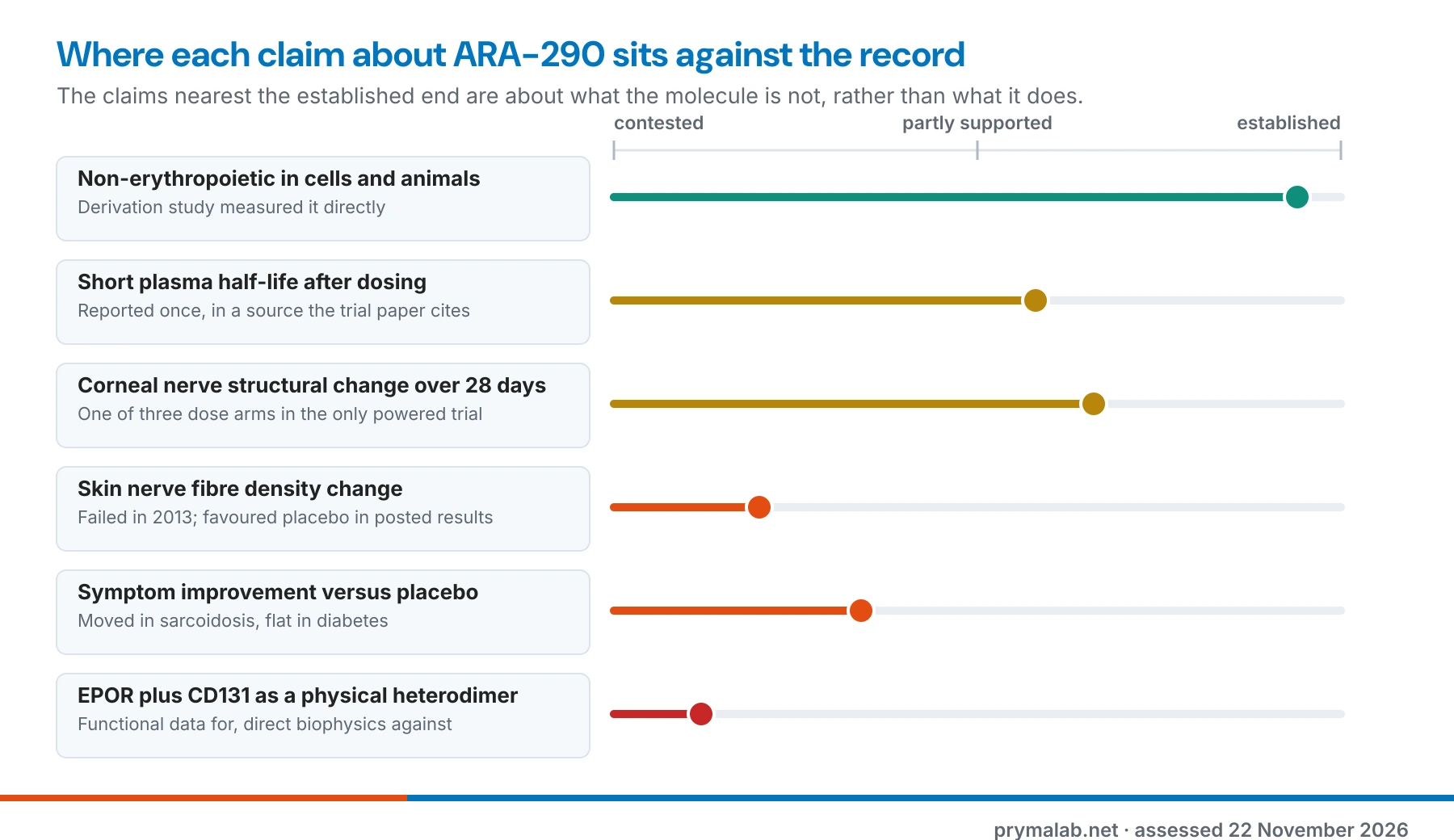
The receptor. No biophysical confirmation of a direct EPOR and CD131 heterodimer exists, and one study looking specifically for it found none.[3] The target of ARA-290 is defined by what it does, not by a structure anyone has resolved.
Durable clinical benefit. No trial has shown a lasting, placebo-controlled improvement in a hard clinical outcome. The corneal measure that moved is a surrogate, and the 2017 investigators argue for its use as a surrogate rather than claiming it is the outcome itself.[2]
Independent replication. Araim staff appear as authors on four of the five human trials. No group unconnected to the sponsor has run one.
Long-term safety. The longest published human exposure is twelve weeks in eight people.[14] Nothing is known beyond that.
Pharmacokinetics. The peak plasma concentration and roughly twenty-minute terminal half-life that everyone quotes appear in the methods section of the 2015 trial, which attributes them to a 2013 review article that is not indexed in PubMed and that I could not open.[13][47] I have not seen the underlying pharmacokinetic study and I am not going to present a figure I could not trace to its source.
Whether anyone will finish the work. No trial has started since 2017 and no phase 3 has ever been registered. The most recent primary-source activity on this compound is a retraction notice.[5]
Frequently asked questions
Is ARA-290 the same thing as cibinetide?
Yes. Cibinetide is the international non-proprietary name for the same eleven-residue peptide that Araim Pharmaceuticals developed under the code ARA-290. The literature also calls it pHBSP and HBSP. All four names point to CAS 1208243-50-8 and PubChem CID 91810664.[1] A supplier using one name rather than another is following a different slice of the literature, not selling a different molecule.
Has ARA-290 ever completed a phase 3 trial?
No. No phase 3 trial of ARA-290 has ever been registered in any registry. The five human trials that exist are phase 2 or earlier, the largest enrolled 64 subjects, and the most recent one finished recruiting in April 2017.[2][14][16] Any page describing ARA-290 as being in late-stage development is describing something that has not happened.
Why do two different molecular formulas for ARA-290 circulate?
Because one of them is a transcription error that has been copied widely. PubChem gives C51H84N16O21, and the monoisotopic mass of 1256.5997 is only consistent with 51 carbons.[1] The variant showing 55 carbons appears in several secondary summaries. If you are checking a certificate of analysis, use the PubChem values and remember that acetate-salt material carries a different mass from the free base.
Which ARA-290 papers have been retracted?
Two. Collino and colleagues in British Journal of Pharmacology 2014, on diet-induced insulin resistance in mice, was retracted in April 2024.[4][28] Patel and colleagues in Molecular Medicine 2012, on pHBSP in acute kidney injury, was retracted on 26 February 2026.[5][27] The 2015 human diabetes trial cites the first of those as preclinical support for its metabolic findings.[13]
Did the corneal nerve findings hold up against placebo?
In one trial, in one dose arm. The 2017 phase 2b reported a placebo-corrected increase in corneal nerve fibre area in its middle dose arm at p equal to 0.012, while the lowest and highest arms did not reach significance.[2] The widely quoted 2013 corneal result is a within-group comparison against each arm's own baseline, and that paper reports no between-group p value for the endpoint.[10]
Why did the skin biopsy endpoint fail when the corneal one did not?
Nobody knows, and the two candidate explanations point in opposite directions. The investigators argue that corneal confocal microscopy detects smaller changes than a skin punch biopsy can, so a real effect might show in one and not the other.[45] The alternative is that the corneal measure moved by chance in small samples. In the posted 2017 results the skin measure favoured placebo over every dose arm, which the first explanation does not account for.[15]
What does an orphan designation actually grant?
Development incentives, not permission to sell. Cibinetide holds EU/3/13/1191 for sarcoidosis from October 2013 and EU/3/16/1721 for islet transplant graft loss from August 2016.[34][35] Both are recorded as positive and neither produced a marketing authorisation in the decade since. A designation records that a condition is rare and that a plausible case was made, which is a much lower bar than an efficacy review.
What does FDA category 3 mean for cibinetide?
It means the substance was nominated for pharmacy compounding and the FDA judged the nomination inadequately supported. The entry reads "Cibinetide (ARA-290)" in the category 3 list, in a document updated 14 May 2026.[33] Category 1 substances may be used under the agency's interim compounding policy. Category 3 substances sit outside it, which is the weakest of the three positions.
Is ARA-290 named on the WADA Prohibited List?
No, and that fact is routinely misread. Neither the 2026 nor the 2027 list contains the words ARA-290 or cibinetide anywhere.[36][37] Class S2.1.5 covers innate repair receptor agonists and names asialo EPO and carbamylated EPO as examples, and the S2 preamble extends the class to substances of similar structure or biological effect.[36] Eligibility questions belong with your own anti-doping organisation, not with a supplier.
Who designed ARA-290 and who owns the patent?
Michael Brines and Anthony Cerami, working at Warren Pharmaceuticals and later Araim Pharmaceuticals. The derivation was published in PNAS in 2008.[6] US patent 8,853,358 B2 lists Cerami and Brines as inventors and Araim Pharmaceuticals as assignee, with a priority date of 22 January 2008 and grant on 7 October 2014. Google Patents estimates an adjusted expiry of 16 May 2030.[38]
Why was the diabetic macular oedema trial stopped?
The study drug expired and no replacement was available. That is the reason recorded on the registry entry for NCT06626971, which lists the trial as terminated after nine of a planned ten patients were recruited.[16] The published results were null on visual acuity, retinal thickness, retinal sensitivity and tear production.[14]
Did any trial detect antibodies against the peptide?
No. Three trials tested serum for anti-drug antibodies before and after dosing and all three found none.[10][13][14] For an eleven-residue sequence copied from a human protein, that is the expected outcome. It applies only to the exposure actually studied, which was 28 days in two of those trials and twelve weeks in the third.
Why was a trial from 2017 registered on ClinicalTrials.gov in 2024?
I do not know, and the registry does not say. The Belfast macular oedema study recruited between May 2016 and April 2017 and published in 2020, but its ClinicalTrials.gov record was first posted on 4 October 2024.[16] The trial was registered prospectively on the EU register and on ISRCTN, so it was never unregistered.[14] Retrospective addition to a second registry is unusual and worth knowing about.
What is pHBSP, and is it a different compound?
It is the same compound. pHBSP stands for pyroglutamate helix B surface peptide and is the name used across most of the preclinical kidney, cardiac and brain literature. Searching for it returns a complication: several 1990s papers on a plasma hyaluronan binding serine protease use the same abbreviation for an unrelated enzyme. Anyone counting ARA-290 publications by keyword will over-count unless they filter those out.
How large is the total human exposure to ARA-290?
Fewer than 200 people across five trials, with 22, 38, 49, 64 and 9 enrolled respectively.[2][9][10][13][14] Dosing ran 28 days in four of them and twelve weeks in the fifth. A combined exposure that size can detect a common adverse effect and has very little power to detect a rare one, and it says nothing at all about exposure beyond three months.
Does ARA-290 raise red blood cell counts?
It did not in the original derivation experiments. Neither helix B nor the eleven-residue peptide was erythropoietic in cells or in animals, which was the whole point of building it.[6] The 2015 human trial reported no clinically significant changes in haematological parameters including erythrocytes.[13] This is the best-supported claim about the compound, and it is a claim about what it does not do.
Is there a published stability dataset for ARA-290?
I could not find one. No forced-degradation study and no long-term stability profile specific to this peptide appears in the public literature. What is published is the clinical formulation buffer used in the 2015 trial, which was a phosphate buffer at pH 6.5 with sucrose and mannitol.[13] That records what stabilised the peptide in a trial setting and is not a substitute for lot-specific testing.
What would change the evidence picture for ARA-290?
One adequately powered randomised trial run by a group with no financial stake in the outcome, using a pre-specified clinical endpoint rather than a structural surrogate, lasting longer than 28 days. That trial does not exist and nothing in the registries suggests anyone is planning it. A structural confirmation of the receptor, by crystallography or any other direct method, would settle the other half of the argument.[3]
References
- National Center for Biotechnology Information. PubChem Compound Summary for CID 91810664, Cibinetide. PubChem CID 91810664
- Culver DA, Dahan A, Bajorunas D, et al. Cibinetide improves corneal nerve fiber abundance in patients with sarcoidosis-associated small nerve fiber loss and neuropathic pain. Invest Ophthalmol Vis Sci. 2017;58(6):BIO52-BIO60. PMID 28475703
- Cheung Tung Shing KS, Broughton SE, Nero TL, et al. EPO does not promote interaction between the erythropoietin and beta-common receptors. Sci Rep. 2018;8(1):12457. PMID 30127368
- Retraction: A non-erythropoietic peptide derivative of erythropoietin decreases susceptibility to diet-induced insulin resistance in mice. Br J Pharmacol. 2024;181(8):1341. PMID 38433016
- Retraction Note: Delayed administration of pyroglutamate helix B surface peptide (pHBSP), a novel nonerythropoietic analog of erythropoietin, attenuates acute kidney injury. Mol Med. 2026;32(1):31. PMID 41749083
- Brines M, Patel NS, Villa P, et al. Nonerythropoietic, tissue-protective peptides derived from the tertiary structure of erythropoietin. Proc Natl Acad Sci U S A. 2008;105(31):10925-10930. PMID 18676614
- Brines M, Cerami A. The receptor that tames the innate immune response. Mol Med. 2012;18(1):486-496. PMID 22183892
- Leist M, Ghezzi P, Grasso G, et al. Derivatives of erythropoietin that are tissue protective but not erythropoietic. Science. 2004;305(5681):239-242. PMID 15247477
- Heij L, Niesters M, Swartjes M, et al. Safety and efficacy of ARA 290 in sarcoidosis patients with symptoms of small fiber neuropathy: a randomized, double-blind pilot study. Mol Med. 2012;18(1):1430-1436. PMID 23168581
- Dahan A, Dunne A, Swartjes M, et al. ARA 290 improves symptoms in patients with sarcoidosis-associated small nerve fiber loss and increases corneal nerve fiber density. Mol Med. 2013;19(1):334-345. PMC3883966
- Erratum. Mol Med. 2016;22:674. Erratum for Mol Med. 2013;19:334-345. PMID 28059429
- Tracey KJ. Editorial. Mol Med. 2013;19(1):333. Published as a Comment on reference 10. PMID 24178588
- Brines M, Dunne AN, van Velzen M, et al. ARA 290, a nonerythropoietic peptide engineered from erythropoietin, improves metabolic control and neuropathic symptoms in patients with type 2 diabetes. Mol Med. 2015;20(1):658-666. PMC4365069
- Lois N, Gardner E, McFarland M, et al. A phase 2 clinical trial on the use of cibinetide for the treatment of diabetic macular edema. J Clin Med. 2020;9(7):2225. PMID 32674280
- Araim Pharmaceuticals. A double blind, placebo controlled phase 2 dose ranging study of the effects of ARA 290 on corneal nerve fiber density and neuropathic symptoms of subjects with sarcoidosis. Posted results. NCT02039687
- Belfast Health and Social Care Trust. A phase II clinical trial on the use of ARA 290 for the treatment of diabetic macular oedema. Terminated. NCT06626971
- Ostenson CG. Effects of ARA 290 on glucose tolerance, insulin secretion, insulin sensitivity and long-term glucose control in individuals with prediabetes and/or drug-naive type 2 diabetes. NCT01933529
- Swartjes M, van Velzen M, Niesters M, et al. ARA 290, a peptide derived from the tertiary structure of erythropoietin, produces long-term relief of neuropathic pain coupled with suppression of the spinal microglia response. Mol Pain. 2014;10:13. PMID 24529189
- Swartjes M, Niesters M, Heij L, et al. Ketamine does not produce relief of neuropathic pain in mice lacking the beta-common receptor (CD131). PLoS One. 2013;8(8):e71326. PMID 23936499
- Schmidt RE, Feng D, Wang Q, et al. Effect of insulin and an erythropoietin-derived peptide (ARA290) on established neuritic dystrophy and neuronopathy in Akita (Ins2 Akita) diabetic mouse sympathetic ganglia. Exp Neurol. 2011;232(2):126-135. PMID 21872588
- McVicar CM, Hamilton R, Colhoun LM, et al. Intervention with an erythropoietin-derived peptide protects against neuroglial and vascular degeneration during diabetic retinopathy. Diabetes. 2011;60(11):2995-3005. PMID 21911748
- Ahmet I, Tae HJ, Juhaszova M, et al. A small nonerythropoietic helix B surface peptide based upon erythropoietin structure is cardioprotective against ischemic myocardial damage. Mol Med. 2011;17(3-4):194-200. PMID 21170473
- Ahmet I, Tae HJ, Brines M, et al. Chronic administration of small nonerythropoietic peptide sequence of erythropoietin effectively ameliorates the progression of postmyocardial infarction-dilated cardiomyopathy. J Pharmacol Exp Ther. 2013;345(3):446-456. PMID 23584743
- Ueba H, Brines M, Yamin M, et al. Cardioprotection by a nonerythropoietic, tissue-protective peptide mimicking the 3D structure of erythropoietin. Proc Natl Acad Sci U S A. 2010;107(32):14357-14362. PMID 20660739
- Bohr S, Patel SJ, Shen K, et al. Alternative erythropoietin-mediated signaling prevents secondary microvascular thrombosis and inflammation within cutaneous burns. Proc Natl Acad Sci U S A. 2013;110(9):3513-3518. PMID 23401545
- Patel NS, Nandra KK, Brines M, et al. A nonerythropoietic peptide that mimics the 3D structure of erythropoietin reduces organ injury/dysfunction and inflammation in experimental hemorrhagic shock. Mol Med. 2011;17(9-10):883-892. PMID 21607291
- Patel NS, Kerr-Peterson HL, Brines M, et al. Delayed administration of pyroglutamate helix B surface peptide (pHBSP), a novel nonerythropoietic analog of erythropoietin, attenuates acute kidney injury. Mol Med. 2012;18(1):719-727. Retracted. PMID 22415011
- Collino M, Benetti E, Rogazzo M, et al. A non-erythropoietic peptide derivative of erythropoietin decreases susceptibility to diet-induced insulin resistance in mice. Br J Pharmacol. 2014;171(24):5802-5815. Retracted. PMID 25164531
- van Rijt WG, Nieuwenhuijs-Moeke GJ, van Goor H, et al. Renoprotective capacities of non-erythropoietic EPO derivative, ARA290, following renal ischemia/reperfusion injury. J Transl Med. 2013;11:286. PMID 24225194
- van Rijt WG, Nieuwenhuijs-Moeke GJ, van Goor H, et al. ARA290, a non-erythropoietic EPO derivative, attenuates renal ischemia/reperfusion injury. J Transl Med. 2013;11:9. PMID 23302512
- Abdelwahid E, Smith G. Promising antiapoptotic effects of helix B-surface peptide (HBSP) for treatment of heart diseases? Proc Natl Acad Sci U S A. 2011;108(6):E17, author reply E18. PMID 21278330
- Author Correction: EPO does not promote interaction between the erythropoietin and beta-common receptors. Sci Rep. 2019;9(1):7851. doi 10.1038/s41598-019-43988-9
- US Food and Drug Administration. Bulk drug substances nominated for use in compounding under section 503A of the FD&C Act, updated 14 May 2026. Cibinetide (ARA-290) appears in Category 3. fda.gov/media/94155/download
- European Medicines Agency. EU/3/13/1191, orphan designation for treatment of sarcoidosis, granted 7 October 2013. EMA EU/3/13/1191
- European Medicines Agency. EU/3/16/1721, orphan designation for prevention of graft loss in pancreatic islet transplantation, granted 29 August 2016. EMA EU/3/16/1721
- World Anti-Doping Agency. The 2026 Prohibited List, in force 1 January 2026. Class S2.1.5. WADA 2026 Prohibited List (PDF)
- World Anti-Doping Agency. The 2027 Prohibited List, in force 1 January 2027. Class S2.1.5, wording unchanged from 2026. Copy hosted by the Athletics Integrity Unit. 2027 Prohibited List (PDF); index at wada-ama.org
- Cerami A, Brines M. Tissue protective peptides and peptide analogs for preventing and treating diseases and disorders associated with tissue damage. US patent 8,853,358 B2, granted 7 October 2014. US8853358B2
- Nairz M, Haschka D, Dichtl S, et al. Cibinetide dampens innate immune cell functions thus ameliorating the course of experimental colitis. Sci Rep. 2017;7(1):13012. PMID 29026145
- Yao M, Domogatskaya A, Ågren N, et al. Cibinetide protects isolated human islets in a stressful environment and improves engraftment in the perspective of intra portal islet transplantation. Cell Transplant. 2021;30:9636897211039739. PMID 34498509
- Yao M, Watanabe M, Sun S, et al. Improvement of islet allograft function using cibinetide, an innate repair receptor ligand. Transplantation. 2020;104(10):2048-2058. PMID 32345869
- Awida Z, Bachar A, Saed H, et al. The non-erythropoietic EPO analogue cibinetide inhibits osteoclastogenesis in vitro and increases bone mineral density in mice. Int J Mol Sci. 2021;23(1). PMID 35008482
- Al-Onaizi MA, Thériault P, Lecordier S, et al. Early monocyte modulation by the non-erythropoietic peptide ARA 290 decelerates AD-like pathology progression. Brain Behav Immun. 2022;99:363-382. PMID 34343617
- Zhang W, Yu G, Zhang M. ARA 290 relieves pathophysiological pain by targeting TRPV1 channel: integration between immune system and nociception. Peptides. 2016;76:73-79. PMID 26774587
- Brines M, Culver DA, Ferdousi M, et al. Corneal nerve fiber size adds utility to the diagnosis and assessment of therapeutic response in patients with small fiber neuropathy. Sci Rep. 2018;8(1):4734. PMID 29549285
- US National Library of Medicine. ClinicalTrials.gov registry search, conducted 22 November 2026, for BPC-157, KPV and elamipretide. clinicaltrials.gov
- Niesters M, Swartjes M, Heij L, et al. The erythropoietin-analogue ARA 290 for treatment of sarcoidosis-induced chronic neuropathic pain. Expert Opin Orphan Drugs. 2013;1(1):77-87. Cited by reference 13 as the source of its pharmacokinetic figures; not indexed in PubMed and not independently read for this article. doi 10.1517/21678707.2013.719289
Final disclaimer: This article describes published research on ARA-290 for an audience of laboratory researchers. ARA-290 is not approved for human or veterinary use in any country. Nothing here is medical advice, and nothing here describes how to prepare or administer any substance.
PrymaLab sells research chemicals for laboratory use only. Products are synthesized in the United States and tested in our Ashland lab, which is not ISO 17025 accredited. Where this article states that something could not be verified, that statement is as accurate as the public record allowed on 22 November 2026, and I will correct it if a primary source turns up.