


Description
PrymaLab · Research use only
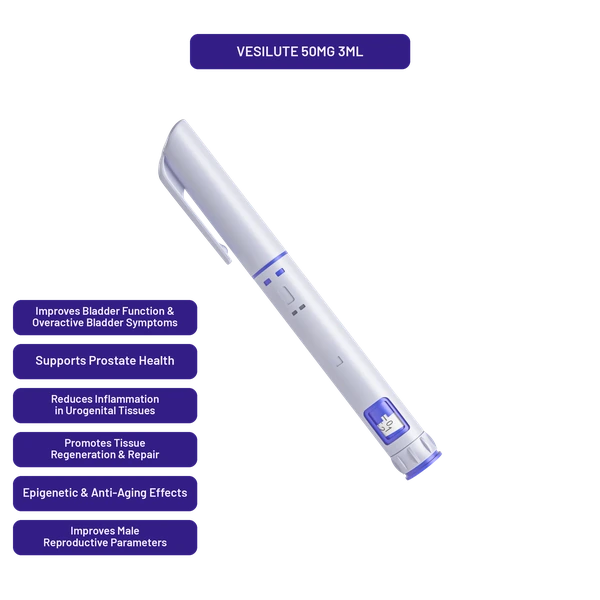
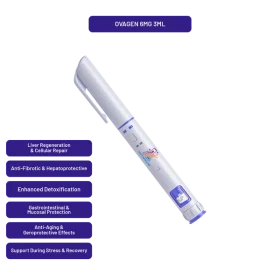
Preloaded Autoinjector | Vesilute | 3ml Pen | 50mg
Vesilute (Glu-Asp) in solution at 1.7% w/v, 50 mg in a preloaded 3 mL pen
Vesilute, the Khavinson bladder bioregulator that PrymaLab lists as the dipeptide Glu-Asp (ED), comes here as a preloaded pen: 3 mL of solution holding 50 mg of peptide, more than twice the 20 mg in the freeze-dried vial. The literature behind Vesilute is the developers’ general model of short peptides acting on genes. No published experiment on Glu-Asp itself is cited here, and nothing has been reported on its stability in solution.
Specifications
| Property | Value |
|---|---|
| Compound | Vesilute (Glu-Asp dipeptide (ED)) |
| CAS number | Not assigned |
| Molecular formula | C9H14N2O7 |
| Contents | Vesilute: 50 mg per 3 mL pen (1.7% w/v) |
| Form | Sterile aqueous solution in bacteriostatic water (0.9% benzyl alcohol), supplied in a 3 mL glass cartridge inside a preloaded autoinjector pen fitted with a needle |
| Storage, sealed | Store at 2–8 °C in the original carton, protected from light |
| Safety data sheet | PL-SDS-178 |
What is in the pen
The 3 mL glass cartridge holds a sterile aqueous solution of Vesilute at 1.7% w/v, 50 mg per pen. The safety data sheet identifies the peptide as Glu-Asp, formula C9H14N2O7, with no CAS number assigned and no hazard classification. It is dissolved in bacteriostatic water with 0.9% benzyl alcohol as an antimicrobial preservative, and benzyl alcohol is the classified ingredient: harmful if swallowed or inhaled, a serious eye irritant and a possible cause of allergic skin reactions.
Store the pen at 2 to 8 °C in its original carton, away from light, and keep it capped once in use. It must not freeze; a pen whose solution has frozen, discoloured or clouded should be discarded. The Vesilute 20 mg vial holds the dry peptide, and peptide pen vs vial covers the general differences between the formats.
What the research covers
Vesilute belongs to the short-peptide programme of Vladimir Khavinson’s group in St Petersburg, which proposes that peptides of two to seven residues act inside the nucleus, on histones, DNA and DNA methylation1. The bladder role given to Vesilute comes from that programme. None of the papers cited here tested Glu-Asp in bladder tissue or in any other model, so the compound’s biology rests on the general hypothesis rather than on measurements.
Because this listing is a solution, the chemistry of the first residue matters more than it does for a dry vial. An N-terminal glutamic acid can close into pyroglutamic acid without enzymes. In antibody chains, Chelius and colleagues detected that conversion after a few weeks at 37 and 45 °C, and found it slowest near pH 6.2 and faster at pH 4 and pH 82. Whether, and how fast, the same happens to Glu-Asp held at 2 to 8 °C in bacteriostatic water has not been measured in any study cited here. Cold storage away from light, as the safety data sheet requires, is the control available. The Vesilute guide describes the programme’s claims, and the Vesilute 20 mg vial page covers the sequence question and related chemistry in more detail.
How each lot is tested
Every lot is tested in PrymaLab’s own laboratory in Ashland, Kentucky before release: RP-HPLC for purity, LC-MS for identity, Karl Fischer titration for water, LAL for endotoxin and USP <71> for sterility. Published certificates are listed on the results page and can be checked by number and key on the verify page. The certificate covers the peptide lot used to fill the pen, not the finished solution. These are in-house results from PrymaLab Analytical, not an independent test, and the lab is not accredited to ISO 17025. The third-party testing guarantee on this page still applies: if any independent laboratory finds the wrong compound, or less than the stated purity or amount, the order is refunded and the cost of the test is reimbursed.
Frequently asked questions
How does the pen differ from the Vesilute vial?
The vial holds 20 mg of freeze-dried Vesilute, kept frozen until it is dissolved in the lab. The pen holds 50 mg already in 3 mL of bacteriostatic water at 1.7% w/v and is kept at 2 to 8 °C, never frozen. Both safety data sheets list the same Glu-Asp dipeptide.
What does the certificate cover for the pen?
It covers the Vesilute peptide lot used to fill the pen, not the finished solution in the cartridge. The testing section on this page explains what certificates report and how to check one by its number and key.
Is anything known about Vesilute's stability in solution?
Not from published work; no paper cited here measured it. Related chemistry, such as the slow conversion of N-terminal glutamic acid to pyroglutamic acid, has been measured only in other molecules. Follow the storage conditions on the safety data sheet.
Can the Vesilute pen be used in people?
No. The pen is sold only for laboratory research. It is not approved for human or veterinary use, and nothing on this page describes using it in people or animals.
References
- Khavinson VK, Popovich IG, Linkova NS, et al. Peptide Regulation of Gene Expression: A Systematic Review. Molecules. 2021;26(22). DOI · PubMed
- Chelius D, Jing K, Lueras A, et al. Formation of pyroglutamic acid from N-terminal glutamic acid in immunoglobulin gamma antibodies. Anal Chem. 2006;78(7):2370-6. DOI · PubMed
Research use only
For laboratory research use only. This product is not a drug, food, cosmetic or dietary supplement, is not approved by the FDA or any comparable authority for human or veterinary use, and must not be given to people or animals. It is sold to qualified researchers and institutions, and the buyer is responsible for lawful handling and disposal.







Reviews
There are no reviews yet.