

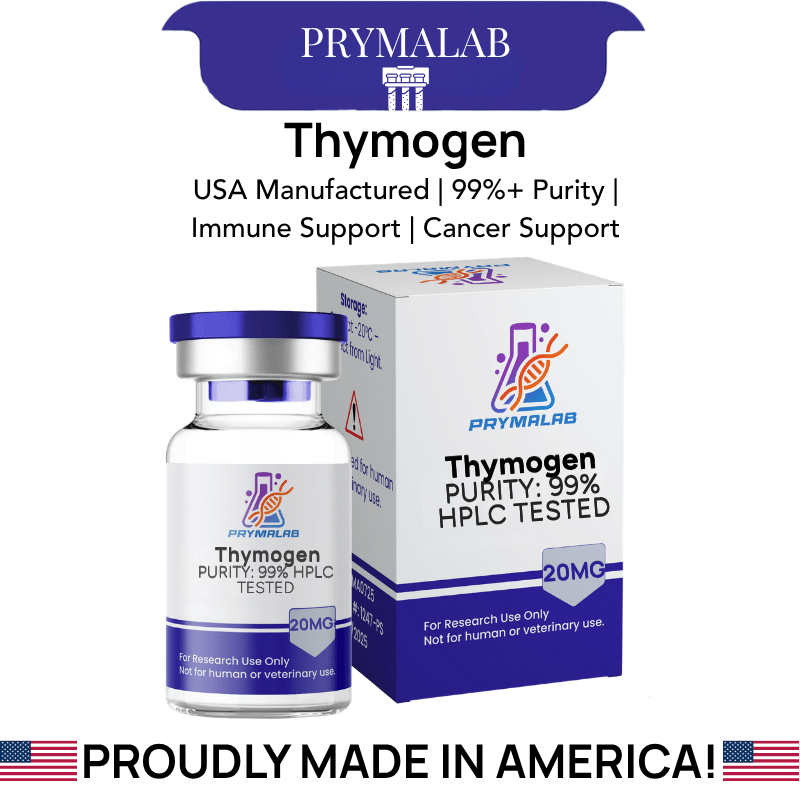
$45.99 / month – $389.99
Thymogen peptide (EW) is a Khavinson dipeptide bioregulator targeting thymic tissue and the immune system. This research-grade compound modulates gene expression in thymocytes and T-lymphocytes for preclinical immune restoration and thymic function research. 20mg lyophilized powder, =98% purity, COA included.
Thymogen is a synthetic dipeptide bioregulator with the amino acid sequence Glu-Trp (EW), developed by Professor Vladimir Khavinson at the St. Petersburg Institute of Bioregulation and Gerontology. Thymogen targets thymic tissue and immune system function, serving as a thymus bioregulator that modulates gene expression patterns in T-lymphocytes and thymic epithelial cells. It is one of the earliest and most extensively studied compounds in the Khavinson bioregulator peptides program, with published research spanning immune reconstitution, anti-tumor immune surveillance, and thymic involution reversal in preclinical and clinical gerontology settings.
Thymogen should be distinguished from thymogen alpha 1 (Thymosin Alpha-1, Thymalfasin), a 28-amino acid peptide derived from prothymosin alpha that is an approved pharmaceutical in some countries for hepatitis B and immunodeficiency conditions. While both compounds target immune function, they differ substantially in molecular weight, sequence, mechanism, and regulatory status. Thymogen (EW dipeptide) operates through the Khavinson epigenetic bioregulation mechanism — modulating transcription through peptide-DNA interaction — while Thymosin Alpha-1 acts through direct T-cell activation and toll-like receptor signaling. PrymaLab Thymogen 20mg is supplied exclusively for preclinical research.
| Specification | Detail |
|---|---|
| Compound | Thymogen (dipeptide bioregulator, EW) |
| Sequence | Glu-Trp (EW) |
| Quantity | 20mg |
| Target Tissue | Thymus, T-lymphocytes, immune system |
| Class | Khavinson bioregulator peptide (short regulatory peptide) |
| Purity | ≥98% (HPLC-verified per batch) |
| Testing | HPLC, mass spectrometry, identity verification |
| Form | Lyophilized powder |
| Storage | Store at −20°C desiccated; protect from light |
| Intended Use | Preclinical research only — not for human or veterinary therapeutic use |
Thymogen operates through the Khavinson bioregulation mechanism — direct interaction with complementary DNA sequences in the promoter regions of immune-related genes. The EW dipeptide targets gene clusters governing T-lymphocyte differentiation, thymic epithelial cell function, and immune surveillance pathways.
The thymus undergoes progressive involution with aging, resulting in reduced naïve T-cell output, contracted T-cell receptor diversity, and impaired adaptive immune responses. Thymogen has been studied for its capacity to modulate thymic epithelial cell gene expression, potentially slowing or partially reversing the transcriptional changes associated with thymic involution. Published research from the Khavinson group demonstrates that thymogen administration in aged animal models was associated with improved thymic tissue architecture markers and enhanced T-lymphocyte maturation indices.
Beyond thymic tissue effects, thymogen has been studied for direct modulation of T-cell gene expression profiles, including genes governing T-helper cell differentiation (Th1/Th2 balance), cytotoxic T-cell activation, and regulatory T-cell function. In immunosenescence models, thymogen administration was associated with improved T-cell proliferative responses to mitogenic stimulation and normalization of CD4+/CD8+ T-cell ratios that become dysregulated during immune aging.
A significant area of thymogen research examines its effects on anti-tumor immune surveillance. Age-related decline in T-cell function reduces the immune system’s capacity to detect and eliminate transformed cells, contributing to increased cancer incidence with aging. Preclinical studies have examined thymogen’s effects on natural killer (NK) cell activity, cytotoxic T-lymphocyte (CTL) function, and tumor-specific immune response generation in aged animal models bearing experimental tumors.
The following reflects published preclinical and clinical gerontology literature. PrymaLab Thymogen 20mg is supplied exclusively for research purposes.
Thymogen is among the most extensively studied Khavinson bioregulators for immunosenescence — the progressive decline of immune function with aging. Published data demonstrates effects on T-cell proliferative capacity, cytokine production profiles, thymic architecture preservation, and immune response quality in aged animal models. Khavinson’s research group has published data indicating that bioregulator peptide treatment, including thymogen, was associated with improved immune function parameters and reduced age-related immune dysfunction markers in elderly cohorts in gerontological studies.
Preclinical studies have examined thymogen’s role as an adjunct in cancer immunology research, focusing on its capacity to enhance anti-tumor immune responses through T-cell and NK cell activation. Published animal studies documented improved tumor immune surveillance markers and reduced tumor growth rates in aged animals treated with thymic bioregulator peptides compared to untreated age-matched controls. These findings are of research interest in the context of immuno-oncology and age-related cancer susceptibility.
Age-related immune decline increases susceptibility to infectious diseases, and thymogen has been studied for its effects on immune defense capacity against bacterial and viral challenge models. Published data indicates improved immune response kinetics and enhanced pathogen clearance in bioregulator-treated aged animals, consistent with restored T-cell functional competence.
| Feature | Thymogen (EW Dipeptide) | Thymogen Alpha-1 (Thymalfasin) |
|---|---|---|
| Sequence | Glu-Trp (2 amino acids) | 28 amino acids (Ac-SDAAVDTSSEITTKD…) |
| Molecular Weight | ~333 g/mol | ~3,108 g/mol |
| Origin | Khavinson bioregulator program (St. Petersburg) | Derived from prothymosin alpha (Goldstein, 1977) |
| Mechanism | Epigenetic: peptide-DNA interaction, gene expression modulation | Direct: T-cell activation, TLR signaling, DC maturation |
| Regulatory Status | Research compound (not approved for therapeutic use) | Approved pharmaceutical in some countries (Zadaxin) |
| Research Focus | Bioregulation, anti-aging, immunosenescence reversal | Hepatitis B/C, immunodeficiency, cancer immunotherapy adjunct |
PrymaLab supplies Thymogen 20mg as a high-purity research-grade bioregulator peptide verified at ≥98% purity by reverse-phase HPLC and identity-confirmed by mass spectrometry. Each batch ships with a unique lot number and Certificate of Analysis. Independent third-party testing ensures unbiased quality verification and full traceability.
Thymogen is a synthetic dipeptide (Glu-Trp, EW) from the Khavinson bioregulator program that targets thymic and immune tissue through epigenetic gene expression modulation. Thymogen alpha 1 (Thymalfasin/Zadaxin) is a separate 28-amino acid peptide that acts through direct T-cell activation and TLR signaling. They differ in size (2 vs 28 amino acids), mechanism, and regulatory status. Thymogen is a research compound; Thymosin Alpha-1 is an approved pharmaceutical in some countries.
Thymogen has been studied in immunosenescence (immune aging) models, anti-tumor immune surveillance research, infectious disease resistance, and thymic involution reversal. Research areas include T-lymphocyte differentiation and function, NK cell activity enhancement, and normalization of age-related immune dysregulation. All applications are in preclinical research settings.
Published Khavinson research protocols have used thymogen alongside other bioregulator peptides targeting different organ systems. As an immune-specific bioregulator, thymogen is most commonly studied in combination with organ-specific bioregulators when researchers are investigating comprehensive multi-system anti-aging protocols involving simultaneous immune support and target organ bioregulation.
Store lyophilized thymogen at −20°C, desiccated and protected from light, for 24+ months stability. After reconstitution, refrigerate at 2–8°C and use within 2–4 weeks. Aliquot to avoid freeze-thaw cycles.
Every batch is verified at ≥98% purity by reverse-phase HPLC and identity-confirmed by mass spectrometry. Independent third-party testing with batch-specific Certificate of Analysis ensures unbiased quality verification and full traceability.
For Research Use Only. PrymaLab Thymogen 20mg is intended exclusively for qualified preclinical research use. This product is not intended for human consumption, therapeutic use, veterinary treatment, or any application outside controlled research environments. Thymogen (EW dipeptide) has not been approved by the FDA or any equivalent regulatory authority for therapeutic use. All research applications described are from published preclinical and gerontological literature. Researchers are responsible for regulatory compliance.
| Weight | N/A |
|---|---|
| Dimensions | N/A |
Only logged in customers who have purchased this product may leave a review.

support@prymalab.net info@prymalab.net

30 Day return window. Satisfaction guaranteed or your money back.

All orders over %150 in value will receive free shipping.

Reviews
There are no reviews yet.